
[Paper Review] Chemo-Dynamical Evolution of Galaxies
This paper presents a chemodynamical simulation framework that links nuclear astrophysics to galaxy evolution, enabling self-consistent modeling of elemental abundances from cosmological initial conditions. It demonstrates that inhomogeneous chemical enrichment and multi-source nucleosynthesis (including SNe Ia, core-collapse SNe, AGB stars, and potential r-process sites like MRSNe) are essential to reproduce observed [α/Fe] trends and metallicity gradients in the Milky Way and dwarf spheroidal galaxies.
Stars are fossils that retain the history of their host galaxies. Elements heavier than helium are created inside stars and are ejected when they die. From the spatial distribution of elements in galaxies, it is therefore possible to constrain the physical processes during galaxy formation and evolution. This approach, Galactic archaeology, has been popularly used for our Milky Way Galaxy with a vast amount of data from Gaia satellite and multi-object spectrographs to understand the origins of sub-structures of the Milky Way. Thanks to integral field units, this approach can also be applied to external galaxies from nearby to distant universe with the James Webb Space Telescope. In order to interpret these observational data, it is necessary to compare with theoretical predictions, namely chemodynamical simulations of galaxies, which include detailed chemical enrichment into hydrodynamical simulations from cosmological initial conditions. These simulations can predict the evolution of internal structures (e.g., metallicity radial gradients) as well as that of scaling relations (e.g., the mass-metallicity relations). After explaining the formula and assumptions, we will show some example results, and discuss future prospects.
Motivation & Objective
- To develop a self-consistent chemodynamical simulation framework that incorporates detailed nuclear astrophysics to model galaxy formation and evolution.
- To resolve the [α/Fe] problem in the Milky Way and its satellite galaxies by including realistic yields from diverse supernova types and stellar populations.
- To enable extra-galactic archaeology by extending Galactic archaeology techniques to external and high-redshift galaxies using IFU and MOS data.
- To investigate the role of stellar feedback, IMF variations, binary evolution, and magnetic fields in shaping elemental abundance patterns.
- To guide future observational surveys (e.g., WEAVE, 4MOST, JWST/MIRI) by predicting observable abundance trends and spectral signatures.
Proposed method
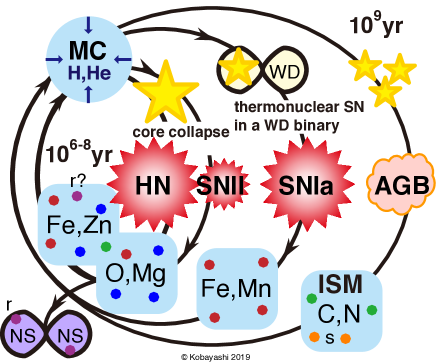
- Integrates detailed nucleosynthetic yields from core-collapse SNe, SNe Ia, AGB stars, and potential r-process sites (e.g., NSMs, MRSNe, MRHNe) into cosmological hydrodynamical simulations.
- Uses a multi-phase interstellar medium model with metallicity-dependent cooling and star formation, coupled with supernova feedback and black hole feedback.
- Employs adaptive mesh refinement or moving-mesh techniques (e.g., AREPO or Gadget-3) to resolve spatial and temporal inhomogeneities in chemical enrichment.
- Applies element-by-element dust formation, growth, and destruction models to account for locked-up metals in solid phases.
- Compares simulated abundance ratios ([X/Fe]) and radial metallicity gradients with observations from APOGEE, HERMES-GALAH, and IFU surveys (e.g., MaNGA, MUSE).
- Tests the impact of stellar rotation, binary fraction, and IMF variations on observed abundance patterns, particularly in metal-poor systems.
Experimental results
Research questions
- RQ1Can chemodynamical simulations with realistic nucleosynthetic yields reproduce the observed [α/Fe] bimodality and radial gradients in the Milky Way's disk and halo?
- RQ2What are the relative contributions of different supernova types (e.g., near-Chandrasekhar vs. sub-Chandrasekhar SNe Ia, hypernovae) to the observed iron-peak and α-element abundances?
- RQ3How does inhomogeneous chemical enrichment affect the observed N/O–O/H relation and r-process element patterns in metal-poor stars?
- RQ4To what extent do stellar rotation, magnetic fields, and binary interactions alter the predicted elemental abundance trends in early galaxies?
- RQ5Can chemodynamical models predict the abundance patterns in high-redshift galaxies, particularly those with potential pair-instability SNe or Wolf-Rayet-driven enrichment?
Key findings
- Inhomogeneous chemical enrichment is essential to reproduce the observed N/O–O/H relation, which cannot be explained by AGB stars and SNe alone.
- The observed r-process abundance patterns in metal-poor stars cannot be reproduced by neutron-star mergers alone; additional r-process sources such as magneto-rotational hypernovae are required.
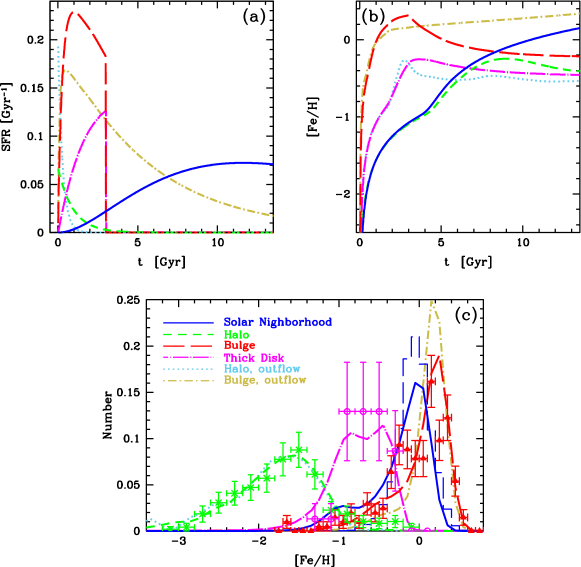
- The [α/Fe] trend in the Milky Way and dSph galaxies is best reproduced when SNe Ia delay time distribution and progenitor mass functions are consistently modeled with nuclear astrophysics.
- Stellar rotation and binary evolution significantly affect the production of light neutron-capture elements (e.g., Sr), influencing abundance patterns in metal-poor stars.
- High-redshift galaxies may exhibit distinct abundance signatures—such as high (C,N)/O or (Si,S)/O—if Wolf-Rayet stars or pair-instability SNe dominate early enrichment.
- Dust locking of metals is non-negligible and must be modeled element-by-element to accurately predict observable metallicities and abundance ratios in high-redshift galaxies.
Better researchstarts right now
From reading papers to final review, dramatically reduce your research time.
No credit card · Free plan available
This review was created by AI and reviewed by human editors.