
[Paper Review] ChessGPT: Bridging Policy Learning and Language Modeling
ChessGPT introduces a large-scale chess dataset and two models (ChessGPT and ChessCLIP) to integrate policy learning with language modeling, and provides an evaluation framework for chess-oriented language models.
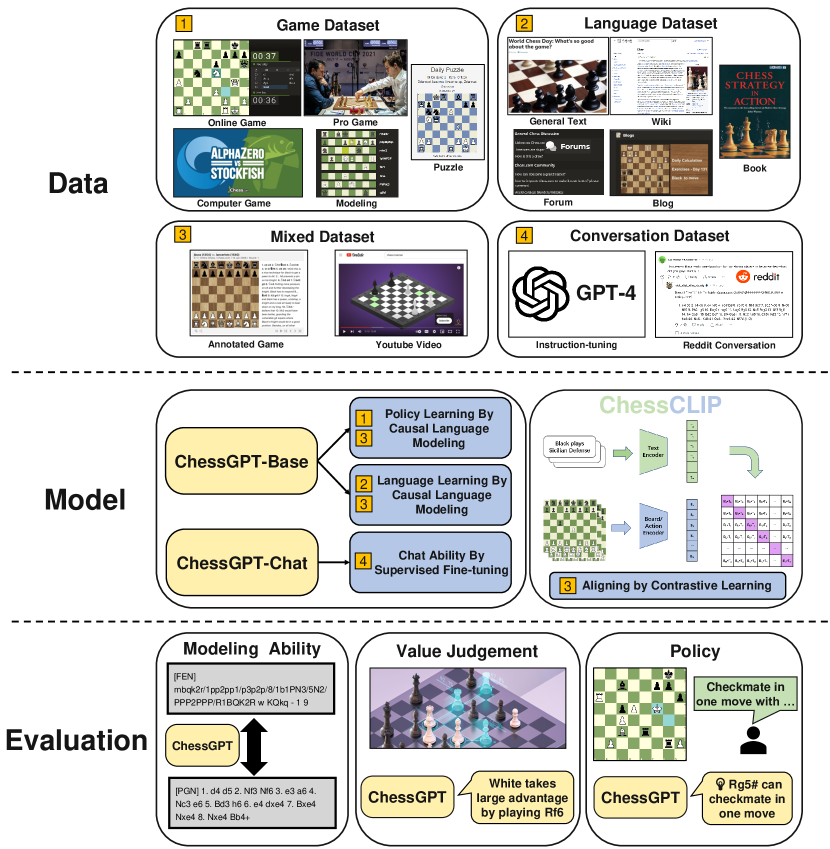
When solving decision-making tasks, humans typically depend on information from two key sources: (1) Historical policy data, which provides interaction replay from the environment, and (2) Analytical insights in natural language form, exposing the invaluable thought process or strategic considerations. Despite this, the majority of preceding research focuses on only one source: they either use historical replay exclusively to directly learn policy or value functions, or engaged in language model training utilizing mere language corpus. In this paper, we argue that a powerful autonomous agent should cover both sources. Thus, we propose ChessGPT, a GPT model bridging policy learning and language modeling by integrating data from these two sources in Chess games. Specifically, we build a large-scale game and language dataset related to chess. Leveraging the dataset, we showcase two model examples ChessCLIP and ChessGPT, integrating policy learning and language modeling. Finally, we propose a full evaluation framework for evaluating language model's chess ability. Experimental results validate our model and dataset's effectiveness. We open source our code, model, and dataset at https://github.com/waterhorse1/ChessGPT.
Motivation & Objective
- Motivate integration of historical policy data with natural language knowledge for autonomous agents.
- Create a large-scale chess-focused dataset spanning game, language, mixed, and conversational data.
- Develop and evaluate models (ChessGPT and ChessCLIP) that fuse policy learning with language understanding in chess.
Proposed method
- Construct a four-category chess dataset: Game, Language, Mixed, and Instruction/Conversation data.
- Train ChessCLIP to bridge board/state (policy) and language via a board/text encoder setup.
- Fine-tune a GPT-based model (ChessGPT) on chess data with base model fine-tuning and supervised chat/response fine-tuning; plan for RLHF in future.
- Establish a three-dimensional evaluation framework: modeling ability (state tracking), value judgement, and policy ability.
Experimental results
Research questions
- RQ1Can a single model effectively leverage both historical game policy data and natural language knowledge to perform chess tasks?
- RQ2How well can a language-model-based agent track game state, assess position value, and decide optimal moves in chess?
- RQ3Does integrating policy data with language data yield superior performance on chess-related reasoning and decision tasks compared to pure LLM baselines?
- RQ4What is the role of auxiliary data (Elo metadata, annotated games, puzzles) in improving policy and language alignment for chess?
Key findings
- ChessGPT and ChessGPT-Base outperform baseline LLMs on state tracking and policy-related tasks across multiple evaluation settings.
- ChessGPT-Base and ChessGPT-Chat achieve high board-state tracking similarity, averaging above 90% in UCI to FEN and PGN to FEN conversions, outperforming baselines.
- In value judgement tasks, ChessGPT variants show stronger alignment with true value functions and human annotations compared to LLAMA and RedPajama baselines.
- ChessGPT-Chat exhibits strong language-driven capabilities and commentary, while ChessGPT-Base emphasizes policy-focused performance; ChessCLIP excels in some annotation-oriented tasks.
- The evaluation framework demonstrates robust assessment of modeling capability, value judgement, and policy proficiency for chess-oriented LLMs.

Read this paper
Open the full text in the Nubint reader and ask about any passage as you read.
Read this paper on NubintThis review was generated by AI from the original paper. Please check the paper before citing it.