
[Paper Review] Chiplet Cloud: Building AI Supercomputers for Serving Large Generative Language Models
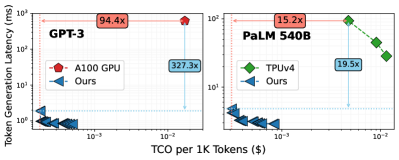
Chiplet Cloud proposes a chiplet-based ASIC AI supercomputer architecture that fits all large language model parameters in on-chip SRAMs to eliminate bandwidth bottlenecks, enabling unprecedented total cost of ownership (TCO) per token. By co-designing hardware and software mapping across thousands of chiplets, it achieves up to 94× and 15× lower TCO/Token compared to A100 GPU and TPUv4 clouds, respectively.
Large language models (LLMs) such as OpenAI's ChatGPT and Google's Gemini have demonstrated unprecedented capabilities of autoregressive AI models across multiple tasks triggering disruptive technology innovations around the world. However, as models continue to grow the cost to serve these models also continues to grow threatening the democratization of LLMs. To address this issue, we propose Chiplet Cloud, a chiplet-based ASIC LLM-supercomputer architecture whose goal is to optimize the total cost of ownership (TCO) per generated token. This architecture is a highly parameterizable ASIC and server-level architecture leveraging thousands of replicated accelerator modules collaborating to scale-up the performance of LLMs at cloud-scale. To determine specific parameterizations of the Chiplet Cloud architecture, we implemented a two-phase hardware-software co-design methodology that can search the massive design space and fine tune the architecture across a collection of LLMs based on an accurate inference simulation. A common bottleneck for LLMs is the memory access performance therefore we introduce CC-MEM, a scalable on-chip memory system for Chiplet Cloud architectures. Using the CC-MEM, Chiplet Clouds can be built using only SRAMs for design points where the power and performance of memory access is critical. The CC-MEM also includes a compression decoder module to add support for sparse models without impacting the compute units using a Store-as-Compressed, Load-as-Dense mechanism. We evaluate Chiplet Cloud architectures across eight popular LLMs. Using fine tuned Chiplet Cloud servers we are able to achieve $97 imes$ and $18 imes$ improvement in TCO/Token over rented GPU and TPU clouds, or a $8.3 imes$ and $3.7 imes$ improvement over fabricated GPU and TPU clouds respectively. Chiplet Cloud can also support $1.7 imes$ larger models with a sparsity of 60\%.
Motivation & Objective
- Address the rising hardware cost and energy inefficiency of serving large generative language models (LLMs) on existing GPU and TPU platforms.
- Overcome the scalability limitations of monolithic chips due to shrinking Moore’s Law and increasing memory bandwidth demands in LLM inference.
- Reduce the total cost of ownership (TCO) per generated token to democratize access to large-scale LLMs in real-world applications.
- Develop a scalable, cost-optimized AI supercomputer architecture that supports diverse LLM workloads with varying model sizes and context lengths.
Proposed method
- Design a chiplet-based ASIC architecture where thousands of replicated chiplet accelerator modules collaborate to perform token generation in parallel.
- Store all model parameters in on-chip SRAMs of individual chiplets to eliminate off-chip memory bandwidth limitations, a key bottleneck in large-scale LLM inference.
- Use software-hardware co-design to map model computations across chiplets, exploiting parallelism to mitigate inter-chip communication overhead.
- Implement a comprehensive design methodology that explores the joint hardware-software design space, generating performance-cost trade-off analyses across all valid configurations.
- Apply a Pareto frontier analysis to identify optimal system designs that minimize TCO/Token across multiple LLMs and context lengths.
- Evaluate the architecture on four real-world LLMs (GPT-3, PaLM 540B, etc.) with varying sizes and context lengths, using realistic cost models from Lambda and Google Cloud.
Experimental results
Research questions
- RQ1Can a chiplet-based ASIC architecture achieve significantly lower TCO/Token than existing GPU and TPU platforms for serving large generative language models?
- RQ2How can on-chip SRAM storage of all model parameters eliminate bandwidth bottlenecks in large-scale LLM inference?
- RQ3What is the optimal trade-off between chiplet die size, inter-chip communication, and system cost in a scalable AI supercomputer design?
- RQ4Can a single generic Chiplet Cloud server design efficiently support multiple LLMs and varying context lengths with minimal performance loss?
- RQ5To what extent can software-aware hardware mapping improve system efficiency and reduce TCO in a massively parallel chiplet architecture?
Key findings
- Chiplet Cloud achieves up to 94.4× improvement in TCO/Token compared to A100 GPU clouds and 15.2× improvement compared to TPUv4 clouds for serving GPT-3 and PaLM 540B.
- By storing all model parameters in on-chip SRAMs, the architecture eliminates off-chip memory bandwidth as a performance bottleneck, enabling high throughput at lower cost.
- The design methodology successfully identifies Pareto-optimal configurations across the hardware-software design space, enabling accurate performance-cost trade-off analysis.
- A single generic Chiplet Cloud server achieves 9% and 12% performance loss in aggregated TCO/Token when supporting multiple models and context lengths, respectively, compared to individually optimized servers.
- The approach reduces system cost and energy consumption by moderating die size through chiplets while maintaining high computational efficiency via intelligent software mapping.
- The results demonstrate that chiplet-based ASICs can enable planet-scale deployment of LLMs by drastically reducing the capital and operational costs of inference.
Read this paper
Open the full text in the Nubint reader and ask about any passage as you read.
Read this paper on NubintThis review was generated by AI from the original paper. Please check the paper before citing it.