
[Paper Review] Choose Your Diffusion: Efficient and flexible ways to accelerate the diffusion model in fast high energy physics simulation
This paper proposes a flexible, training-free framework to accelerate diffusion models in high-energy physics simulations using advanced ODE/SDE-based samplers and noise schedulers. By optimizing sampling dynamics and introducing soft loss weighting, it achieves up to 10× speedup on CaloChallenge and JetNet datasets with minimal performance degradation, setting a new baseline for fast, high-fidelity simulation in collider physics.
The diffusion model has demonstrated promising results in image generation, recently becoming mainstream and representing a notable advancement for many generative modeling tasks. Prior applications of the diffusion model for both fast event and detector simulation in high energy physics have shown exceptional performance, providing a viable solution to generate sufficient statistics within a constrained computational budget in preparation for the High Luminosity LHC. However, many of these applications suffer from slow generation with large sampling steps and face challenges in finding the optimal balance between sample quality and speed. The study focuses on the latest benchmark developments in efficient ODE/SDE-based samplers, schedulers, and fast convergence training techniques. We test on the public CaloChallenge and JetNet datasets with the designs implemented on the existing architecture, the performance of the generated classes surpass previous models, achieving significant speedup via various evaluation metrics.
Motivation & Objective
- Address the trade-off between sample quality and generation speed in diffusion models for high-energy physics simulations.
- Improve sampling efficiency without retraining by leveraging advanced ODE/SDE-based samplers and noise schedulers.
- Demonstrate generalizability across diverse datasets, including pixel-based calorimeter showers (CaloChallenge) and jet point clouds (JetNet).
- Provide a portable, flexible framework for accelerating diffusion models in fast simulation with minimal computational overhead.
- Establish a new performance baseline for fast, high-fidelity simulation in preparation for the High Luminosity LHC.
Proposed method
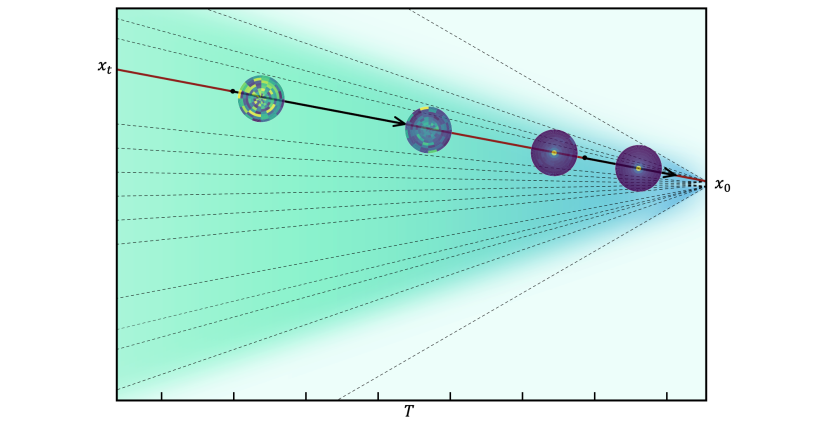
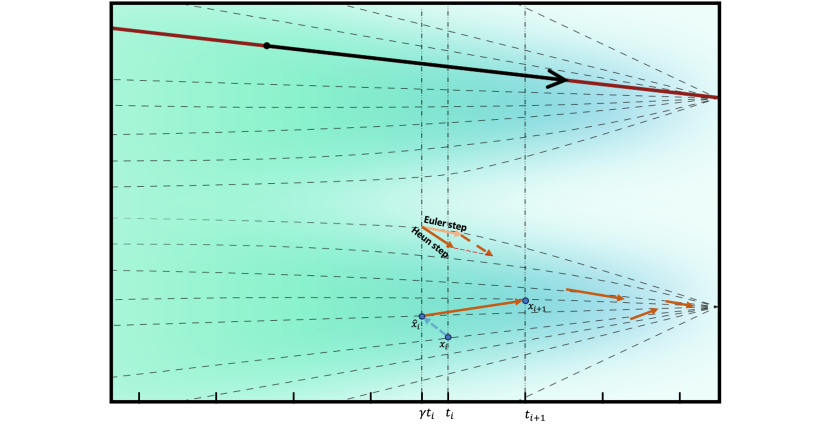
- Apply state-of-the-art training-free samplers such as DPM-solver, LMS, EDM, and multi-level Restart samplers to accelerate the reverse denoising process.
- Employ noise schedulers from the post-DDPM era to balance discretization and accumulated errors in sampling, improving convergence.
- Introduce a soft loss weighting technique to accelerate convergence of physics-informed metrics during training without retraining.
- Use a conditional U-Net architecture as the base model, adapted for both image (CaloChallenge) and point cloud (JetNet) generation tasks.
- Evaluate sampling performance using metrics like AUC, Frechét Particle Distance (FPD), and angular/kinematic distributions.
- Test the framework across two public datasets—CaloChallenge (calorimeter showers) and JetNet (jet substructure)—to validate portability and robustness.
Experimental results
Research questions
- RQ1Which ODE/SDE-based samplers and noise schedulers yield the best trade-off between sampling speed and generation quality in high-energy physics diffusion models?
- RQ2Can soft loss weighting techniques accelerate convergence of physics-informed metrics without retraining?
- RQ3How does the performance of fast samplers compare to standard 100-step DDPM across different datasets like CaloChallenge and JetNet?
- RQ4To what extent can the proposed framework be generalized across different data modalities (images vs. point clouds) and physics tasks?
- RQ5What is the optimal number of sampling steps that maintains high fidelity while achieving significant speedup?
Key findings
- The multi-level Restart sampler achieves state-of-the-art performance with only 18 steps, reducing generation time by a factor of ~10 compared to 200-step DDIM Euler.
- On CaloChallenge, the 18-step Restart sampler achieves an AUC of 51.2 and FPD of 0.02 for top quark jets, outperforming the 200-step DDIM Euler (AUC 52.6, FPD 0.15) in key metrics.
- The EDM sampler with 50 steps achieves superior performance on jet mass and angular distribution alignment, especially in high-boost regions.
- The DPM-solver sampler shows rapid convergence, achieving near-optimal performance by the 15th sampling step, with diminishing returns beyond 20 steps.
- The Restart and EDM samplers significantly outperform DDIM Euler in capturing tails of distributions in complex topologies, such as gluon and top quark jets.
- The framework is highly portable: the same sampler configurations yield consistent improvements across both CaloChallenge (image-based) and JetNet (point cloud) datasets.
Read this paper
Open the full text in the Nubint reader and ask about any passage as you read.
Read this paper on NubintThis review was generated by AI from the original paper. Please check the paper before citing it.