
[Paper Review] CiPR: An Efficient Framework with Cross-instance Positive Relations for Generalized Category Discovery
This paper proposes CiPR, a novel framework for generalized category discovery (GCD) that leverages cross-instance positive relations from unlabelled data to improve representation learning. By introducing a semi-supervised hierarchical clustering algorithm called Selective Neighbor Clustering (SNC), CiPR enables efficient, one-time label assignment and class number estimation without requiring prior knowledge of the number of unseen categories, achieving state-of-the-art performance on both generic and fine-grained datasets.
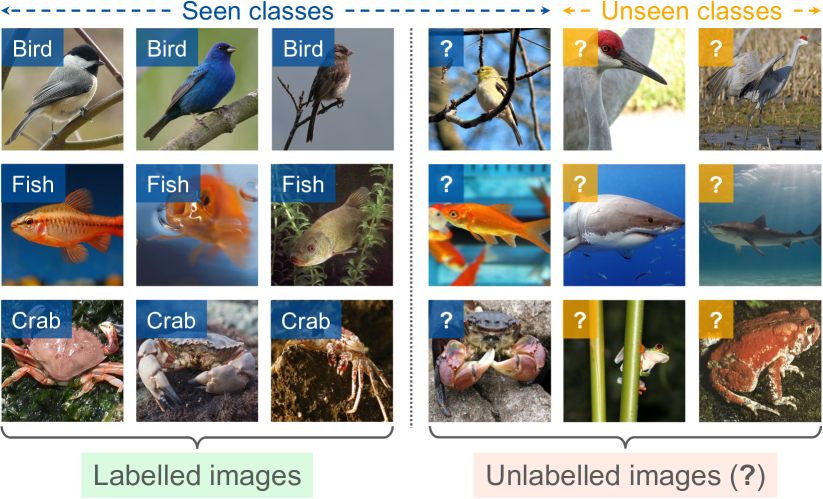
We tackle the issue of generalized category discovery (GCD). GCD considers the open-world problem of automatically clustering a partially labelled dataset, in which the unlabelled data may contain instances from both novel categories and labelled classes. In this paper, we address the GCD problem with an unknown category number for the unlabelled data. We propose a framework, named CiPR, to bootstrap the representation by exploiting Cross-instance Positive Relations in the partially labelled data for contrastive learning, which have been neglected in existing methods. To obtain reliable cross-instance relations to facilitate representation learning, we introduce a semi-supervised hierarchical clustering algorithm, named selective neighbor clustering (SNC), which can produce a clustering hierarchy directly from the connected components of a graph constructed from selective neighbors. We further present a method to estimate the unknown class number using SNC with a joint reference score that considers clustering indexes of both labelled and unlabelled data, and extend SNC to allow label assignment for the unlabelled instances with a given class number. We thoroughly evaluate our framework on public generic image recognition datasets and challenging fine-grained datasets, and establish a new state-of-the-art. Code: https://github.com/haoosz/CiPR
Motivation & Objective
- To address the limitations of existing GCD methods that treat labelled and unlabelled data independently and require known category numbers.
- To improve representation learning in GCD by exploiting cross-instance positive relations from unlabelled data, which are often neglected in prior approaches.
- To develop a method that estimates the unknown number of unseen categories efficiently without repeated clustering runs.
- To enable reliable, high-purity pseudo-label generation for both unlabelled and labelled data using a semi-supervised clustering approach.
Proposed method
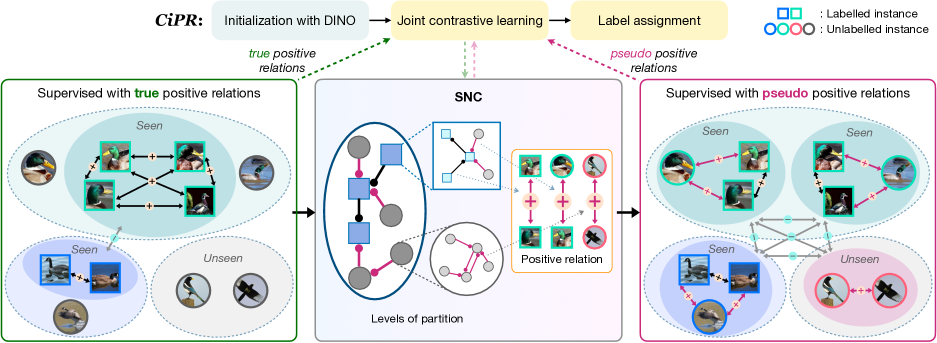
- Proposes CiPR, a framework that enhances contrastive representation learning by incorporating cross-instance positive relations between unlabelled instances and between unlabelled and labelled instances.
- Introduces Selective Neighbor Clustering (SNC), a parameter-free, hierarchical clustering algorithm that uses graph-based connected components from selectively chosen neighbors to generate reliable pseudo labels.
- SNC integrates label supervision by constraining cluster formation with known class labels, ensuring consistency with seen categories during clustering.
- SNC enables efficient class number estimation by computing a joint reference score based on clustering quality metrics from both labelled and unlabelled data.
- The framework uses SNC for both representation learning (via pseudo-positive relations) and final label assignment in a single run, eliminating the need for iterative clustering.
- SNC's one-by-one merging strategy allows fast and accurate estimation of the unknown number of categories without multiple algorithmic runs.
Experimental results
Research questions
- RQ1Can cross-instance positive relations between unlabelled data improve representation learning in generalized category discovery?
- RQ2How can a semi-supervised hierarchical clustering method be designed to generate reliable pseudo labels while respecting known class labels?
- RQ3Can the number of unseen categories in unlabelled data be estimated efficiently without repeated clustering runs?
- RQ4Does leveraging both unlabelled–unlabelled and unlabelled–labelled relations lead to better performance than using only one type of relation?
- RQ5How does the proposed SNC-based framework compare to existing state-of-the-art methods in terms of accuracy and efficiency on both generic and fine-grained datasets?
Key findings
- CiPR achieves state-of-the-art performance on both CIFAR-100 and CUB-200 datasets, outperforming the previous SOTA method by a significant margin.
- The use of both unlabelled–unlabelled and unlabelled–labelled relations via SNC leads to the highest performance, with a 1.0% absolute improvement in overall accuracy on CIFAR-100 compared to using only one relation type.
- SNC generates pseudo labels with consistently higher purity than k-means and FINCH throughout the training process, indicating more reliable supervision signals.
- The method achieves the best performance on unseen categories, with 55.6% accuracy on CUB-200, significantly outperforming the baseline and other baselines.
- Class number estimation using SNC is more than 10x faster than the iterative k-means approach in the prior SOTA method, due to a single-run estimation strategy.
- The joint reference score for class number estimation using SNC achieves high accuracy in identifying the true number of unseen categories across multiple datasets.
Read this paper
Open the full text in the Nubint reader and ask about any passage as you read.
Read this paper on NubintThis review was generated by AI from the original paper. Please check the paper before citing it.