
[Paper Review] Citation-Enhanced Generation for LLM-based Chatbots
This paper proposes Citation-Enhanced Generation (CEG), a training-free, post-hoc framework that reduces hallucinations in LLM-based chatbots by retrieving supporting documents and using natural language inference (NLI) to generate citations. It regenerates responses when statements lack citations, achieving state-of-the-art performance on three hallucination benchmarks without requiring model fine-tuning or data annotation.
Large language models (LLMs) exhibit powerful general intelligence across diverse scenarios, including their integration into chatbots. However, a vital challenge of LLM-based chatbots is that they may produce hallucinated content in responses, which significantly limits their applicability. Various efforts have been made to alleviate hallucination, such as retrieval augmented generation and reinforcement learning with human feedback, but most of them require additional training and data annotation. In this paper, we propose a novel post-hoc Citation-Enhanced Generation (CEG) approach combined with retrieval argumentation. Unlike previous studies that focus on preventing hallucinations during generation, our method addresses this issue in a post-hoc way. It incorporates a retrieval module to search for supporting documents relevant to the generated content, and employs a natural language inference-based citation generation module. Once the statements in the generated content lack of reference, our model can regenerate responses until all statements are supported by citations. Note that our method is a training-free plug-and-play plugin that is capable of various LLMs. Experiments on various hallucination-related datasets show our framework outperforms state-of-the-art methods in both hallucination detection and response regeneration on three benchmarks. Our codes and dataset will be publicly available.
Motivation & Objective
- To address hallucinations in LLM-based chatbots without requiring additional training or data annotation.
- To develop a flexible, plug-and-play solution compatible with various pre-trained LLMs.
- To improve factual consistency by detecting unsupported claims and regenerating responses with citations.
- To evaluate the effectiveness of retrieval and NLI modules in a post-hoc verification pipeline.
Proposed method
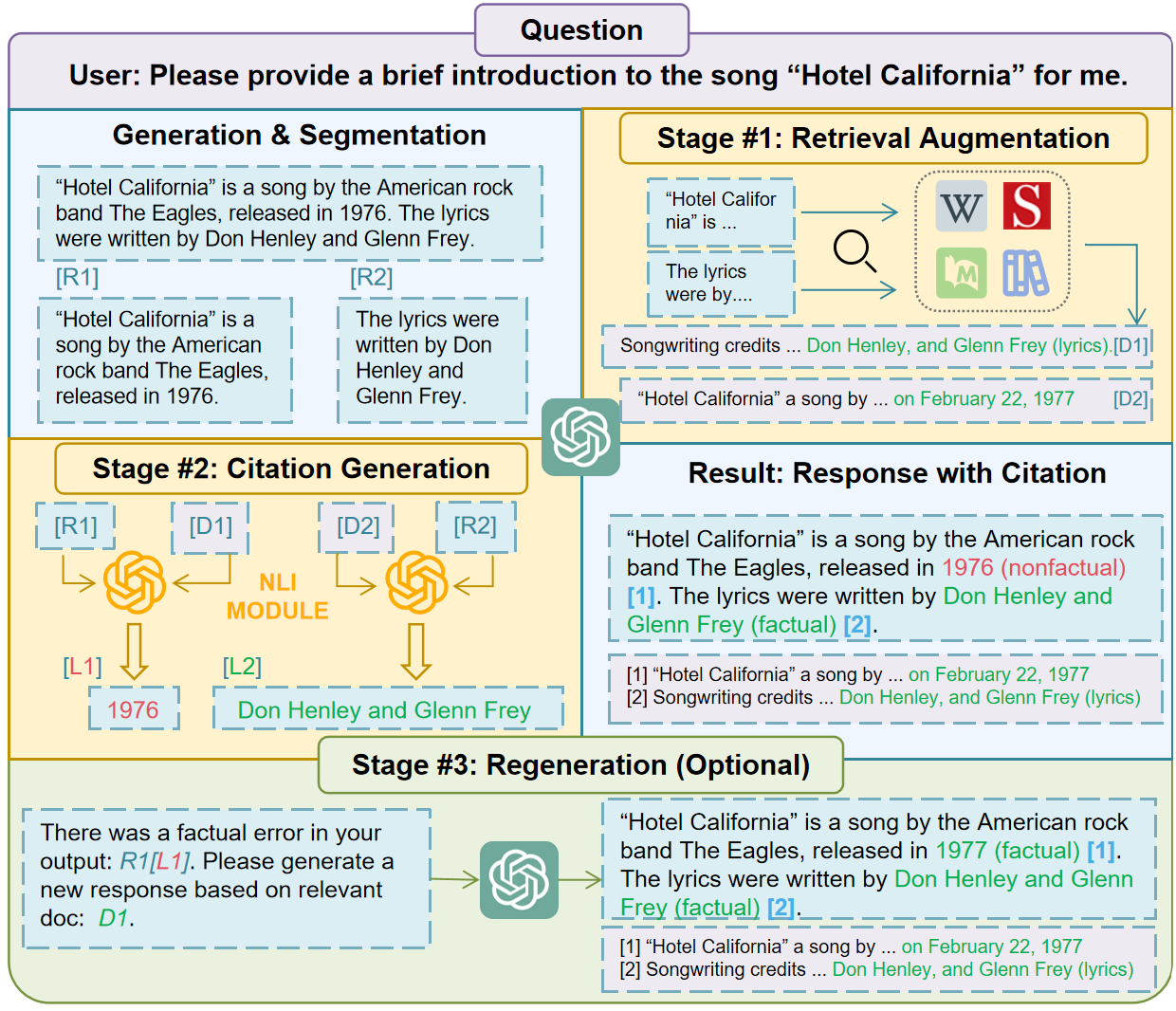
- A post-hoc retrieval module searches for relevant documents using a dense retrieval model (e.g., SimCSE-BERT) to support generated content.
- An NLI-based citation generation module verifies whether statements in the LLM’s output are supported by retrieved documents.
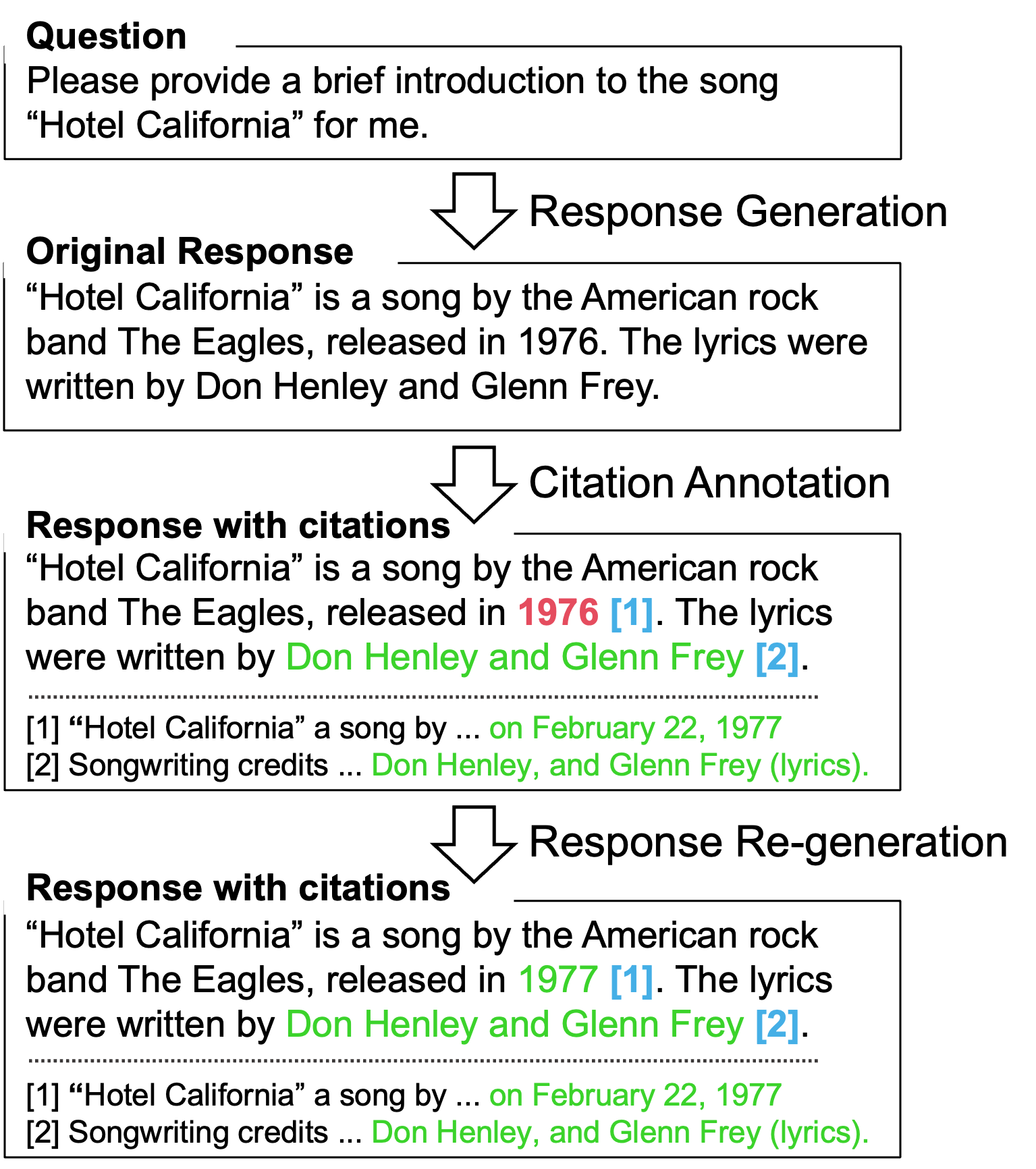
- If unsupported statements are detected, the model prompts the LLM to regenerate the response using citation feedback.
- The framework operates as a plug-in, requiring no model fine-tuning or architectural changes.
- The system uses top-k retrieved documents (k ≈ 5–6) to balance efficiency and effectiveness.
- NLI models such as GPT-4 and GPT-3.5-Turbo-Instruct are used to assess entailment between claims and retrieved evidence.
Experimental results
Research questions
- RQ1Can a post-hoc citation generation framework effectively reduce hallucinations in LLM-based chatbots without retraining?
- RQ2How effective is retrieval-augmented NLI in identifying unsupported claims in LLM-generated responses?
- RQ3What is the optimal number of retrieved documents (k) for balancing performance and efficiency?
- RQ4How do different LLMs perform as NLI models in citation verification?
- RQ5Can this framework be universally applied across diverse LLMs and benchmarks?
Key findings
- The CEG framework achieved state-of-the-art performance on three hallucination-related benchmarks, outperforming existing methods in both hallucination detection and response regeneration.
- Using SimCSE-BERT as the retriever, the framework achieved 76.8% retrieval accuracy with top-10 documents on the WikiRetr dataset.
- GPT-4 and GPT-3.5-Turbo-Instruct achieved 96% and 91% agreement rates with human annotators on citation verification, respectively.
- The optimal k value was found to be around 5–6, as higher k values reduced performance due to attention dispersion and lower relevance.
- The citation generation module achieved 78.2% precision on the WikiRetr-GPT3 dataset and 75.7% on WikiRetr-GPT4, indicating high-quality claim-evidence alignment.
- The framework demonstrated robustness across different LLMs, with no need for fine-tuning or additional data annotation.
Read this paper
Open the full text in the Nubint reader and ask about any passage as you read.
Read this paper on NubintThis review was generated by AI from the original paper. Please check the paper before citing it.