
[Paper Review] CLAP: Learning Audio Concepts From Natural Language Supervision
CLAP introduces a contrastive learning framework that trains audio and text encoders to align audio and natural language descriptions in a shared embedding space, enabling state-of-the-art zero-shot performance across 16 downstream audio tasks with only 128k audio-text pairs—demonstrating strong generalization and flexibility without task-specific fine-tuning.
Mainstream Audio Analytics models are trained to learn under the paradigm of one class label to many recordings focusing on one task. Learning under such restricted supervision limits the flexibility of models because they require labeled audio for training and can only predict the predefined categories. Instead, we propose to learn audio concepts from natural language supervision. We call our approach Contrastive Language-Audio Pretraining (CLAP), which learns to connect language and audio by using two encoders and a contrastive learning to bring audio and text descriptions into a joint multimodal space. We trained CLAP with 128k audio and text pairs and evaluated it on 16 downstream tasks across 8 domains, such as Sound Event Classification, Music tasks, and Speech-related tasks. Although CLAP was trained with significantly less pairs than similar computer vision models, it establishes SoTA for Zero-Shot performance. Additionally, we evaluated CLAP in a supervised learning setup and achieve SoTA in 5 tasks. Hence, CLAP's Zero-Shot capability removes the need of training with class labels, enables flexible class prediction at inference time, and generalizes to multiple downstream tasks.
Motivation & Objective
- To develop a general-purpose audio representation model that learns from natural language supervision instead of predefined class labels.
- To enable flexible, zero-shot audio classification by aligning audio and text embeddings in a shared multimodal space.
- To achieve strong generalization across diverse audio domains such as sound event classification, music, and speech tasks without task-specific fine-tuning.
- To explore the impact of model freezing and prompt engineering on zero-shot performance in audio understanding.
- To establish a foundation model for audio that generalizes effectively with limited data compared to vision counterparts.
Proposed method
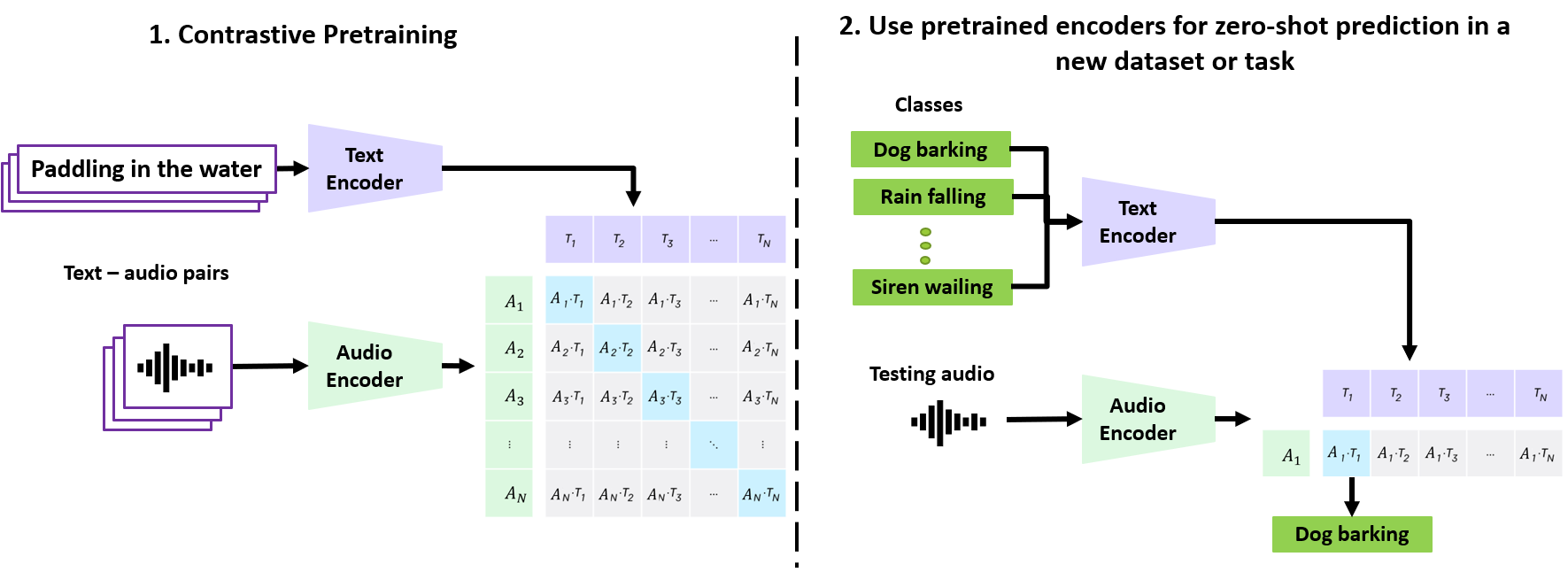
- CLAP uses two separate encoders: an audio encoder and a text encoder, each processing input audio and text pairs independently.
- Audio and text representations are projected into a shared embedding space of dimension d using learnable linear layers $L_a$ and $L_t$.
- Contrastive learning is applied using a temperature-scaled similarity matrix $C = \tau \cdot (E_t \cdot E_a^\top)$, where positive pairs are on the diagonal.
- The loss function $\mathcal{L} = 0.5(\ell_{\text{text}}(C) + \ell_{\text{audio}}(C))$ optimizes for matching audio-text pairs while pushing apart negative pairs.
- At inference, zero-shot classification is performed by computing cosine similarity between audio embeddings and text embeddings of class labels.
- Prompt engineering is applied during inference using templates like 'This is a sound of [class label]' to improve zero-shot transfer performance.
Experimental results
Research questions
- RQ1Can a contrastive learning framework trained on 128k audio-text pairs achieve state-of-the-art zero-shot performance in audio understanding?
- RQ2How does natural language supervision compare to class-label supervision in enabling flexible, unseen-class prediction in audio models?
- RQ3What is the impact of freezing audio and text encoders on downstream zero-shot performance?
- RQ4How do different prompt templates affect zero-shot classification accuracy on audio benchmarks?
- RQ5To what extent does CLAP generalize across diverse audio domains such as sound events, music, and speech?
Key findings
- CLAP achieved state-of-the-art zero-shot performance on 16 downstream tasks across 8 domains, including 82.6% accuracy on ESC50 using the optimal prompt template.
- On the FSD50K dataset, CLAP achieved 53.8% mAP in zero-shot evaluation, outperforming Wav2CLIP by 27 percentage points.
- In supervised fine-tuning, CLAP achieved state-of-the-art results on 5 tasks, including 100% accuracy on GTZAN’s Music vs Speech Classification.
- Freezing the text encoder while fine-tuning the audio encoder yielded better zero-shot performance than freezing the audio encoder, suggesting text encoders are more critical for cross-modal alignment.
- Prompt engineering significantly improved zero-shot performance, with the template 'This is a sound of [class label]' yielding the highest ESC50 accuracy at 82.6%.
- CLAP outperformed random baseline by 22% in Instrument Classification and 33% in Vocal Sound classification, demonstrating meaningful generalization even without fine-tuning.
Read this paper
Open the full text in the Nubint reader and ask about any passage as you read.
Read this paper on NubintThis review was generated by AI from the original paper. Please check the paper before citing it.