
[Paper Review] CLARA: Classifying and Disambiguating User Commands for Reliable Interactive Robotic Agents
This paper proposes CLARA, a framework that classifies user commands as clear, ambiguous, or infeasible using large language models (LLMs) with situational awareness, and disambiguates ambiguous commands via LLM-generated questions. It achieves superior performance in uncertainty classification (AUROC of 0.89) and disambiguation success rate (0.75) on a new benchmark dataset and real-world robotic interactions.
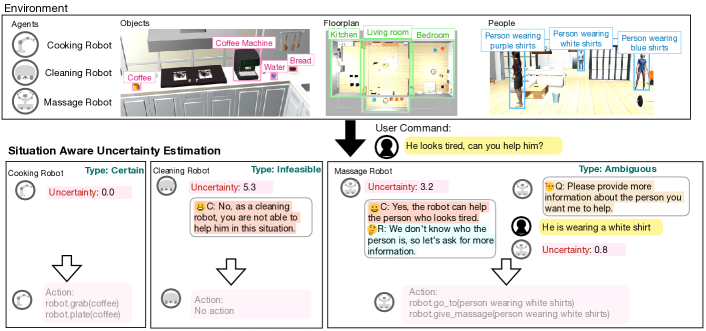
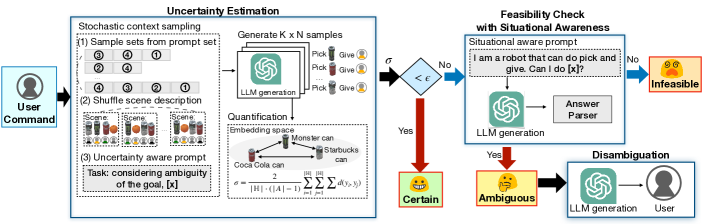
In this paper, we focus on inferring whether the given user command is clear, ambiguous, or infeasible in the context of interactive robotic agents utilizing large language models (LLMs). To tackle this problem, we first present an uncertainty estimation method for LLMs to classify whether the command is certain (i.e., clear) or not (i.e., ambiguous or infeasible). Once the command is classified as uncertain, we further distinguish it between ambiguous or infeasible commands leveraging LLMs with situational aware context in a zero-shot manner. For ambiguous commands, we disambiguate the command by interacting with users via question generation with LLMs. We believe that proper recognition of the given commands could lead to a decrease in malfunction and undesired actions of the robot, enhancing the reliability of interactive robot agents. We present a dataset for robotic situational awareness, consisting pair of high-level commands, scene descriptions, and labels of command type (i.e., clear, ambiguous, or infeasible). We validate the proposed method on the collected dataset, pick-and-place tabletop simulation. Finally, we demonstrate the proposed approach in real-world human-robot interaction experiments, i.e., handover scenarios.
Motivation & Objective
- To improve the reliability of interactive robotic agents by classifying user commands into clear, ambiguous, or infeasible types.
- To address the challenge of interpreting ambiguous or infeasible commands in real-world robotic environments.
- To develop a zero-shot, LLM-based method that leverages situational context for uncertainty classification.
- To enable dynamic disambiguation through free-form question generation on ambiguous commands.
- To create a new benchmark dataset for evaluating situational awareness in robotic command understanding.
Proposed method
- The method estimates predictive uncertainty in LLM outputs to distinguish clear commands from uncertain ones (ambiguous or infeasible).
- It uses zero-shot LLM reasoning with situational context to classify uncertain commands as either ambiguous or infeasible.
- For ambiguous commands, the system generates free-form questions via LLMs to elicit user clarification, enabling iterative disambiguation.
- The framework integrates uncertainty estimation and situational awareness into a unified pipeline for reliable command interpretation.
- It leverages the GPT-3.5-turbo and InstructGPT models for classification and question generation, relying on API-based inference without fine-tuning.
- A new dataset, SaGC, is constructed with high-level commands, scene descriptions, and uncertainty-type annotations for evaluation.
Experimental results
Research questions
- RQ1Can LLMs effectively estimate uncertainty in user commands to distinguish clear commands from ambiguous or infeasible ones?
- RQ2How well can zero-shot LLMs classify uncertain commands as ambiguous or infeasible when grounded in situational context?
- RQ3To what extent does LLM-based question generation improve disambiguation success in human-robot interaction?
- RQ4How does the proposed method compare to baselines in classifying command uncertainty and handling real-world interactions?
- RQ5Can the proposed framework generalize to raw, vague inputs and support iterative disambiguation in real-world robotic systems?
Key findings
- The proposed method achieved an AUROC of 0.89 in distinguishing clear commands from uncertain ones, outperforming baselines by 0.018.
- On the classification of uncertainty types, the method achieved a 0.17 higher accuracy than baselines on both GPT-3.5-turbo and InstructGPT.
- The disambiguation process increased success rate by an average of 0.05 compared to baselines, with optimal interaction timing (0.23 gap).
- The system successfully handled raw and vague inputs like "he looks sleepy" and performed iterative disambiguation when users provided incomplete information.
- Real-world demonstrations confirmed the method's effectiveness, with GPT-3.5-turbo showing higher success due to more question generation, while InstructGPT offered a balance for users preferring fewer questions.
- Limitations include hallucination in feasibility prediction and failure to generate multi-faceted questions for commands with multiple missing details.
Read this paper
Open the full text in the Nubint reader and ask about any passage as you read.
Read this paper on NubintThis review was generated by AI from the original paper. Please check the paper before citing it.