
[Paper Review] Clarify When Necessary: Resolving Ambiguity Through Interaction with LMs
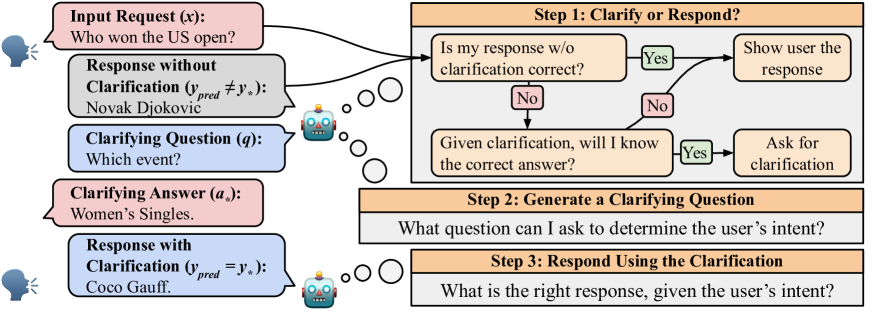
This paper proposes a task-agnostic framework for resolving ambiguity in LLMs through interactive clarification, decomposing the process into three stages: detecting when clarification is needed, generating effective clarifying questions, and responding accurately to user answers. The key contribution is Intent-Sim, a novel uncertainty estimation method that uses intent entropy to identify when clarification improves performance, outperforming baselines by doubling gains when clarifying only 10% of inputs.
Resolving ambiguities through interaction is a hallmark of natural language, and modeling this behavior is a core challenge in crafting AI assistants. In this work, we study such behavior in LMs by proposing a task-agnostic framework for resolving ambiguity by asking users clarifying questions. Our framework breaks down this objective into three subtasks: (1) determining when clarification is needed, (2) determining what clarifying question to ask, and (3) responding accurately with the new information gathered through clarification. We evaluate systems across three NLP applications: question answering, machine translation and natural language inference. For the first subtask, we present a novel uncertainty estimation approach, intent-sim, that determines the utility of querying for clarification by estimating the entropy over user intents. Our method consistently outperforms existing uncertainty estimation approaches at identifying predictions that will benefit from clarification. When only allowed to ask for clarification on 10% of examples, our system is able to double the performance gains over randomly selecting examples to clarify. Furthermore, we find that intent-sim is robust, demonstrating improvements across a wide range of NLP tasks and LMs. Together, our work lays foundation for studying clarifying interactions with LMs.
Motivation & Objective
- To model interactive ambiguity resolution in LLMs by enabling systems to detect when clarification is needed.
- To develop a framework for generating effective clarifying questions that expose user intent ambiguity.
- To improve downstream task performance by accurately responding to user-provided clarifications.
- To evaluate the framework across diverse NLP tasks, including question answering, machine translation, and natural language inference.
- To introduce and validate Intent-Sim, a novel uncertainty estimation method for identifying ambiguous inputs that benefit from clarification.
Proposed method
- The framework is structured into three sequential subtasks: (1) determining when to ask for clarification, (2) generating a clarifying question, and (3) producing the correct output using the user’s response.
- Intent-Sim estimates uncertainty by simulating multiple user-assistant interactions and computing the entropy over predicted user intents.
- The method uses multiple annotations from ambiguous inputs to model the natural distribution of user intents and compute intent entropy.
- For evaluation, the authors use oracle-generated clarifying QA pairs to isolate and assess the performance of the clarification generation and response modules.
- The system is evaluated across three NLP tasks—question answering, machine translation, and natural language inference—using existing ambiguous datasets with multiple annotations.
- Performance is measured using end-task accuracy and AUROC, with a focus on minimizing interaction cost while maximizing performance gains.
Experimental results
Research questions
- RQ1Can uncertainty estimation based on intent entropy effectively identify ambiguous inputs that would benefit from clarification?
- RQ2How does the proposed framework improve downstream task performance when only a small fraction of inputs are clarified?
- RQ3To what extent is the Intent-Sim method robust across different NLP tasks and LLM architectures?
- RQ4How does the quality of clarifying questions impact the final output accuracy after user feedback?
- RQ5Can a task-agnostic framework for ambiguity resolution be effectively applied to diverse NLP applications like QA, MT, and NLI?
Key findings
- Intent-Sim outperforms existing uncertainty estimation methods in identifying ambiguous inputs that would benefit from clarification.
- When restricted to clarifying only 10% of inputs, the system achieves double the performance gain compared to random selection.
- Intent-Sim demonstrates consistent improvements across all evaluated tasks and LLMs, with the strongest performance in four out of six LLM-plus-task settings.
- The method shows robustness even under low interaction budgets, maintaining high utility despite coarse entropy estimation from limited samples.
- The framework successfully improves end-task accuracy by enabling LLMs to detect ambiguity and interactively resolve it through user feedback.
- The results suggest that uncertainty estimation based on intent entropy is a more effective signal for clarification than likelihood-based or heuristic approaches.
Better researchstarts right now
From reading papers to final review, dramatically reduce your research time.
No credit card · Free plan available
This review was created by AI and reviewed by human editors.