
[Paper Review] ClarifyGPT: Empowering LLM-based Code Generation with Intention Clarification
ClarifyGPT detects ambiguous requirements via code consistency checks, asks targeted clarifying questions via reasoning-based prompts, and generates refined code with user feedback.
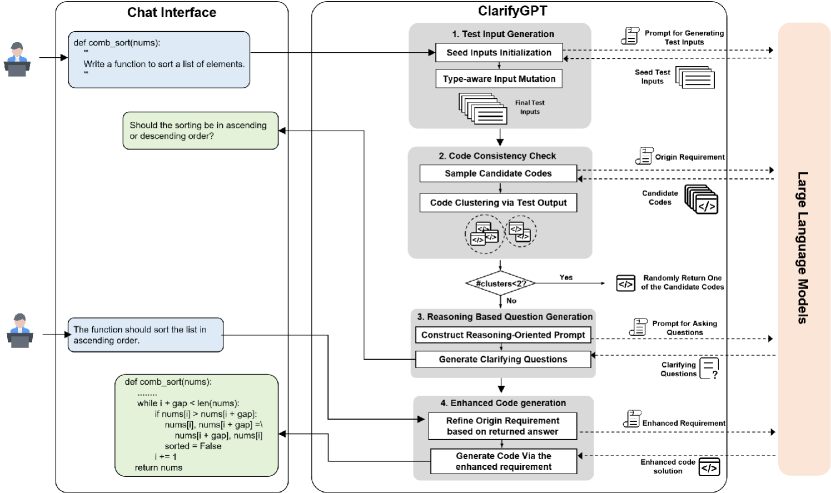
We introduce a novel framework named ClarifyGPT, which aims to enhance code generation by empowering LLMs with the ability to identify ambiguous requirements and ask targeted clarifying questions. In particular, ClarifyGPT first detects whether a given requirement is ambiguous by performing a code consistency check. If it is ambiguous, ClarifyGPT prompts an LLM to generate targeted clarifying questions. After receiving question responses, ClarifyGPT refines the ambiguous requirement and inputs it into the same LLM to generate a final code solution. To evaluate our ClarifyGPT, we first conduct a human evaluation involving ten participants who use ClarifyGPT for code generation on two publicly available benchmarks: MBPP-sanitized and MBPP-ET. The results show that ClarifyGPT elevates the performance (Pass@1) of GPT-4 from 70.96% to 80.80% on MBPP-sanitized. Furthermore, to perform large-scale automated evaluations of ClarifyGPT across different LLMs and benchmarks without requiring user participation, we introduce a high-fidelity simulation method to simulate user responses. The automated evaluation results also demonstrate that ClarifyGPT can significantly enhance code generation performance compared to the baselines. In particular, ClarifyGPT improves the average performance of GPT-4 and ChatGPT across four benchmarks from 68.02% to 75.75% and from 58.55% to 67.22%, respectively. We believe that ClarifyGPT can effectively facilitate the practical application of LLMs in real-world development environments.
Motivation & Objective
- Motivate improving code generation when user requirements are ambiguous or incomplete.
- Propose a four-stage framework to detect ambiguity, generate clarifying questions, and refine prompts for code generation.
- Enable automated evaluation via a high-fidelity user simulation to enable large-scale, reproducible testing.
- Evaluate ClarifyGPT on multiple benchmarks and with real user feedback to quantify performance gains.
Proposed method
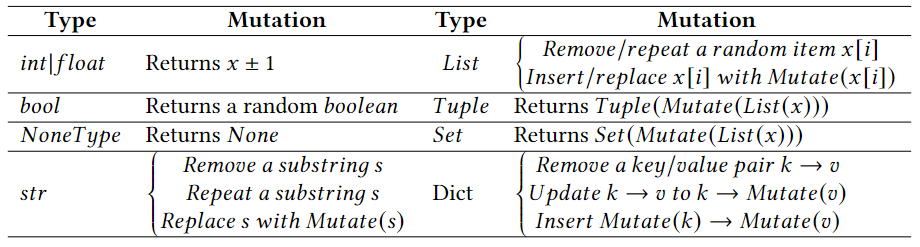
- Stage 1: Generate high-quality test inputs for a given requirement using seed inputs and type-aware mutation.
- Stage 2: Conduct a code consistency check by sampling multiple code solutions and comparing their outputs on generated test inputs to detect ambiguity.
- Stage 3: Generate targeted clarifying questions through reasoning-based prompting that analyzes inconsistencies among code solutions.
- Stage 4: Refine the original requirement with answers to clarifying questions and generate the final code solution from the refined prompt.
Experimental results
Research questions
- RQ1RQ1: How does ClarifyGPT perform with real user feedback compared to baselines?
- RQ2RQ2: How does ClarifyGPT perform with simulated user feedback compared to baselines in automated evaluations?
- RQ3RQ3: How does the number of demonstrations in a prompt affect ClarifyGPT performance?
Key findings
- ClarifyGPT with human feedback improves GPT-4 Pass@1 on MBPP-sanitized from 70.96% to 80.80%.
- ClarifyGPT with human feedback improves GPT-4 Pass@1 on MBPP-ET from 51.52% (baseline) to 60.19%.
- Across four benchmarks, ClarifyGPT yields average gains of 11.52 percentage points for GPT-4 and 15.07 percentage points for ChatGPT over baselines.
- Automated simulations show ClarifyGPT improves average Pass@1 by 11.52% (GPT-4) and 15.07% (ChatGPT) across four benchmarks.
- ClarifyGPT achieves substantial improvements over Default, CoT, and GPT-Engineer baselines in both human-assisted and automated evaluations.
Read this paper
Open the full text in the Nubint reader and ask about any passage as you read.
Read this paper on NubintThis review was generated by AI from the original paper. Please check the paper before citing it.