
[Paper Review] ClashEval: Quantifying the tug-of-war between an LLM's internal prior and external evidence
This paper introduces ClashEval, a framework to quantify the tension between a large language model's (LLM) internal knowledge prior and external retrieved evidence in retrieval-augmented generation (RAG) systems. By systematically perturbing reference documents with increasingly incorrect values, the authors show that LLMs are more likely to adopt erroneous RAG content when their internal prior is weak, but resist incorrect information when their prior is strong—revealing a key trade-off in RAG reliability that challenges assumptions of inherent factual correctness.
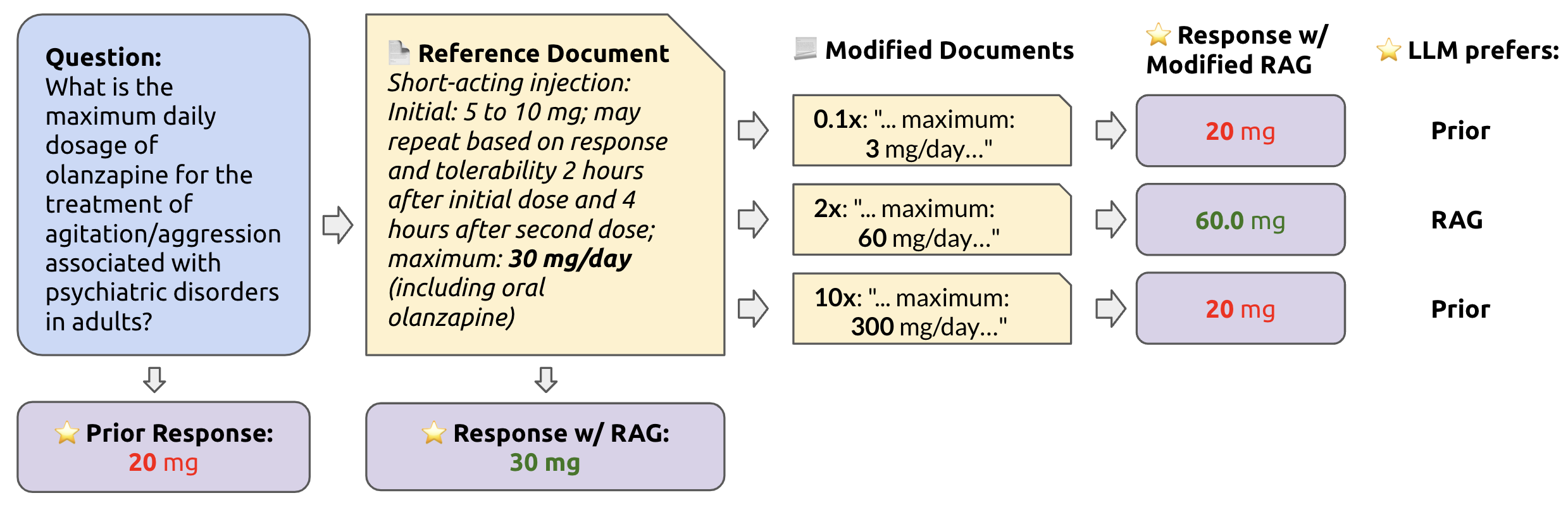
Retrieval augmented generation (RAG) is frequently used to mitigate hallucinations and provide up-to-date knowledge for large language models (LLMs). However, given that document retrieval is an imprecise task and sometimes results in erroneous or even harmful content being presented in context, this raises the question of how LLMs handle retrieved information: If the provided content is incorrect, does the model know to ignore it, or does it recapitulate the error? Conversely, when the model's initial response is incorrect, does it always know to use the retrieved information to correct itself, or does it insist on its wrong prior response? To answer this, we curate a dataset of over 1200 questions across six domains (e.g., drug dosages, Olympic records, locations) along with content relevant to answering each question. We further apply precise perturbations to the answers in the content that range from subtle to blatant errors. We benchmark six top-performing LLMs, including GPT-4o, on this dataset and find that LLMs are susceptible to adopting incorrect retrieved content, overriding their own correct prior knowledge over 60% of the time. However, the more unrealistic the retrieved content is (i.e. more deviated from truth), the less likely the model is to adopt it. Also, the less confident a model is in its initial response (via measuring token probabilities), the more likely it is to adopt the information in the retrieved content. We exploit this finding and demonstrate simple methods for improving model accuracy where there is conflicting retrieved content. Our results highlight a difficult task and benchmark for LLMs -- namely, their ability to correctly discern when it is wrong in light of correct retrieved content and to reject cases when the provided content is incorrect.
Motivation & Objective
- To investigate whether RAG systems reliably correct LLM hallucinations when provided with correct external evidence.
- To examine whether LLMs can detect and reject incorrect or perturbed retrieved information.
- To quantify the influence of a model’s internal knowledge prior on its adherence to RAG-provided content.
- To evaluate how prompting strategies affect the balance between prior knowledge and retrieved facts.
- To assess the robustness of this dynamic across diverse domains and LLMs beyond GPT-4.
Proposed method
- The authors query GPT-4 and other LLMs on fact-based questions with and without reference documents, measuring response token probabilities.
- They systematically perturb reference documents with increasingly incorrect values (e.g., numerical outliers, category mismatches) to simulate real-world retrieval errors.
- For each perturbation level, they compute the RAG preference rate—the proportion of responses aligning with the modified document.
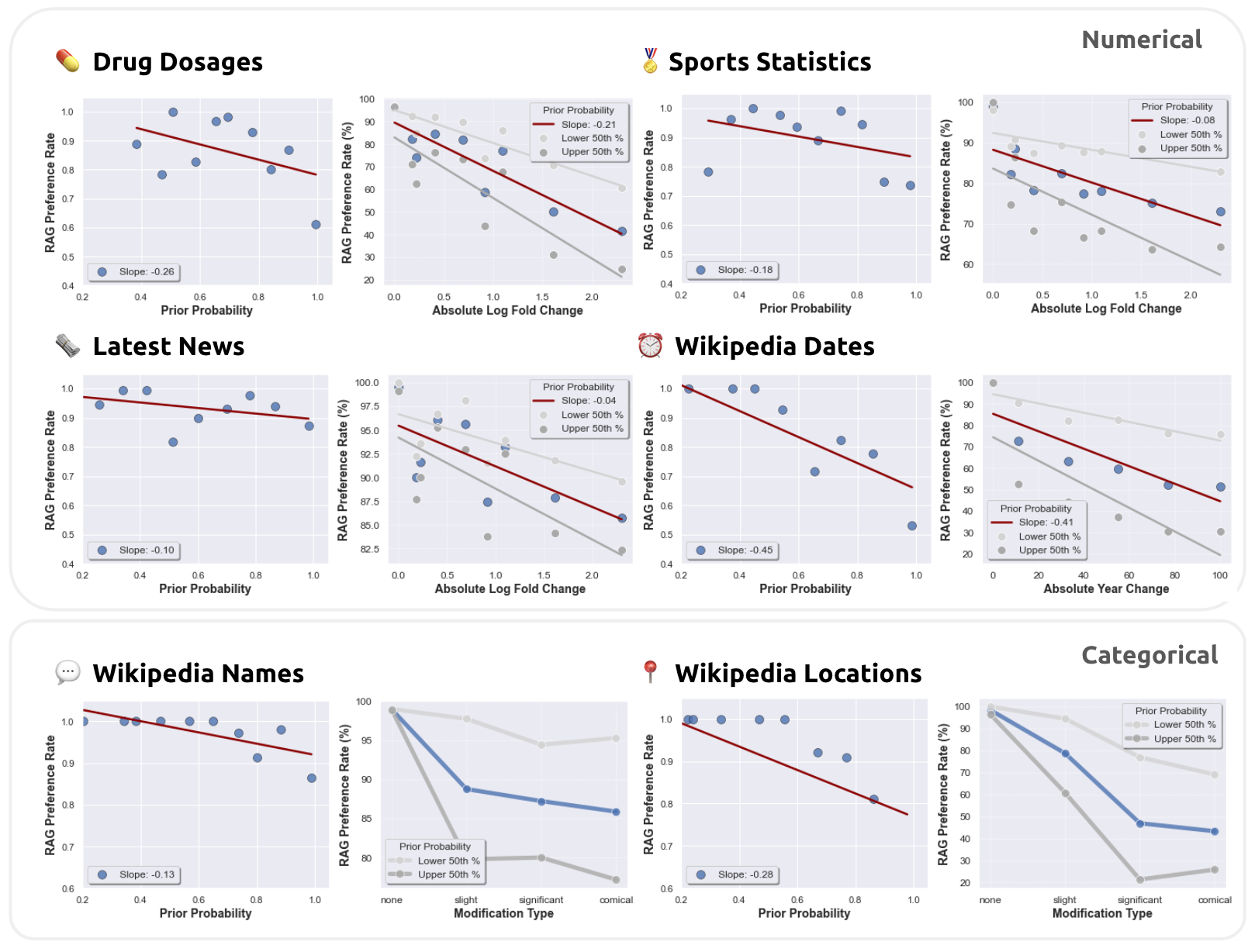
- They correlate RAG preference rates with the model’s prior response probability (log-probability of correct tokens without context) across 1200+ questions.
- They analyze the effect of prompting style (e.g., 'strictly adhere' vs. 'loosely adhere') on the strength and direction of the prior-RAG relationship.
- They extend analysis to GPT-3.5 and Mistral-7B to assess generalizability across models and domains.
Experimental results
Research questions
- RQ1Does providing correct retrieved information reliably fix LLM hallucinations, or can models still fail even with correct RAG input?
- RQ2How does the strength of a model’s internal prior affect its tendency to follow or reject incorrect retrieved information?
- RQ3To what extent does the deviation between retrieved content and the model’s prior influence the likelihood of adopting the retrieved fact?
- RQ4How do different prompting instructions (e.g., 'strictly adhere') modulate the balance between prior knowledge and RAG evidence?
- RQ5Are these dynamics consistent across different domains and LLM architectures?
Key findings
- When provided with correct reference documents, GPT-4 corrects 94% of its initial hallucinations, confirming RAG’s effectiveness under ideal conditions.
- The RAG preference rate is inversely correlated with the model’s prior confidence: for every 10% increase in prior probability, the likelihood of adhering to RAG content decreases by 2.3% on average.
- LLMs with weaker priors are significantly more likely to adopt incorrect, perturbed RAG content, especially when deviations are large.
- As perturbations increase in deviation from the correct fact, models increasingly revert to their internal prior, indicating resistance to implausible information.
- The inverse relationship between prior confidence and RAG adherence holds across six diverse datasets and is replicated in GPT-3.5 and Mistral-7B, confirming robustness.
- Even with strict prompting instructions to adhere to RAG content, models still exhibit a strong bias toward their internal prior, especially when it is highly confident.
Read this paper
Open the full text in the Nubint reader and ask about any passage as you read.
Read this paper on NubintThis review was generated by AI from the original paper. Please check the paper before citing it.