
[Paper Review] Class-Incremental Learning with Repetition
This paper introduces the Class-Incremental Learning with Repetition (CIR) scenario, where natural repetition of classes in data streams is modeled via two stochastic stream generators. It proposes Frequency-Aware Replay (ER-FA), a novel replay strategy that outperforms existing methods on unbalanced CIR streams by improving accuracy on infrequent classes without sacrificing performance on frequent ones, demonstrating that repetition naturally enables knowledge accumulation even without explicit replay.
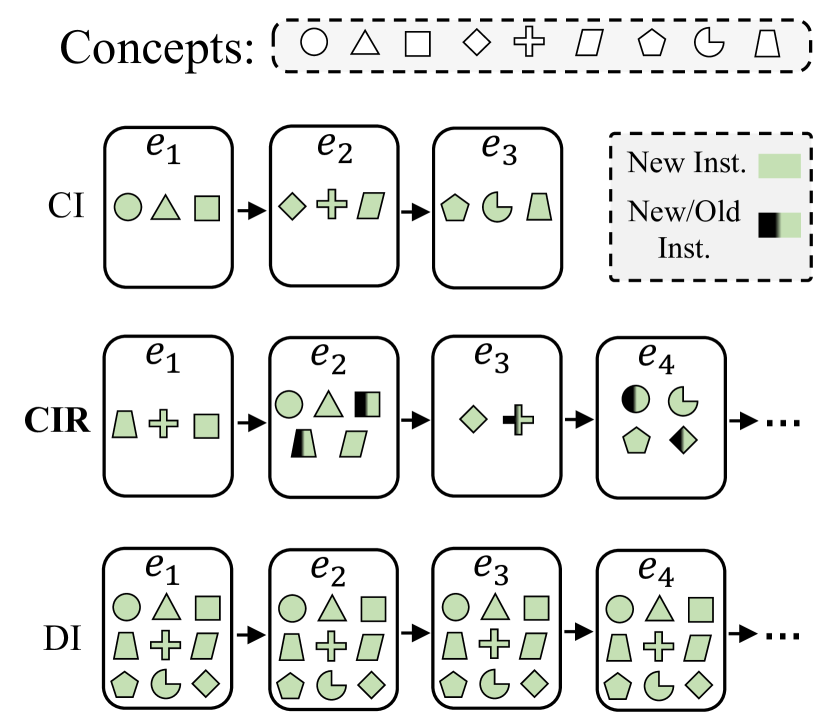
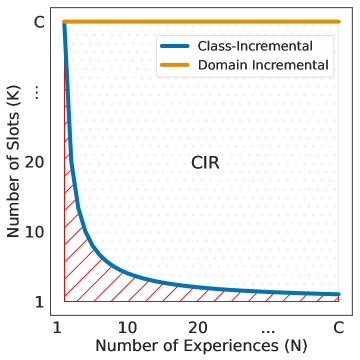
Real-world data streams naturally include the repetition of previous concepts. From a Continual Learning (CL) perspective, repetition is a property of the environment and, unlike replay, cannot be controlled by the agent. Nowadays, the Class-Incremental (CI) scenario represents the leading test-bed for assessing and comparing CL strategies. This scenario type is very easy to use, but it never allows revisiting previously seen classes, thus completely neglecting the role of repetition. We focus on the family of Class-Incremental with Repetition (CIR) scenario, where repetition is embedded in the definition of the stream. We propose two stochastic stream generators that produce a wide range of CIR streams starting from a single dataset and a few interpretable control parameters. We conduct the first comprehensive evaluation of repetition in CL by studying the behavior of existing CL strategies under different CIR streams. We then present a novel replay strategy that exploits repetition and counteracts the natural imbalance present in the stream. On both CIFAR100 and TinyImageNet, our strategy outperforms other replay approaches, which are not designed for environments with repetition.
Motivation & Objective
- To address the lack of realistic data stream modeling in continual learning by introducing the Class-Incremental with Repetition (CIR) scenario, where repetition is a natural, uncontrollable property of the environment.
- To design two easy-to-use, parameterized stream generators that produce diverse CIR streams from a single dataset, enabling reproducible and interpretable evaluation.
- To empirically evaluate existing CL strategies in CIR settings and analyze how natural repetition affects knowledge accumulation and forgetting.
- To propose a novel replay strategy, Frequency-Aware Replay (ER-FA), tailored for unbalanced CIR streams where some classes are rarely repeated.
- To demonstrate that natural repetition reduces reliance on artificial replay and that ER-FA provides robust, balanced performance across class frequency distributions.
Proposed method
- Two stochastic stream generators are designed: one controlling class repetition frequency and another managing first occurrence and repetition patterns, both configurable via interpretable parameters.
- Generators are implemented in the Avalanche framework and support any image classification dataset, enabling integration into standard CL pipelines.
- The proposed ER-FA replay strategy dynamically prioritizes replay samples based on class frequency, giving higher priority to infrequently repeated classes.
- ER-FA uses a memory buffer that stores exemplars weighted by class frequency, ensuring underrepresented classes are better preserved during training.
- The method is evaluated across CIFAR-100 and TinyImageNet using both balanced and unbalanced repetition distributions, with accuracy measured per class and overall.
- Centered Kernel Alignment (CKA) and weight analysis are used to study model representation dynamics over time, providing insights into knowledge retention.
Experimental results
Research questions
- RQ1How does natural repetition in data streams affect knowledge accumulation in continual learning, especially in the absence of explicit replay?
- RQ2To what extent do existing replay-based CL strategies generalize to CIR streams with unbalanced repetition?
- RQ3Can a replay strategy be designed to specifically exploit the statistical properties of CIR streams, particularly class frequency imbalance?
- RQ4Does natural repetition alone suffice to mitigate catastrophic forgetting, or is artificial replay still necessary?
- RQ5How does model representation evolve over time in CIR streams, and how does this compare to standard CI or DI scenarios?
Key findings
- Knowledge accumulation occurs naturally in CIR streams even without any CL strategy, as demonstrated by fine-tuning achieving non-trivial accuracy on previously seen classes.
- Replay strategies still provide a performance advantage in CIR, but they are not essential for preventing catastrophic forgetting when repetition is naturally present.
- LwF-based distillation methods show competitive performance in CIR streams with moderate repetition, outperforming some replay baselines.
- ER-FA achieves the highest accuracy on infrequent classes (37.6±2.9 on CIFAR-100) while maintaining strong performance on frequent classes, outperforming all other replay variants.
- On unbalanced streams with 10% of classes repeated only 10% of the time, ER-FA improves average accuracy by 10.7 percentage points over standard replay and 7.5 over ER-ACE.
- ER-FA reduces performance variance across classes and provides more robust, consistent results compared to baseline replay strategies.
Read this paper
Open the full text in the Nubint reader and ask about any passage as you read.
Read this paper on NubintThis review was generated by AI from the original paper. Please check the paper before citing it.