
[Paper Review] Classification of 1+1D gapless symmetry protected phases via topological holography
This paper establishes a one-to-one correspondence between 1+1D bosonic gapless symmetry-protected topological (gSPT) phases and partially-confined boundaries of 2+1D symmetry topological field theories (SymTFTs), using anyon condensation in quantum double models. The key contribution is a complete classification of gSPTs via topological holography, showing that edge modes and emergent anomalies arise from the SymTFT structure through symmetry-preserving anyon condensation.
Symmetry topological field theory (SymTFT) gives a holographic correspondence between systems with a global symmetry and a higher-dimensional topological field theory. In this framework, classification of gapped phases of matter in spacetime dimension 1+1D correspond to classifications of mechanisms to confine the SymTFT by condensing anyons. In this work, we extend these results to characterize gapless symmetry-protected topological states: symmetry-enriched gapless phases or critical points that exhibit edge modes protected by symmetry and topology. We establish a one-to-one correspondence between 1+1D bosonic gSPTs, and partially-confined boundaries of 2+1D SymTFTs. From general physical considerations, we determine the set of data and consistency conditions required to define a 1+1D gSPT, and show that this data precisely matches that of symmetry-preserving partial confinement (or partially gapped boundaries) of 2+1D quantum double models. We illustrate this correspondence through a dimensional reduction (thin-slab) construction, which enables a physically-intuitive derivation of how properties of the gSPT such as edge modes, emergent anomalies, and stability to perturbations arise from the SymTFT perspective.ditions required to define a 1+1D gSPT and show that they fully determine the physics of the gSPT including edge modes and emergent anomaly.
Motivation & Objective
- To extend the SymTFT framework—previously used for gapped phases—to classify gapless symmetry-protected topological (gSPT) phases in 1+1D systems.
- To identify the algebraic data and consistency conditions that fully characterize 1+1D bosonic gSPTs, including edge modes and emergent anomalies.
- To establish a holographic duality between gSPTs and partially-confined boundaries of 2+1D SymTFTs, particularly quantum double models.
- To demonstrate that the topological features of gSPTs, such as edge modes and anomalies, emerge from the condensation of anyons in the SymTFT bulk.
- To generalize the bulk-edge correspondence to gapless phases by linking 1+1D gSPTs to 0+1D edge theories via topological data from SymTFTs.
Proposed method
- Introduces a set of topological data $(\eta, \epsilon)$ to classify 1+1D bosonic gSPTs, where $\eta$ encodes the SPT class of the gapped sector and $\epsilon$ governs symmetry interplay with the gapless sector.
- Applies the SymTFT duality by mapping gSPTs to partially-confined boundaries of 2+1D quantum double models $D(\Gamma)$, where anyon condensation preserves topological order partially.
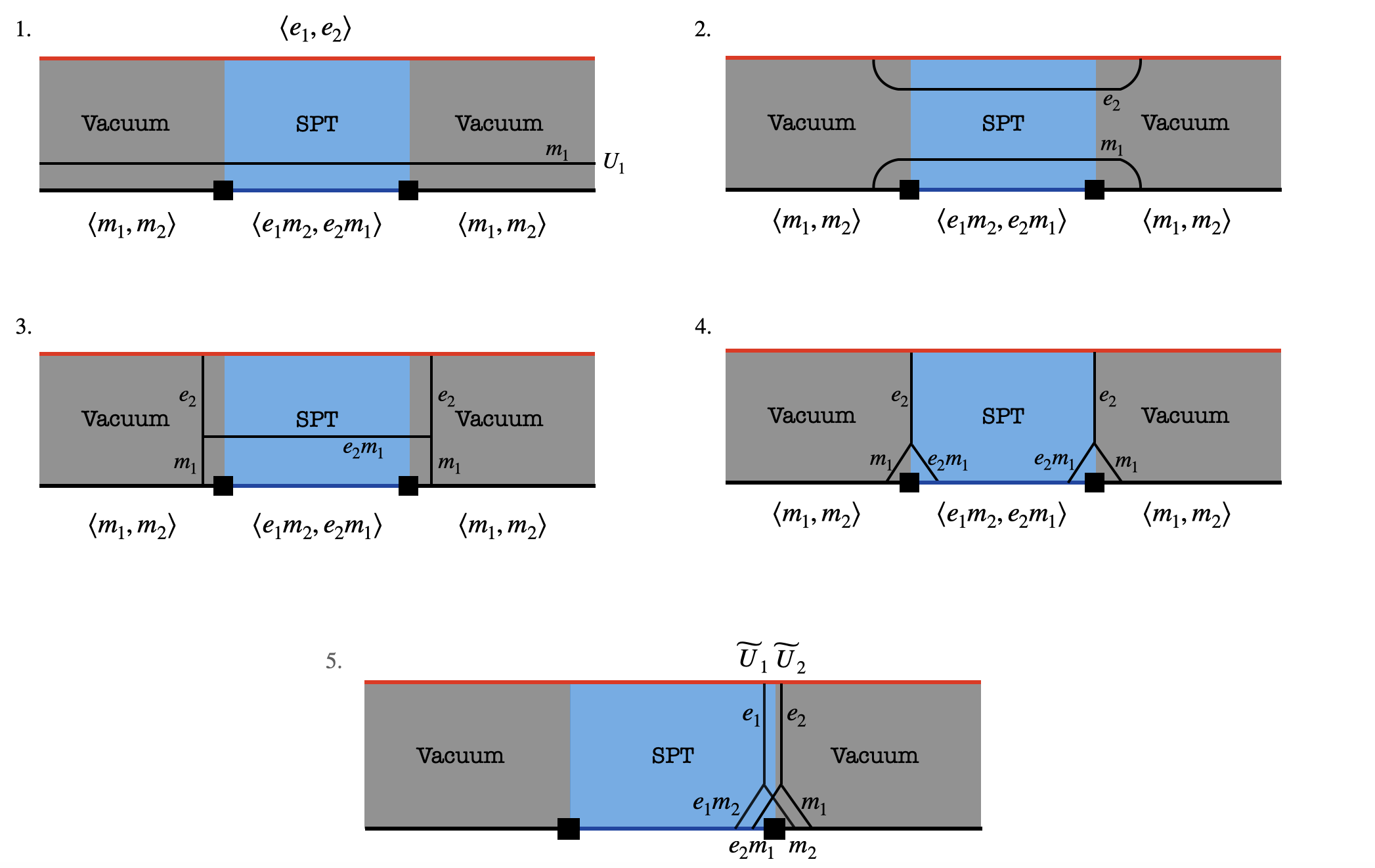
- Uses dimensional reduction (thin-slab construction) to derive physical intuition: gapped and gapless sectors emerge from the boundary and bulk of the SymTFT, respectively.
- Derives consistency conditions on $(\eta, \epsilon)$ using group cohomology and topological field theory constraints, ensuring anomaly-free symmetry realizations.
- Establishes a bulk-edge correspondence by showing that the emergent anomaly in the gSPT matches the post-condensation twist structure in the SymTFT, linking 1+1D gSPTs to 0+1D edge anomalies.
- Demonstrates that stacking a gSPT with a trivial SPT (classified by $\omega_2$) corresponds to trivializing the $\eta$ factor via pull-back, preserving the emergent anomaly.

Experimental results
Research questions
- RQ1How can gapless symmetry-protected topological phases in 1+1D be classified using topological holography?
- RQ2What is the precise correspondence between 1+1D gSPTs and partially-confined boundaries of 2+1D SymTFTs?
- RQ3How do edge modes and emergent anomalies in gSPTs arise from the anyon condensation mechanism in SymTFTs?
- RQ4What algebraic data fully characterizes a 1+1D bosonic gSPT, and what consistency conditions must it satisfy?
- RQ5How does the bulk-edge correspondence generalize from gapped SPTs to gapless SPTs in the SymTFT framework?
Key findings
- A one-to-one correspondence is established between 1+1D bosonic gSPTs and symmetric, partially-confining anyon condensations in 2+1D quantum double models.
- The classification of gSPTs is fully captured by two phase factors $(\eta, \epsilon)$, where $\eta$ determines the SPT class of the gapped sector and $\epsilon$ encodes the symmetry interplay with the gapless sector.
- Edge modes in gSPTs emerge from the anyonic excitations at the partially-confined boundary of the SymTFT, with their structure determined by the condensation pattern.
- The emergent anomaly in the gSPT is shown to be equivalent to the post-condensation twist structure in the SymTFT, confirming a bulk-edge correspondence in the gapless regime.
- Stacking a gSPT with a trivial SPT (classified by $\omega_2$) corresponds to a pull-back of $\omega_2$ that trivializes $\eta$, preserving the emergent anomaly and confirming anomaly invariance under SPT stacking.
- The framework successfully reproduces known gSPT families, such as the $\mathbb{Z}_4$-igSPT and SPT-pump type phases, via the SymTFT duality and anyon condensation.
Read this paper
Open the full text in the Nubint reader and ask about any passage as you read.
Read this paper on NubintThis review was generated by AI from the original paper. Please check the paper before citing it.