
[Paper Review] Classification of Diabetic Retinopathy using Pre-Trained Deep Learning Models
This study proposes a computer-aided diagnosis system using fine-tuned pre-trained deep learning models—VGG-16, MobileNet, InceptionV3, and InceptionResNetV2—for multi-class classification of diabetic retinopathy into five stages (Normal to Proliferative DR). Using 1,000 fundus images from the Kaggle dataset with data augmentation and transfer learning, InceptionResNetV2 achieved the highest AUC of 0.69, outperforming other models due to its depth and architectural efficiency in medical image classification.
Diabetic Retinopathy (DR) stands as the leading cause of blindness globally, particularly affecting individuals between the ages of 20 and 70. This paper presents a Computer-Aided Diagnosis (CAD) system designed for the automatic classification of retinal images into five distinct classes: Normal, Mild, Moderate, Severe, and Proliferative Diabetic Retinopathy (PDR). The proposed system leverages Convolutional Neural Networks (CNNs) employing pre-trained deep learning models. Through the application of fine-tuning techniques, our model is trained on fundus images of diabetic retinopathy with resolutions of 350x350x3 and 224x224x3. Experimental results obtained on the Kaggle platform, utilizing resources comprising 4 CPUs, 17 GB RAM, and 1 GB Disk, demonstrate the efficacy of our approach. The achieved Area Under the Curve (AUC) values for CNN, MobileNet, VGG-16, InceptionV3, and InceptionResNetV2 models are 0.50, 0.70, 0.53, 0.63, and 0.69, respectively.
Motivation & Objective
- To develop an automated, accurate, and scalable computer-aided diagnosis (CAD) system for diabetic retinopathy (DR) using deep learning.
- To evaluate the performance of multiple pre-trained CNN architectures—VGG-16, MobileNet, InceptionV3, and InceptionResNetV2—on multi-class DR classification.
- To improve classification accuracy through data augmentation and fine-tuning of pre-trained models on a limited fundus image dataset.
- To identify the most effective deep learning architecture for detecting subtle DR severity levels in medical retinal images.
- To enable future deployment of a mobile diagnostic tool for early DR detection using lightweight models like MobileNet.
Proposed method
- Fine-tuned pre-trained deep learning models (VGG-16, MobileNet, InceptionV3, InceptionResNetV2) on a 1,000-image fundus dataset from Kaggle, using transfer learning.
- Applied image augmentation techniques to increase training data diversity and reduce overfitting, expanding the dataset to 2,000 images.
- Resized images to 350x350x3 and 224x224x3 resolutions to match model input requirements and preserve critical retinal features.
- Used Adam optimizer with early stopping to improve convergence and prevent overfitting during training.
- Implemented a two-stage classification head: a 1x1 convolutional layer followed by two dense blocks with dropout (0.5) for regularization.
- Froze lower layers and fine-tuned higher layers to adapt pre-trained features to the medical imaging domain.
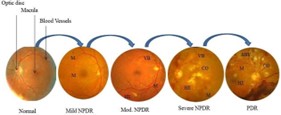
Experimental results
Research questions
- RQ1Which pre-trained deep learning model performs best for multi-class diabetic retinopathy classification on a limited fundus image dataset?
- RQ2How does data augmentation impact the generalization and AUC performance of transfer learning models in DR classification?
- RQ3What is the effect of model depth and architecture (e.g., Inception vs. VGG) on AUC and accuracy in medical image classification tasks?
- RQ4Can fine-tuned lightweight models like MobileNet achieve competitive performance compared to deeper models like InceptionResNetV2 on DR detection?
- RQ5How do different image resolutions (224x224 vs. 350x350) influence model performance and training efficiency?
Key findings
- InceptionResNetV2 achieved the highest Area Under the Curve (AUC) of 0.69, outperforming VGG-16 (0.53), InceptionV3 (0.63), MobileNet (0.70), and a custom CNN (0.50).
- MobileNet achieved an AUC of 0.70, the second-highest, due to its depthwise separable convolutions and efficient architecture despite fewer parameters.
- InceptionV3 achieved an AUC of 0.63 after 43 epochs with early stopping, showing improved performance over prior studies using the same model.
- VGG-16 performed poorly (AUC 0.53) despite 85 training epochs, likely due to its shallow depth (23 layers) and limited capacity for fine-grained feature learning.
- The custom CNN built from scratch achieved the lowest AUC (0.50), indicating poor performance due to insufficient depth and limited training data.
- Image augmentation and fine-tuning significantly improved model generalization, with the final training set expanded to 1,620 images through augmentation techniques.
Better researchstarts right now
From reading papers to final review, dramatically reduce your research time.
No credit card · Free plan available
This review was created by AI and reviewed by human editors.