
[Paper Review] Classification of Human- and AI-Generated Texts: Investigating Features for ChatGPT
This paper proposes a novel classification framework to detect human- and AI-generated texts using a diverse set of traditional and novel features, including perplexity, semantic similarity, list lookup, error-based metrics, readability, AI feedback, and text vectors. The best system achieves an F1-score of 96.9% for advanced AI-generated text and 81.7% for AI-rephrased text, significantly outperforming GPTZero by 183.8% relative in F1 for basic rephrasing detection.
Recently, generative AIs like ChatGPT have become available to the wide public. These tools can for instance be used by students to generate essays or whole theses. But how does a teacher know whether a text is written by a student or an AI? In our work, we explore traditional and new features to (1) detect text generated by AI from scratch and (2) text rephrased by AI. Since we found that classification is more difficult when the AI has been instructed to create the text in a way that a human would not recognize that it was generated by an AI, we also investigate this more advanced case. For our experiments, we produced a new text corpus covering 10 school topics. Our best systems to classify basic and advanced human-generated/AI-generated texts have F1-scores of over 96%. Our best systems for classifying basic and advanced human-generated/AI-rephrased texts have F1-scores of more than 78%. The systems use a combination of perplexity, semantic, list lookup, error-based, readability, AI feedback, and text vector features. Our results show that the new features substantially help to improve the performance of many classifiers. Our best basic text rephrasing detection system even outperforms GPTZero by 183.8% relative in F1-score.
Motivation & Objective
- To address the growing challenge of detecting AI-generated and AI-rephrased student texts in educational settings.
- To investigate the effectiveness of novel features—such as list lookup, error-based metrics, and AI feedback—beyond traditional ones like perplexity and burstiness.
- To develop and evaluate a robust, generalizable detection system for both basic and advanced AI text generation and rephrasing.
- To provide a publicly available, high-quality corpus for future research in AI text detection.
- To benchmark performance against existing tools like GPTZero and demonstrate superior detection accuracy.
Proposed method
- The authors constructed a new, publicly shared corpus of 500 articles across 10 school topics, labeled as human- or AI-generated and rephrased.
- They engineered a comprehensive set of features: perplexity, semantic similarity, list lookup (including title repetition), error-based metrics (e.g., grammatical errors), readability scores, AI feedback signals, and text vector representations.
- Multiple classifiers—XGBoost, Random Forest, and Multilayer Perceptron—were trained and evaluated on different feature combinations.
- The study systematically compared feature sets, including traditional and newly introduced features, to isolate their impact on detection performance.
- Performance was measured using accuracy and F1-score, with comparisons to GPTZero as a baseline.
- The best-performing models combined all feature categories, demonstrating that feature diversity enhances detection robustness.
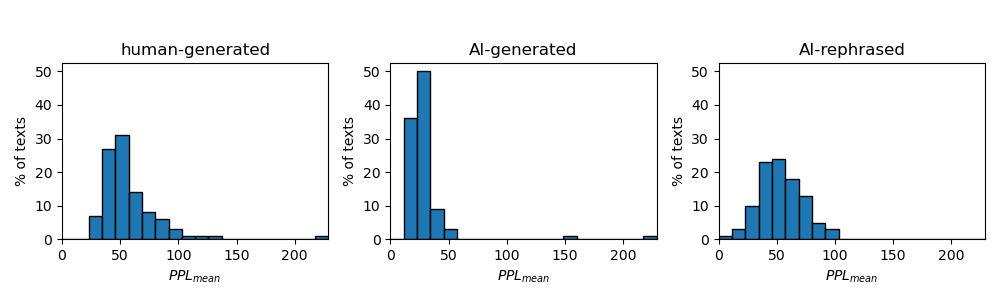
Experimental results
Research questions
- RQ1How effective are traditional and novel features in distinguishing between human- and AI-generated texts, especially under advanced prompting strategies?
- RQ2To what extent do features like list lookup, error-based metrics, and AI feedback improve detection performance beyond standard metrics like perplexity and burstiness?
- RQ3Can detection systems outperform existing tools like GPTZero, particularly in detecting AI-rephrased texts?
- RQ4How does the performance of detection models vary between basic and advanced text generation and rephrasing scenarios?
- RQ5What is the relative contribution of each feature category to overall classification performance?
Key findings
- The best system for detecting advanced AI-generated text achieved an F1-score of 96.9%, demonstrating high reliability in distinguishing complex AI outputs.
- For AI-rephrased texts, the best system achieved an F1-score of 81.7%, significantly outperforming GPTZero, which scored only 45.8% F1.
- The best basic text rephrasing detection system outperformed GPTZero by 183.8% in relative F1-score improvement.
- The inclusion of novel features—especially list lookup and AI feedback—substantially improved detection performance across all settings.
- Text vector and document-level features were among the most predictive, while error-based features showed moderate but consistent gains.
- System performance was robust across classifiers, with XGBoost, Random Forest, and MLP showing comparable results when using the full feature set.

Read this paper
Open the full text in the Nubint reader and ask about any passage as you read.
Read this paper on NubintThis review was generated by AI from the original paper. Please check the paper before citing it.