
[Paper Review] CLEAR: Cross-Transformers with Pre-trained Language Model is All you need for Person Attribute Recognition and Retrieval
CLEAR proposes a unified cross-transformer model with a pre-trained language model to jointly optimize person attribute recognition (PAR) and attribute-based person retrieval (AR). By leveraging pseudo-descriptions from query attributes and fine-tuning lightweight adapters, CLEAR achieves state-of-the-art performance on five benchmarks, significantly outperforming prior methods on Market-1501 for retrieval.
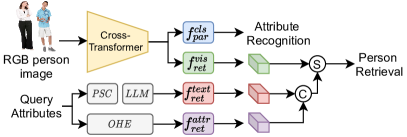
Person attribute recognition and attribute-based retrieval are two core human-centric tasks. In the recognition task, the challenge is specifying attributes depending on a person's appearance, while the retrieval task involves searching for matching persons based on attribute queries. There is a significant relationship between recognition and retrieval tasks. In this study, we demonstrate that if there is a sufficiently robust network to solve person attribute recognition, it can be adapted to facilitate better performance for the retrieval task. Another issue that needs addressing in the retrieval task is the modality gap between attribute queries and persons' images. Therefore, in this paper, we present CLEAR, a unified network designed to address both tasks. We introduce a robust cross-transformers network to handle person attribute recognition. Additionally, leveraging a pre-trained language model, we construct pseudo-descriptions for attribute queries and introduce an effective training strategy to train only a few additional parameters for adapters, facilitating the handling of the retrieval task. Finally, the unified CLEAR model is evaluated on five benchmarks: PETA, PA100K, Market-1501, RAPv2, and UPAR-2024. Without bells and whistles, CLEAR achieves state-of-the-art performance or competitive results for both tasks, significantly outperforming other competitors in terms of person retrieval performance on the widely-used Market-1501 dataset.
Motivation & Objective
- Address the modality gap between image and text queries in attribute-based person retrieval by generating natural language descriptions from discrete attributes.
- Unify person attribute recognition and retrieval into a single end-to-end model to improve generalization and reduce pipeline complexity.
- Leverage powerful pre-trained language models to generate high-quality, semantically rich embeddings for attribute queries without requiring large-scale paired text-image data.
- Develop a parameter-efficient adaptation strategy using lightweight adapters to fine-tune the vision-language model for retrieval, minimizing computational cost.
- Demonstrate that a strong PAR backbone can be effectively extended to retrieval with minimal architectural changes, achieving state-of-the-art performance across multiple benchmarks.
Proposed method
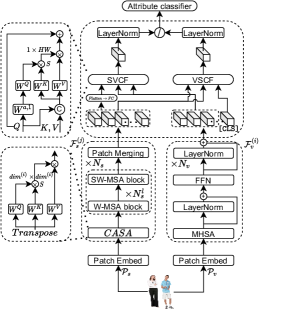
- Design a two-branch cross-transformer backbone inspired by Vision Transformer (ViT) and Swin Transformer, combining global and local self-attention mechanisms to capture long-range dependencies in person images.
- Introduce channel-aware self-attention to emphasize important feature dimensions based on spatial context, enhancing local feature representation.
- Implement a cross-fusion mechanism using attention to aggregate features from global and local branches, improving attribute recognition performance.
- Generate soft pseudo-descriptions from discrete attribute queries using a pre-trained GPT-based language model to create natural language prompts.
- Construct two types of query embeddings: hard (one-hot encoded binary attributes) and soft (contextual embeddings from pseudo-descriptions), and combine them for retrieval.
- Train a lightweight adapter head with margin learning to align image and text embeddings, enabling effective image-attribute matching with minimal additional parameters.
Experimental results
Research questions
- RQ1Can a unified model trained for person attribute recognition be effectively adapted to attribute-based person retrieval with minimal architectural changes?
- RQ2How effective is the use of pseudo-descriptions generated from attribute words in bridging the modality gap between image and text in person retrieval?
- RQ3What is the impact of combining hard (binary) and soft (natural language) query embeddings on retrieval performance?
- RQ4Can a pre-trained language model significantly improve the quality of attribute query embeddings without requiring large-scale text data?
- RQ5Does a robust cross-attention backbone that captures both local and global dependencies lead to superior performance in both recognition and retrieval tasks?
Key findings
- CLEAR achieves state-of-the-art performance on five benchmarks: PETA, PA100K, Market-1501, RAPv2, and UPAR-2024, with the highest mAP of 90.0% on UPAR-2024 dev-test and 87.9% on PA100K.
- On the widely used Market-1501 dataset, CLEAR achieves an mAP of 43.1% and R-1 of 56.8% in attribute-based retrieval, significantly outperforming prior methods.
- The ablation study shows that combining soft pseudo-descriptions (from GPT-based LLM) and hard binary attributes yields the best retrieval performance, with a 1.7% R-1 improvement on PA100K compared to hard-only queries.
- Using a larger embedding dimension (256) for the attribute encoder improves retrieval performance, achieving 55.9% R-1 and 43.0% mAP on Market-1501, compared to 52.1% R-1 and 38.2% mAP with 64-dim embeddings.
- The cross-fusion module combining global and local features improves PAR performance by 1.2% in mA on PA100K compared to the baseline ViT, with a 0.7% increase in mA when using channel-aware self-attention.
- t-SNE visualizations confirm that the proposed margin learning strategy with soft and hard queries leads to better separation of embedding spaces, especially for similar attributes like gender or clothing color.
Read this paper
Open the full text in the Nubint reader and ask about any passage as you read.
Read this paper on NubintThis review was generated by AI from the original paper. Please check the paper before citing it.