
[Paper Review] ClinicalGPT: Large Language Models Finetuned with Diverse Medical Data and Comprehensive Evaluation
ClinicalGPT is a medical-domain large language model finetuned with diverse real-world medical data and evaluated across medical conversation, examination, diagnosis, and QA tasks, outperforming several baselines.
Large language models have exhibited exceptional performance on various Natural Language Processing (NLP) tasks, leveraging techniques such as the pre-training, and instruction fine-tuning. Despite these advances, their effectiveness in medical applications is limited, due to challenges such as factual inaccuracies, reasoning abilities, and lack grounding in real-world experience. In this study, we present ClinicalGPT, a language model explicitly designed and optimized for clinical scenarios. By incorporating extensive and diverse real-world data, such as medical records, domain-specific knowledge, and multi-round dialogue consultations in the training process, ClinicalGPT is better prepared to handle multiple clinical task. Furthermore, we introduce a comprehensive evaluation framework that includes medical knowledge question-answering, medical exams, patient consultations, and diagnostic analysis of medical records. Our results demonstrate that ClinicalGPT significantly outperforms other models in these tasks, highlighting the effectiveness of our approach in adapting large language models to the critical domain of healthcare.
Motivation & Objective
- Motivate the need for medical-specialized LLMs due to factual accuracy and grounding challenges in generic models.
- Assemble extensive real-world medical data (records, KG knowledge, exams, dialogues) for targeted fine-tuning.
- Establish a comprehensive evaluation framework spanning conversation, exam, diagnosis, and QA tasks.
- Demonstrate parameter-efficient fine-tuning (LoRA) and RLHF-based optimization to boost clinical performance.
Proposed method
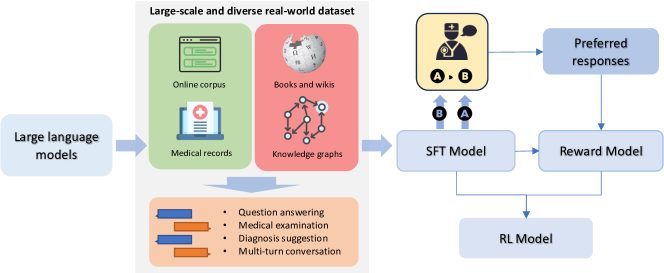
- Fine-tune BLOOM-7B using supervised instruction tuning on domain data and knowledge-graph derived QA pairs.
- Construct a reward model from human-ranked outputs to guide reinforcement learning.
- Apply reinforcement learning with Proximal Policy Optimization to align outputs with medical accuracy and usefulness while penalizing large policy changes (KL penalty).
- Use LoRA for parameter-efficient adaptation and Zero-2 memory optimizations to enable scalable training.
- Incorporate diverse medical datasets (cMedQA2, cMedQA-KG, MD-EHR, MEDQA-MCMLE, MedDialog) and convert medical records into text-generation tasks.
Experimental results
Research questions
- RQ1How does ClinicalGPT perform on medical conversation tasks compared to Open models?
- RQ2Can domain-specific data and reward-guided fine-tuning improve medical knowledge QA, exam accuracy, and diagnostic reasoning?
- RQ3What is the impact of parameter-efficient fine-tuning and RLHF on clinical reliability and safety?
Key findings
- In medical conversation, CLinicalGPT achieves BLEU-1 of 13.9, BLEU-2 3.7, BLEU-3 2.0, BLEU-4 1.2, GLEU 0.9, ROUGE-1 27.9, ROUGE-2 6.5, ROUGE-L 21.3.
- In medical examination (diagnosis task) across disease groups, ClinicalGPT attains an average accuracy of 37.6% in the reported table and an overall average of 80.9% across disease groups, outperforming other models like ChatGLM-6B, LLAMA-7B, and BLOOM-7B in Table 6.
- On medical QA evaluation against BLOOM-7B, LLAMA-7B, and ChatGLM-6B, ClinicalGPT wins 89.7%, 85.0%, and 67.2% of comparisons respectively (Wins vs BLOOM-7B, LLAMA-7B, and ChatGLM-6B).
- Average performance by disease group in diagnosis shows strongest results in Digestive (90.1%) and Urinary (89.9%), with Rheumatic immune highest at 47.4% among categories.
- The framework and results suggest substantial gains when fine-tuning LLMs with domain data and using RLHF with PPO for medical tasks.
- ClinicalGPT outperforms baseline models across several evaluation dimensions, highlighting the value of diverse medical data and targeted evaluation.
Read this paper
Open the full text in the Nubint reader and ask about any passage as you read.
Read this paper on NubintThis review was generated by AI from the original paper. Please check the paper before citing it.