
[Paper Review] CLIP-S$^4$: Language-Guided Self-Supervised Semantic Segmentation
CLIP-S⁴ proposes a self-supervised semantic segmentation framework that leverages CLIP's vision-language embeddings to learn high-quality, language-generalizable pixel representations without any human annotations. By enforcing embedding consistency with CLIP and semantic consistency over known and unknown classes, it achieves state-of-the-art performance in unsupervised and language-driven segmentation, especially in recognizing unknown classes.
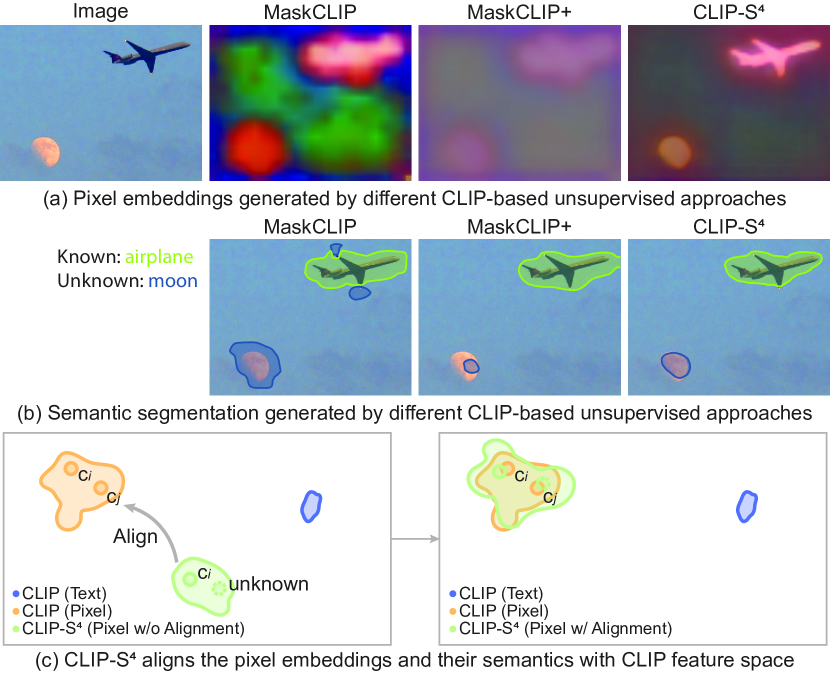
Existing semantic segmentation approaches are often limited by costly pixel-wise annotations and predefined classes. In this work, we present CLIP-S$^4$ that leverages self-supervised pixel representation learning and vision-language models to enable various semantic segmentation tasks (e.g., unsupervised, transfer learning, language-driven segmentation) without any human annotations and unknown class information. We first learn pixel embeddings with pixel-segment contrastive learning from different augmented views of images. To further improve the pixel embeddings and enable language-driven semantic segmentation, we design two types of consistency guided by vision-language models: 1) embedding consistency, aligning our pixel embeddings to the joint feature space of a pre-trained vision-language model, CLIP; and 2) semantic consistency, forcing our model to make the same predictions as CLIP over a set of carefully designed target classes with both known and unknown prototypes. Thus, CLIP-S$^4$ enables a new task of class-free semantic segmentation where no unknown class information is needed during training. As a result, our approach shows consistent and substantial performance improvement over four popular benchmarks compared with the state-of-the-art unsupervised and language-driven semantic segmentation methods. More importantly, our method outperforms these methods on unknown class recognition by a large margin.
Motivation & Objective
- Address the high cost and limitations of pixel-wise human annotations in semantic segmentation.
- Overcome the inability of existing methods to recognize unknown classes without prior class information.
- Enable language-driven semantic segmentation without training-time annotations or predefined class lists.
- Develop a class-free semantic segmentation setting where no class names are required during training.
- Improve pixel embedding quality and alignment with CLIP’s joint visual-textual embedding space through self-supervision and consistency regularization.
Proposed method
- Learn initial pixel embeddings via pixel-segment contrastive learning on augmented image views to group visually similar pixels.
- Enforce embedding consistency by minimizing the distance between model-generated pixel embeddings and CLIP’s joint image-text embeddings.
- Enforce semantic consistency by aligning model predictions with CLIP’s predictions over a set of target classes, including both known and unknown prototypes.
- Use top-activating segments from CLIP to generate class prototypes for both known and unknown classes during training.
- Train the segmentation head end-to-end using a combination of contrastive, embedding consistency, and semantic consistency losses.
- Support class-free semantic segmentation by training without any class names or annotations, relying solely on CLIP’s zero-shot capabilities.
Experimental results
Research questions
- RQ1Can self-supervised pixel representation learning be enhanced using vision-language model guidance to improve semantic segmentation without human annotations?
- RQ2To what extent can a model generalize to unknown classes in semantic segmentation when no class information is provided during training?
- RQ3How does enforcing consistency between model embeddings and CLIP’s joint embedding space affect segmentation performance and zero-shot generalization?
- RQ4What is the impact of using both known and unknown class prototypes in the semantic consistency loss on model robustness and generalization?
- RQ5Can a unified framework achieve state-of-the-art performance across unsupervised, transfer learning, and language-driven segmentation tasks without any supervision?
Key findings
- CLIP-S⁴ achieves a mean IoU of 72.2% on Pascal VOC for unsupervised semantic segmentation, outperforming prior unsupervised methods by over 1.9% in region similarity.
- On language-driven segmentation, CLIP-S⁴ achieves 33.6% mIoU on Pascal Context, surpassing MaskCLIP+ by 2.9% in mIoU and significantly improving unknown class recognition.
- The method maintains strong alignment with CLIP’s embeddings, achieving an average cosine similarity of 0.66 between its segment embeddings and CLIP’s, indicating effective cross-modal consistency.
- Ablation studies show that combining embedding consistency and semantic consistency losses yields the best performance (53.7% pAcc, 33.6% mIoU), outperforming individual losses.
- The model’s performance is robust to the number of unknown class prototypes, with mIoU varying by only 0.6% across 16 to 256 prototypes.
- Using top-32 to top-64 segments for prototype generation yields stable and high-quality embeddings, with cosine similarity to reference prototypes exceeding 0.99.

Read this paper
Open the full text in the Nubint reader and ask about any passage as you read.
Read this paper on NubintThis review was generated by AI from the original paper. Please check the paper before citing it.