
[Paper Review] Cloud Atlas: Navigating the Multiphase Landscape of Tempestuous Galactic Winds
This paper presents 3D magnetohydrodynamical simulations of supernova-driven galactic winds, demonstrating that turbulent radiative mixing layer theory successfully models the formation, morphology, and growth of cool clouds in multiphase outflows. Key results show that cloud size distributions follow a power law (dN/dm ∝ −2), and turbulent pressure provides significant support—matching observed cloud survival and growth rates in realistic, magnetized, turbulent winds.
Galaxies comprise intricate networks of interdependent processes which together govern their evolution. Central among these are the multiplicity of feedback channels, which remain incompletely understood. One outstanding problem is the understanding and modeling of the multiphase nature of galactic winds, which play a crucial role in galaxy formation and evolution. We present the results of three dimensional magnetohydrodynamical tall box interstellar medium patch simulations with clustered supernova driven outflows. Fragmentation of the interstellar medium during superbubble breakout seeds the resulting hot outflow with a population of cool clouds. We focus on analyzing and modeling the origin and properties of these clouds. Their presence induces large scale turbulence, which in turn leads to complex cloud morphologies. Cloud sizes are well described by a power law distribution and mass growth rates can be modelled using turbulent radiative mixing layer theory. Turbulence provides significant pressure support in the clouds, while magnetic fields only play a minor role. We conclude that many of the physical insights and analytic scalings derived from idealized small scale simulations translate well to larger scale, more realistic turbulent magnetized winds, thus paving a path towards their necessary yet challenging inclusion in global-scale galaxy models.
Motivation & Objective
- To understand the origin and evolution of cool, multiphase clouds in turbulent, magnetized galactic winds driven by clustered supernovae.
- To determine whether analytic scalings from idealized small-scale simulations of turbulent mixing layers can be applied to large-scale, realistic galactic wind environments.
- To develop physics-informed subgrid models for unresolved cool clouds in galaxy and cosmological simulations.
- To quantify the roles of turbulence, magnetic fields, and shear in cloud survival, morphology, and mass growth.
Proposed method
- Conducted three-dimensional magnetohydrodynamical (MHD) simulations of tall-box interstellar medium (ISM) patches with clustered supernova feedback.
- Tracked the dynamical fragmentation of the ISM during superbubble breakout as the primary source of cool cloud seeding in the hot outflow.
- Applied turbulent radiative mixing layer theory to model cloud mass growth rates, using the surface area-to-volume scaling (A_cl ∝ V^{5/6}) and inflow velocity (v_in).
- Quantified cloud morphology, size distribution, and survival using statistical analysis of simulation outputs and comparison to theoretical criteria like r_crit,shear.
- Assessed the role of turbulence by measuring turbulent Mach numbers in clouds and the hot wind, and evaluated non-thermal pressure support.
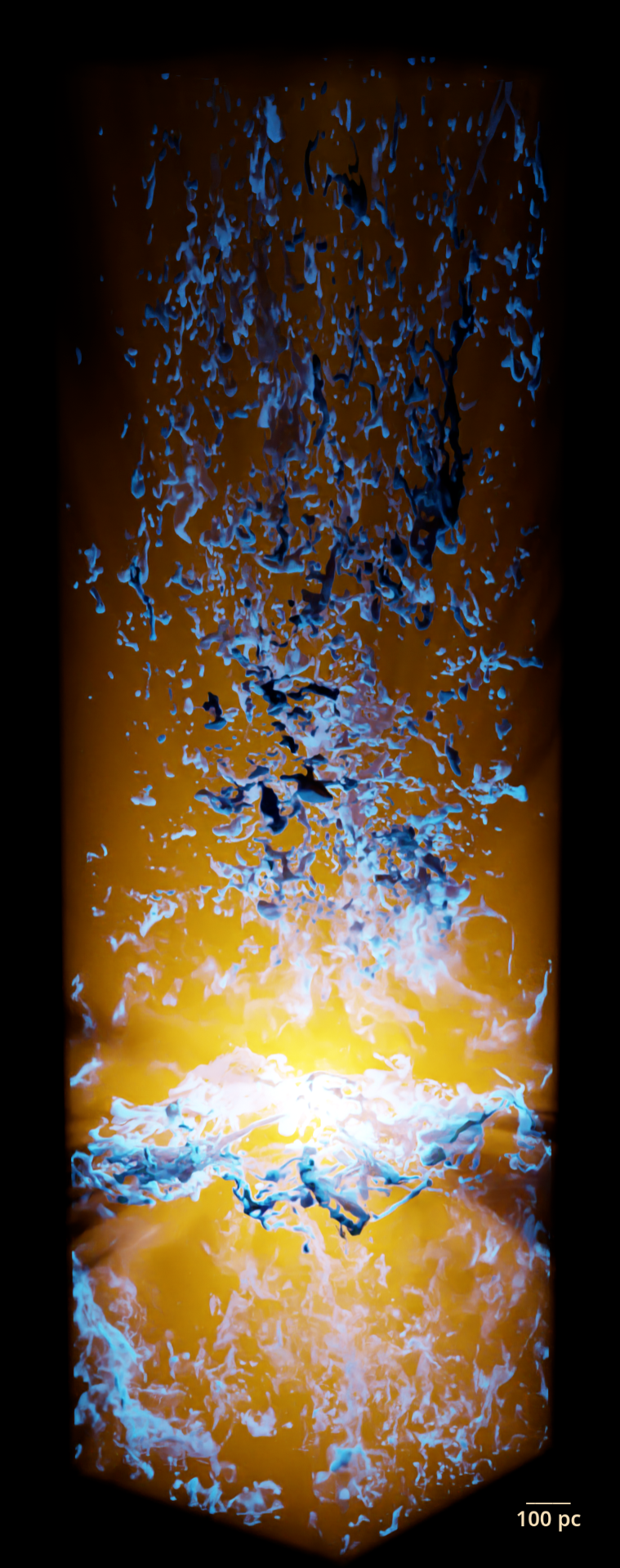
- Used yt, matplotlib, and numpy for data analysis and visualization, with Blender for 3D rendering of cloud structures.
Experimental results
Research questions
- RQ1How do cool clouds form and evolve in turbulent, magnetized galactic winds driven by clustered supernovae?
- RQ2To what extent do analytic scalings from idealized mixing layer models apply to large-scale, realistic multiphase outflows?
- RQ3What determines the size distribution and survival of cool clouds in turbulent galactic winds?
- RQ4How do turbulence, magnetic fields, and shear contribute to cloud morphological complexity and mass growth?
- RQ5What is the relative importance of thermal versus turbulent pressure in supporting cool clouds against gravitational and ram pressure forces?
Key findings
- Cool clouds form via dynamical fragmentation of the ISM during superbubble breakout, seeding the hot outflow with a population of multiphase structures.
- Cloud sizes follow a power-law distribution with dN/dm ∝ −2, consistent across simulations with and without magnetic fields, and consistent with cloud survival radius and disc scale height as physical cutoffs.
- Turbulent Mach number inside clouds is ∼1, indicating that turbulent pressure provides comparable support to thermal pressure, despite initial ISM having β ∼ 1.
- Cloud survival is governed by the condition t_cool,mix < t_shear, with the critical radius r_crit,shear matching the observed survival threshold.
- Mass growth rates are well predicted by turbulent radiative mixing layer theory, with model-predicted scalings and estimated ṁ matching simulation outputs.
- Post-entrainment, turbulence is sustained by cooling or cooling-induced pulsations rather than shear, and the KHI is not the dominant driver of mixing.
Read this paper
Open the full text in the Nubint reader and ask about any passage as you read.
Read this paper on NubintThis review was generated by AI from the original paper. Please check the paper before citing it.