
[Paper Review] CLUSTSEG: Clustering for Universal Segmentation
ClustSeg presents a transformer-based universal segmentation framework that reframes segmentation as iterative clustering, using task-specific, nonparametric, recurrent cross-attention to handle superpixel, semantic, instance, and panoptic segmentation within a single architecture.
We present CLUSTSEG, a general, transformer-based framework that tackles different image segmentation tasks (i.e., superpixel, semantic, instance, and panoptic) through a unified neural clustering scheme. Regarding queries as cluster centers, CLUSTSEG is innovative in two aspects:1) cluster centers are initialized in heterogeneous ways so as to pointedly address task-specific demands (e.g., instance- or category-level distinctiveness), yet without modifying the architecture; and 2) pixel-cluster assignment, formalized in a cross-attention fashion, is alternated with cluster center update, yet without learning additional parameters. These innovations closely link CLUSTSEG to EM clustering and make it a transparent and powerful framework that yields superior results across the above segmentation tasks.
Motivation & Objective
- Motivate a universal segmentation framework that can handle multiple segmentation paradigms without task-specific architectures.
- Recast segmentation as a clustering problem to unify disparate segmentation tasks.
- Introduce a task-aware initialization (Dreamy-Start) to seed cluster centers according to the task.
- Develop a nonparametric, recurrent cross-attention mechanism to perform iterative EM-like clustering.
- Demonstrate superior performance across core segmentation benchmarks.
Proposed method
- Treat queries as cluster centers and initialize them with task-aware semantics: class-centered seeds for semantic/stuff; image-derived seeds for instance/thing; grid-based seeds for superpixels.
- Adopt an EM-inspired iterative scheme where cross-attention updates cluster memberships (E-step) and centers (M-step) without adding learnable parameters.
- Implement Recurrent Cross-Attention to perform multiple EM-like iterations efficiently (complexity O(TKHW D) versus O(HW D) for naive cross-attention).
- Use a memory-bank–assisted Dreamy-Start for semantic initialization to encode global class statistics; use image-context–adaptive seeds for instance segmentation; use grid-based seeds for superpixel segmentation.
- Leverage a hierarchy of RCross_Attention decoders to refine clustering across resolutions and tasks.
Experimental results
Research questions
- RQ1Can a single transformer-based framework unify superpixel, semantic, instance, and panoptic segmentation by formulating segmentation as clustering?
- RQ2How should cluster centers be initialized to respect task-specific semantics (semantic vs. instance vs. superpixel) without changing architecture?
- RQ3Can an EM-inspired, nonparametric, recurrent cross-attention strategy efficiently converge to high-quality segmentations across tasks?
- RQ4What is the impact of Dreamy-Start initialization on segmentation performance across benchmarks?
- RQ5How does ClustSeg perform relative to task-specific and other universal segmentation models on standard datasets?
Key findings
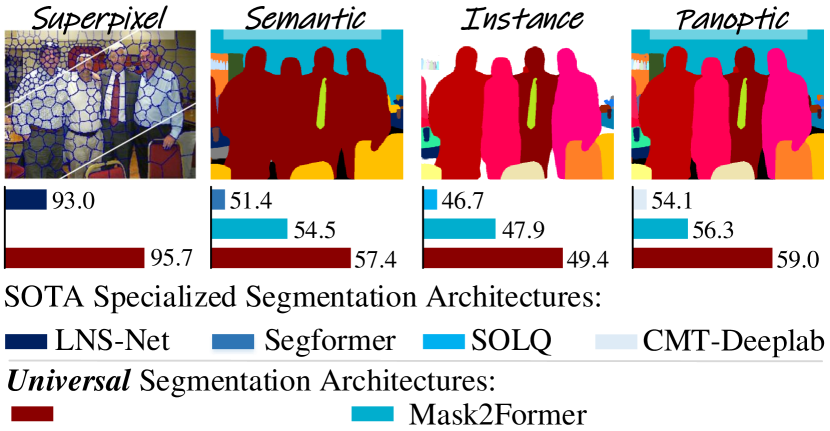
- ClustSeg achieves high segmentation performance across four core tasks, including 59.0 PQ on COCO panoptic segmentation, 49.1 AP on COCO instance segmentation, 57.4 mIoU on ADE20K semantic segmentation, and top ASA/CO on BSDS500 superpixel segmentation.
- Introduces task-aware query initialization (Dreamy-Start) that provides informative clustering seeds for different tasks without architectural changes.
- Presents a nonparametric recurrent cross-attention module that emulates EM clustering with iterative E- and M-steps, improving clustering quality without adding learnable parameters.
- Demonstrates that clustering-based segmentation within a unified transformer framework can outperform specialized and prior universal models on key benchmarks.
- Shows that the ClustSeg design yields strong results on Panoptic COCO (PQ and AP metrics) and semantic/instance/panoptic quality measures across established datasets.

Read this paper
Open the full text in the Nubint reader and ask about any passage as you read.
Read this paper on NubintThis review was generated by AI from the original paper. Please check the paper before citing it.