
[Paper Review] CMB: A Comprehensive Medical Benchmark in Chinese
This paper introduces CMB, a comprehensive medical benchmark in Chinese designed for evaluating large language models (LLMs) within China's unique linguistic and cultural medical context. Built on authentic Chinese medical qualification exams and real clinical cases, CMB evaluates both knowledge recall (CMB-Exam) and clinical reasoning (CMB-Clin), demonstrating strong alignment between automatic (GPT-4) and expert evaluations, with a Spearman correlation of 0.93.
Large Language Models (LLMs) provide a possibility to make a great breakthrough in medicine. The establishment of a standardized medical benchmark becomes a fundamental cornerstone to measure progression. However, medical environments in different regions have their local characteristics, e.g., the ubiquity and significance of traditional Chinese medicine within China. Therefore, merely translating English-based medical evaluation may result in extit{contextual incongruities} to a local region. To solve the issue, we propose a localized medical benchmark called CMB, a Comprehensive Medical Benchmark in Chinese, designed and rooted entirely within the native Chinese linguistic and cultural framework. While traditional Chinese medicine is integral to this evaluation, it does not constitute its entirety. Using this benchmark, we have evaluated several prominent large-scale LLMs, including ChatGPT, GPT-4, dedicated Chinese LLMs, and LLMs specialized in the medical domain. We hope this benchmark provide first-hand experience in existing LLMs for medicine and also facilitate the widespread adoption and enhancement of medical LLMs within China. Our data and code are publicly available at https://github.com/FreedomIntelligence/CMB.
Motivation & Objective
- To address the limitations of English-centric medical benchmarks in evaluating LLMs within China’s unique medical context.
- To create a standardized, culturally grounded evaluation framework that reflects China’s medical education and practice, including traditional Chinese medicine.
- To provide a self-assessment tool for LLMs rather than a competitive leaderboard, enabling continuous model improvement in medical applications.
- To ensure evaluation rigor by using authentic medical qualification exam data with objective ground truth and a 60% benchmark for expert-level performance.
- To validate the reliability of automatic evaluation using GPT-4 by comparing it with expert human judgments on clinical reasoning tasks.
Proposed method
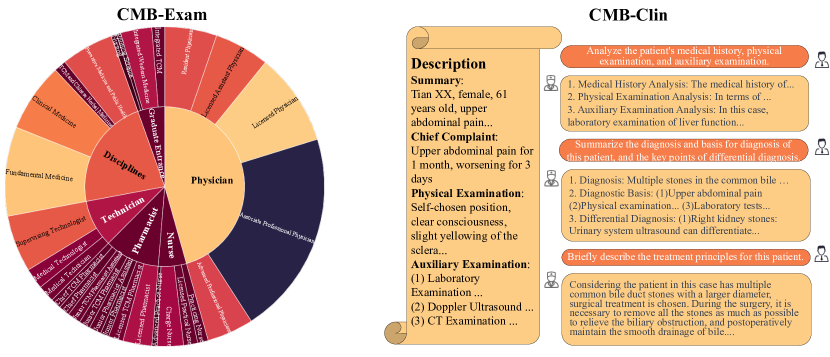
- CMB is constructed from real Chinese medical qualification examination questions spanning all medical professions: physicians, nurses, medical technicians, and pharmacists.
- CMB-Exam consists of multiple-choice questions with 4–6 options and one or more correct answers, derived from official exams ranging from undergraduate to advanced professional titles.
- CMB-Clin comprises complex, multi-turn clinical case studies requiring synthesis of medical knowledge and reasoning, with answers validated by expert consensus.
- The benchmark uses publicly available, anonymized exam data with explicit permission from the Chinese Medical Question Database to ensure ethical compliance and data privacy.
- Automatic evaluation is performed using GPT-4 to score model responses on relevance, completeness, fluency, and proficiency, compared against expert human annotations.
- Statistical validation includes Spearman correlation between GPT-4 and expert rankings (0.93) and analysis of decoding hyperparameters like temperature on performance stability.
Experimental results
Research questions
- RQ1How well do leading LLMs perform on a comprehensive, culturally and linguistically localized medical benchmark in Chinese?
- RQ2To what extent does automatic evaluation using GPT-4 align with expert human evaluation on clinical reasoning tasks in Chinese medicine?
- RQ3Can performance on knowledge-intensive multiple-choice questions (CMB-Exam) predict performance on complex clinical reasoning tasks (CMB-Clin)?
- RQ4How robust are model rankings to changes in decoding temperature during inference?
- RQ5What is the impact of fine-tuning on CMB-Exam data on a model’s ability to generalize to clinical case-based reasoning?
Key findings
- GPT-4, ChatGPT, and Baichuan-13B-chat achieved the highest performance on CMB-Clin, with an average score of 3.45, 3.40, and 3.74 respectively, significantly outperforming other models by at least 7.4% in relevance, completeness, and proficiency.
- The Spearman correlation between GPT-4 evaluation and expert human evaluation on CMB-Clin was 0.93, indicating strong alignment and high reliability of automatic evaluation.
- The correlation between model rankings on CMB-Exam and CMB-Clin was 0.89 (p-value = 2.3e-4), suggesting consistent model performance across knowledge recall and reasoning tasks.
- Performance on CMB-Clin declined with increasing decoding temperature, with the highest scores at temperature 0, indicating that deterministic outputs are preferred in medical contexts.
- Pairwise Spearman correlations between model rankings at different temperatures remained above 0.87, showing that model rankings are robust to hyperparameter changes.
- Models like MedicalGPT, DoctorGLM, Bentsao, and ChatGLM-Med showed unsatisfactory results, indicating potential deficiencies in medical knowledge or reasoning capabilities despite fluency.
Read this paper
Open the full text in the Nubint reader and ask about any passage as you read.
Read this paper on NubintThis review was generated by AI from the original paper. Please check the paper before citing it.