
[Paper Review] CMOS + stochastic nanomagnets: heterogeneous computers for probabilistic inference and learning
The paper demonstrates a CMOS + sMTJ heterogeneous computer that uses stochastic MTJ p-bits to drive an FPGA, enabling probabilistic inference and Boltzmann learning with significantly lower energy and area than digital CMOS p-bits.
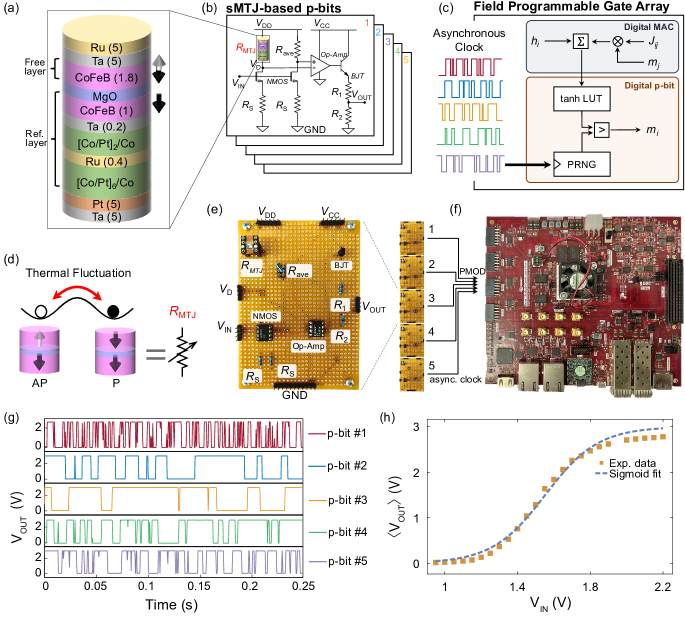
Extending Moore's law by augmenting complementary-metal-oxide semiconductor (CMOS) transistors with emerging nanotechnologies (X) has become increasingly important. One important class of problems involve sampling-based Monte Carlo algorithms used in probabilistic machine learning, optimization, and quantum simulation. Here, we combine stochastic magnetic tunnel junction (sMTJ)-based probabilistic bits (p-bits) with Field Programmable Gate Arrays (FPGA) to create an energy-efficient CMOS + X (X = sMTJ) prototype. This setup shows how asynchronously driven CMOS circuits controlled by sMTJs can perform probabilistic inference and learning by leveraging the algorithmic update-order-invariance of Gibbs sampling. We show how the stochasticity of sMTJs can augment low-quality random number generators (RNG). Detailed transistor-level comparisons reveal that sMTJ-based p-bits can replace up to 10,000 CMOS transistors while dissipating two orders of magnitude less energy. Integrated versions of our approach can advance probabilistic computing involving deep Boltzmann machines and other energy-based learning algorithms with extremely high throughput and energy efficiency.
Motivation & Objective
- Motivate CMOS + X architectures to accelerate Monte Carlo-based probabilistic computing.
- Demonstrate integration of sMTJ-based p-bits with an FPGA to inject true randomness.
- Evaluate probabilistic inference and deep Boltzmann learning on a heterogeneous p-computer.
- Benchmark energy and transistor counts against digital CMOS p-bits using a 7-nm CMOS process.
- Show scalability potential for probabilistic computing with asynchronous, true randomness.
Proposed method
- Fabricate and characterize sMTJ-based p-bits with low-barrier nanomagnets and integrate them as asynchronous clocks for an FPGA-based digital p-bit array.
- Design a new p-bit circuit that converts sMTJ fluctuations into voltages to drive digital p-bits via an operational amplifier.
- Implement digital p-bits in FPGA with LUT-based tanh activation, PRNGs, and comparators, where PRNG clocks are driven by sMTJ randomness.
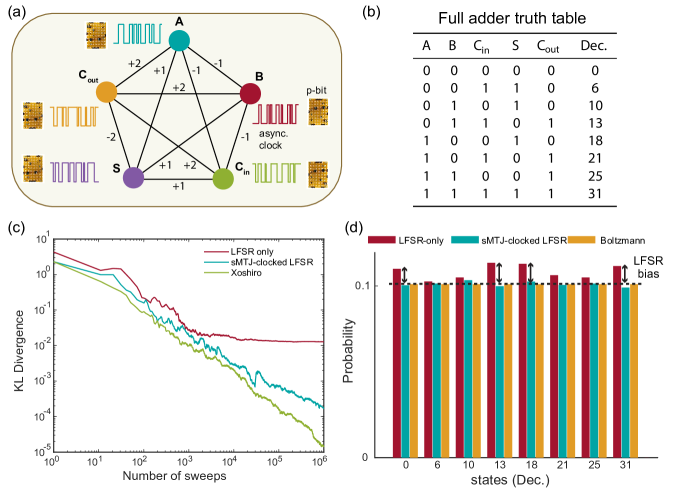
- Evaluate probabilistic inference on a probabilistic full adder by comparing LFSR, sMTJ-clocked LFSR, and Xoshiro RNGs using KL divergence from Boltzmann distribution.
- Train a 32-node Chimera deep Boltzmann machine using the heterogeneous system and compare learning performance against digital RNG baselines.
Experimental results
Research questions
- RQ1Can sMTJ-based p-bits provide high-quality randomness to drive FPGA-based digital p-bits for probabilistic inference and learning?
- RQ2How does the quality of randomness from different PRNGs affect sampling accuracy and Boltzmann learning in a heterogeneous CMOS + sMTJ system?
- RQ3What are the energy, area, and throughput advantages of CMOS + sMTJ p-bits over purely digital CMOS p-bits?
- RQ4Is it feasible to train deep Boltzmann machines using an asynchronous, heterogeneous p-computer with scalable performance?
- RQ5What is the impact of device-to-device variations in sMTJs on inference and learning tasks?
Key findings
- sMTJ-based p-bits provide true randomness that enables accurate probabilistic inference and Boltzmann learning despite sMTJ variations.
- Compared to digital CMOS p-bits, sMTJ-based p-bits replace about 10,000 transistors and dissipate two orders of magnitude less energy per random bit (2 fJ) in the benchmarking.
- LFSR-based RNGs underperform for inference and learning; sMTJ-clocked LFSRs and Xoshiro RNGs match Boltzmann distributions more closely in FA sampling and DBM training.
- Asynchronous sMTJ clocks coupled with FPGA p-bits enable high-quality sampling and scalable training of deep Boltzmann machines.
- Energy and transistor-count benchmarking using ASAP7 7-nm PDK reveal substantial hardware efficiency gains for CMOS + sMTJ over fully digital p-bits.
Read this paper
Open the full text in the Nubint reader and ask about any passage as you read.
Read this paper on NubintThis review was generated by AI from the original paper. Please check the paper before citing it.