
[Paper Review] Coarse to Fine: Multi-label Image Classification with Global/Local Attention
This paper proposes a coarse-to-fine multi-label image classification model using global and local attention mechanisms to mimic human visual perception, first attending to the whole image and then focusing on specific objects. It further introduces a joint max-margin objective that improves performance, achieving state-of-the-art results on Pascal VOC 2007 (85.6% mAP) and MS-COCO (64.64% mAP).
In our daily life, the scenes around us are always with multiple labels especially in a smart city, i.e., recognizing the information of city operation to response and control. Great efforts have been made by using Deep Neural Networks to recognize multi-label images. Since multi-label image classification is very complicated, people seek to use the attention mechanism to guide the classification process. However, conventional attention-based methods always analyzed images directly and aggressively. It is difficult for them to well understand complicated scenes. In this paper, we propose a global/local attention method that can recognize an image from coarse to fine by mimicking how human-beings observe images. Specifically, our global/local attention method first concentrates on the whole image, and then focuses on local specific objects in the image. We also propose a joint max-margin objective function, which enforces that the minimum score of positive labels should be larger than the maximum score of negative labels horizontally and vertically. This function can further improve our multi-label image classification method. We evaluate the effectiveness of our method on two popular multi-label image datasets (i.e., Pascal VOC and MS-COCO). Our experimental results show that our method outperforms state-of-the-art methods.
Motivation & Objective
- To address the challenge of complex scene understanding in multi-label image classification by mimicking human visual attention.
- To reduce the influence of irrelevant or noisy background features by introducing structured attention mechanisms.
- To improve label prediction performance by modeling both global scene context and local object-specific features.
- To enhance discrimination between positive and negative labels through a novel joint max-margin objective function.
- To validate the effectiveness of the proposed method on standard multi-label benchmarks, Pascal VOC and MS-COCO.
Proposed method
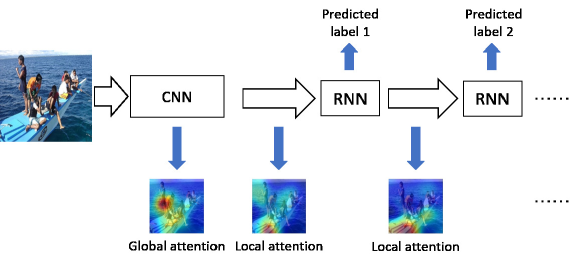
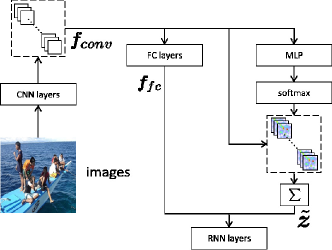
- Uses a CNN encoder (VGG-16) to extract image features from the final convolutional layer.
- Generates global attention from the final feature map to represent a coarse overview of the image.
- Applies an RNN decoder with local attention at each decoding step to focus on specific image regions for individual label prediction.
- Introduces a joint max-margin objective function that enforces a margin between positive and negative label scores in both horizontal and vertical directions.
- Optimizes the model using a combination of cross-entropy loss and the max-margin regularizer with hyperparameters λ₁ = 5×10⁻² and λ₂ = 5×10⁻².
- Visualizes attention maps by upscaling and applying Gaussian filtering to interpret model attention dynamics over training epochs.
Experimental results
Research questions
- RQ1Can a coarse-to-fine attention mechanism improve multi-label image classification by better modeling scene context and object-specific features?
- RQ2How does the integration of global and local attention improve performance compared to models using only global or local attention?
- RQ3To what extent does the joint max-margin objective function enhance discrimination between positive and negative labels in multi-label settings?
- RQ4How do attention maps evolve during training, and do they reflect human-like visual scanning behavior?
- RQ5Does the proposed method achieve state-of-the-art performance on benchmark multi-label datasets like Pascal VOC and MS-COCO?
Key findings
- The proposed method achieved 85.6% mAP on Pascal VOC 2007, outperforming all compared state-of-the-art methods including HCP-2000C, which required additional 2000 classes for training.
- Adding global attention to the local attention model (VGG+LSTM+L/G) improved mAP from 85.2% to 85.4%, demonstrating the benefit of scene-level context.
- The joint max-margin objective (VGG+LSTM+L/G+MM) further boosted performance to 85.6% mAP, confirming its effectiveness in improving label discrimination.
- On MS-COCO, the model achieved 64.64% mAP, surpassing the VGG+LSTM+L/G baseline of 64.07% and outperforming other methods across most metrics including top-3 and top-5 performance.
- Visualization results confirmed that attention evolves from global (broad image coverage) to local (focused on specific objects), mirroring human visual attention patterns.
- The performance drop in VGG+LSTM compared to VGG alone suggests that RNN-based decoding without attention may introduce noise or degrade performance on large, label-dense datasets like MS-COCO.
Read this paper
Open the full text in the Nubint reader and ask about any passage as you read.
Read this paper on NubintThis review was generated by AI from the original paper. Please check the paper before citing it.