
[Paper Review] Cobra: Extending Mamba to Multi-Modal Large Language Model for Efficient Inference
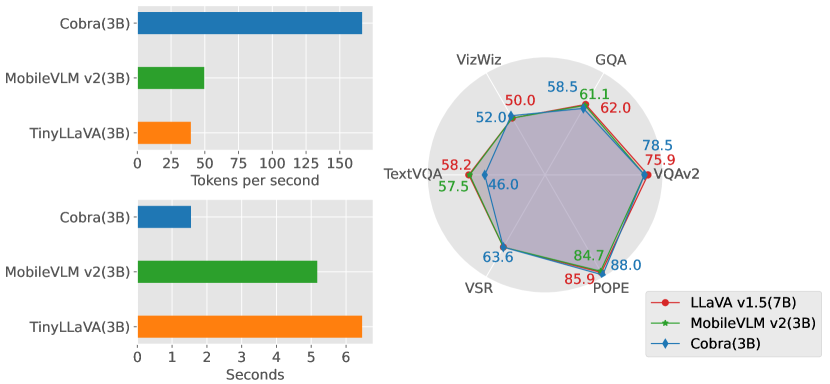
Cobra builds a multimodal LLM by integrating the linear-time Mamba state space model with a vision encoder, achieving competitive accuracy while delivering 3–4x faster inference than Transformer-based baselines and using about 43% of the parameters of larger models.
In recent years, the application of multimodal large language models (MLLM) in various fields has achieved remarkable success. However, as the foundation model for many downstream tasks, current MLLMs are composed of the well-known Transformer network, which has a less efficient quadratic computation complexity. To improve the efficiency of such basic models, we propose Cobra, a linear computational complexity MLLM. Specifically, Cobra integrates the efficient Mamba language model into the visual modality. Moreover, we explore and study various modal fusion schemes to create an effective multi-modal Mamba. Extensive experiments demonstrate that (1) Cobra achieves extremely competitive performance with current computationally efficient state-of-the-art methods, e.g., LLaVA-Phi, TinyLLaVA, and MobileVLM v2, and has faster speed due to Cobra's linear sequential modeling. (2) Interestingly, the results of closed-set challenging prediction benchmarks show that Cobra performs well in overcoming visual illusions and spatial relationship judgments. (3) Notably, Cobra even achieves comparable performance to LLaVA with about 43% of the number of parameters. We will make all codes of Cobra open-source and hope that the proposed method can facilitate future research on complexity problems in MLLM. Our project page is available at: https://sites.google.com/view/cobravlm.
Motivation & Objective
- Motivate efficiency limitations of Transformer-based MLLMs due to quadratic complexity.
- Propose a Cobra architecture that uses a linear-time state space model (Mamba) for multimodal processing.
- Investigate modal fusion schemes to effectively integrate visual and linguistic information.
- Demonstrate Cobra’s competitive performance and superior speed on standard VLM benchmarks.
- Showcase potential reductions in parameter count while maintaining performance.
Proposed method
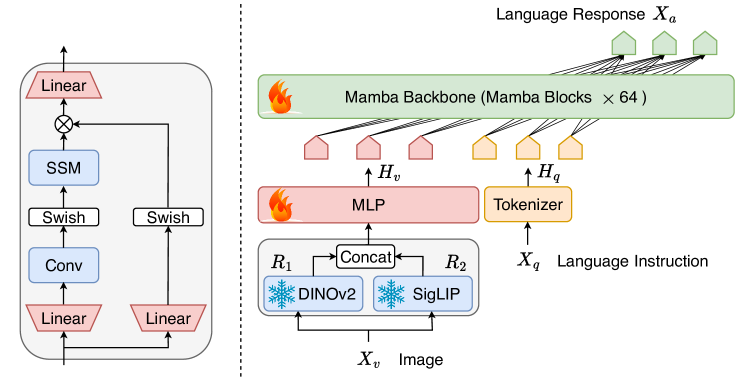
- Use a vision encoder stack (DINOv2 + SigLIP) to extract visual representations from images.
- Introduce a projector module to align visual tokens to the Mamba token space (MLP or alternative).
- Adopt Mamba as the backbone with 64 blocks to process concatenated visual and text embeddings autoregressively.
- Fuse visual and linguistic modalities within Mamba using exploration of different fusion schemes to optimize multimodal representations.
- Train end-to-end by fine-tuning the entire LLM backbone and projector over ~1.2M image-text samples across multiple datasets in two epochs.
Experimental results
Research questions
- RQ1Can a linear-time state-space model (Mamba) effectively support multimodal large language modeling when paired with visual encoders?
- RQ2Which vision encoders and projection strategies best preserve visual information for accurate multimodal reasoning within Cobra?
- RQ3How does Cobra perform in open-ended VQA and closed-set spatial/hallucination benchmarks relative to Transformer-based peers at similar parameter budgets?
- RQ4What are the gains in inference speed and memory usage when adopting a state-space backbone for MLLMs compared to Transformer baselines?
Key findings
- Cobra achieves competitive performance with efficient state-of-the-art methods (e.g., LLaVA-Phi, TinyLLaVA, MobileVLM v2) while benefiting from linear sequential modeling.
- Cobra demonstrates strong robustness on closed-set tasks involving spatial relation judgments and reducing visual hallucinations.
- Cobra with about 43% of the parameters of LLaVA v1.5 7B attains comparable performance on several benchmarks, highlighting efficiency benefits.
- Inference speed is significantly faster for Cobra (e.g., 3×–4× faster than MobileVLM v2 and TinyLLaVA at similar sizes).
- Ablation indicates that combining DINOv2 with SigLIP improves results, and finetuning the chat-tuned Mamba model yields better instruction-following performance.
Read this paper
Open the full text in the Nubint reader and ask about any passage as you read.
Read this paper on NubintThis review was generated by AI from the original paper. Please check the paper before citing it.