
[Paper Review] CoCo: A Coupled Contrastive Framework for Unsupervised Domain Adaptive Graph Classification
CoCo introduces a dual-branch framework (GCN and hierarchical graph kernel network) with coupled and cross-domain contrastive learning to enable unsupervised domain adaptive graph classification. It demonstrates improved transfer across diverse graph datasets.
Although graph neural networks (GNNs) have achieved impressive achievements in graph classification, they often need abundant task-specific labels, which could be extensively costly to acquire. A credible solution is to explore additional labeled graphs to enhance unsupervised learning on the target domain. However, how to apply GNNs to domain adaptation remains unsolved owing to the insufficient exploration of graph topology and the significant domain discrepancy. In this paper, we propose Coupled Contrastive Graph Representation Learning (CoCo), which extracts the topological information from coupled learning branches and reduces the domain discrepancy with coupled contrastive learning. CoCo contains a graph convolutional network branch and a hierarchical graph kernel network branch, which explore graph topology in implicit and explicit manners. Besides, we incorporate coupled branches into a holistic multi-view contrastive learning framework, which not only incorporates graph representations learned from complementary views for enhanced understanding, but also encourages the similarity between cross-domain example pairs with the same semantics for domain alignment. Extensive experiments on popular datasets show that our CoCo outperforms these competing baselines in different settings generally.
Motivation & Objective
- Motivate unsupervised domain adaptation for graph classification where target labels are scarce or absent.
- Propose a dual-branch architecture to capture both implicit and explicit graph topological information.
- Develop a multi-view contrastive learning framework to align representations across branches and domains.
- Validate the approach on standard graph classification benchmarks and analyze ablations.
Proposed method
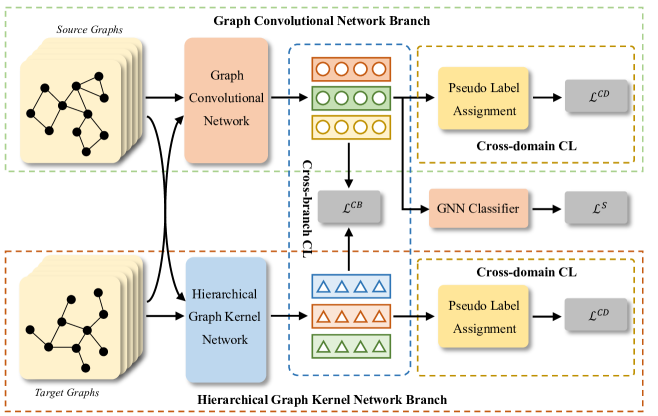
- Two coupled branches: a Graph Convolutional Network (GCN) branch for implicit topology learning.
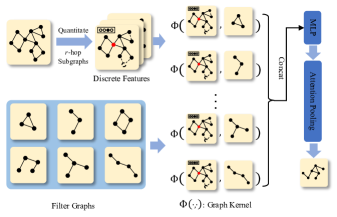
- A Hierarchical Graph Kernel Network (HGKN) branch that uses learnable graph filters and a graph kernel to explicitly capture topology.
- Cross-branch contrastive learning to align representations from GCN and HGKN for each graph.
- Cross-domain contrastive learning with pseudo-labels to reduce domain discrepancy via EM-like log-likelihood framing.
- An overall objective combining cross-branch, cross-domain, and supervised losses.
- Implementation uses two-layer GIN in the GCN branch and WL kernel-based HGKN with trainable filters and quantization to enable end-to-end learning.
Experimental results
Research questions
- RQ1How to effectively extract and leverage graph topological information under limited labeled data?
- RQ2Can coupling implicit (GCN) and explicit (HGKN) topology representations improve graph classification under domain shift?
- RQ3Can cross-domain contrastive learning, guided by pseudo-labels, align source and target graphs semantically to improve domain adaptation?
- RQ4Is the proposed EM-based perspective valid for the cross-domain contrastive objective and improves domain alignment?
Key findings
- CoCo outperforms a broad set of baselines (including GCN, WL subtree, various DA methods) across multiple transfer tasks and datasets.
- Cross-branch contrastive learning improves graph representations by combining complementary topology views.
- Cross-domain contrastive learning reduces domain discrepancy by pulling same-semantics cross-domain pairs closer using pseudo-labels.
- Ablation studies show removing cross-branch or cross-domain contrastive components degrades performance, highlighting their importance.
- The framework achieves notable average improvements on benchmarks such as Mutagenicity, with results indicating robust domain adaptation capability.
Read this paper
Open the full text in the Nubint reader and ask about any passage as you read.
Read this paper on NubintThis review was generated by AI from the original paper. Please check the paper before citing it.