
[Paper Review] CODATA Recommended Values of the Fundamental Physical Constants: 2022
This paper presents the 2022 self-consistent CODATA values of fundamental physical constants obtained from a least-squares adjustment using data through 31 December 2022, and discusses major improvements and data inconsistencies.
We report the 2022 self-consistent values of constants and conversion factors of physics and chemistry recommended by the Committee on Data of the International Science Council (CODATA). The recommended values can also be found at physics.nist.gov/constants. The values are based on a least-squares adjustment that takes into account all theoretical and experimental data available through 31 December 2022. A discussion of the major improvements as well as inconsistencies within the data is given.
Motivation & Objective
- Provide a self-consistent set of fundamental physical constants and conversion factors for physics and chemistry.
- Perform a least-squares adjustment incorporating theoretical and experimental data through 31 December 2022.
- Identify major improvements and data inconsistencies that affect the 2022 recommended values.
- Explain the treatment of muonic and electronic transition data and their impact on derived constants.
- Compare the 2022 results with the 2018 adjustment and discuss implications for metrology and theory.
Proposed method
- Use a least-squares adjustment (LSA) of 133 input data and 79 adjusted constants (ν = 54).
- Incorporate a wide range of input data including relative atomic masses, ionization/binding energies, hydrogen/deuterium transition energies, muonic atoms, electron magnetic-moment anomaly, and electroweak quantities.
- Apply uncertainty expansion factors to achieve an acceptable χ² and data consistency (1.7× for Tables 11,12 and D1–D6 with factors 2.5).
- Treat data from AMDC, NIST ASD, and other sources with updated theory and correlations as input to the adjustment.
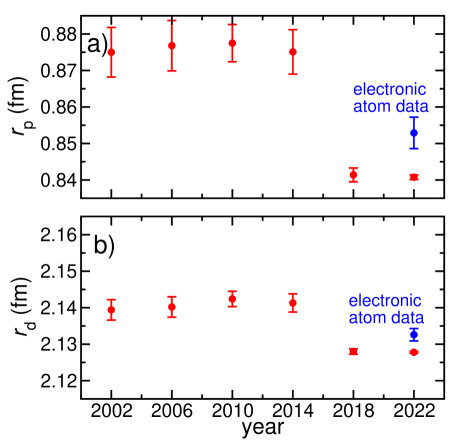
- Discuss the role of muonic Lamb-shift data in radii determinations and the proton radius puzzle.
- Report the 2022 CODATA values and their comparison to the 2018 adjustment, including the effect of the revised SI and theory improvements.
Experimental results
Research questions
- RQ1What are the self-consistent 2022 CODATA recommended values of fundamental constants and conversion factors?
- RQ2How do new experimental and theoretical data up to 31 December 2022 influence the adjusted constants compared with the 2018 adjustment?
- RQ3What are the major improvements and inconsistencies identified in the 2022 adjustment, and how do they affect uncertainty and central values?
- RQ4What is the status of key issues such as the proton radius puzzle and the muon magnetic-moment anomaly in the 2022 adjustment?
Key findings
- The 2022 adjustment uses 133 input data and 79 adjusted constants (ν = 54).
- The initial χ² = 109.6 is reduced to χ² = 44.2 after applying expansion factors, yielding a 83% probability of the χ² value by chance for ν = 54.
- An updated electron magnetic-moment anomaly input and related theory reduce the uncertainty in the fine-structure constant α from multiple independent determinations.
- The muon magnetic-moment anomaly shows a 4.2σ discrepancy between experiment and theory, with recent FNAL results influencing the adjustment.
- There is a persistent proton radius puzzle, as muonic-Lamb-shift radii and electronic transition data yield differing central values within uncertainties.
- The Newtonian constant of gravitation G remains unchanged from the 2018 adjustment, reflecting no new data affecting G in this period.
Better researchstarts right now
From reading papers to final review, dramatically reduce your research time.
No credit card · Free plan available
This review was created by AI and reviewed by human editors.