
[Paper Review] Code Generation with AlphaCodium: From Prompt Engineering to Flow Engineering
AlphaCodium is a code-focused, test-driven multi-stage flow that iteratively generates and fixes code against input-output tests, significantly boosting code-generation performance on CodeContests across models (e.g., GPT-4 validation pass@5 from 19% to 44%).
Code generation problems differ from common natural language problems - they require matching the exact syntax of the target language, identifying happy paths and edge cases, paying attention to numerous small details in the problem spec, and addressing other code-specific issues and requirements. Hence, many of the optimizations and tricks that have been successful in natural language generation may not be effective for code tasks. In this work, we propose a new approach to code generation by LLMs, which we call AlphaCodium - a test-based, multi-stage, code-oriented iterative flow, that improves the performances of LLMs on code problems. We tested AlphaCodium on a challenging code generation dataset called CodeContests, which includes competitive programming problems from platforms such as Codeforces. The proposed flow consistently and significantly improves results. On the validation set, for example, GPT-4 accuracy (pass@5) increased from 19% with a single well-designed direct prompt to 44% with the AlphaCodium flow. Many of the principles and best practices acquired in this work, we believe, are broadly applicable to general code generation tasks. Full implementation is available at: https://github.com/Codium-ai/AlphaCodium
Motivation & Objective
- Address the gap between natural-language prompting and code-generation needs by designing a code-oriented iterative flow.
- Leverage pre-processing, problem reflection, and test-driven iterations to improve solution quality.
- Enhance robustness by generating AI-generated tests and using test anchors to guide iterative fixes.
- Demonstrate effectiveness on CodeContests with open and closed models and compare to prior approaches.
Proposed method
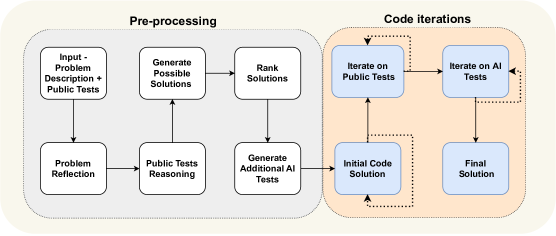
- Introduce AlphaCodium, a two-phase flow (pre-processing in natural language, followed by iterative code generation and testing).
- Use problem reflection and public-test reasoning to ground the task in detail.
- Generate 2–3 candidate solutions and rank them by correctness and robustness.
- Create 6–8 AI-generated tests to cover edge cases not in public tests; generate an initial code solution and run/fix across tests.
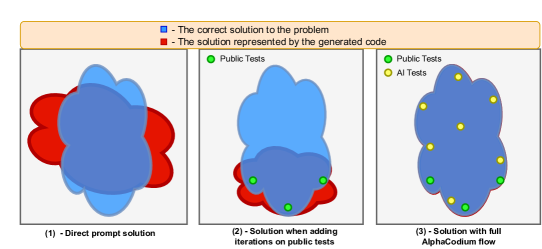
- Iteratively run and fix the code against public tests, then against AI-generated tests, using test anchors to protect against regressions.
- Adopt code-oriented design concepts (YAML-structured output, bullet-point semantic reasoning, modular code, double validation, gradual decision-making, test anchors).
Experimental results
Research questions
- RQ1How does the AlphaCodium flow perform relative to a direct prompt across open and closed models?
- RQ2Does the code-oriented flow improve robustness and success on CodeContests compared to previous methods like AlphaCode and CodeChain?
- RQ3What is the computational efficiency of AlphaCodium compared to prior code-generation systems?
- RQ4Are the proposed design concepts (YAML output, modular code, test anchors) broadly beneficial for code generation tasks?
Key findings
- AlphaCodium consistently improves LLM performance on CodeContests across models (e.g., GPT-4 validation pass@5 improves from 19% to 44%).
- The flow achieves superior results with substantially fewer LLM calls than AlphaCode, indicating higher sample efficiency and lower computational cost.
- AlphaCodium outperforms prior works such as CodeChain and AlphaCode on reported metrics, while using a general-purpose model without extensive fine-tuning.
- On GPT-4, the validation pass@5 improvement is a factor of about 2.3 over direct prompting (19% to 44%).
- The approach maintains effectiveness on both validation and test sets and across open-source and closed-source models.
Read this paper
Open the full text in the Nubint reader and ask about any passage as you read.
Read this paper on NubintThis review was generated by AI from the original paper. Please check the paper before citing it.