
[Paper Review] Cohere: Managing Differential Privacy in Large Scale Systems
Cohere is a unified privacy management system that enables efficient, centralized allocation of differential privacy (DP) budgets across heterogeneous large-scale applications. By introducing fine-grained privacy analysis, partitioning attributes, and a utility-optimized planner, Cohere achieves 6.4–28x higher utility than state-of-the-art methods under the same privacy budget constraints.
The need for a privacy management layer in today's systems started to manifest with the emergence of new systems for privacy-preserving analytics and privacy compliance. As a result, many independent efforts have emerged that try to provide system support for privacy. Recently, the scope of privacy solutions used in systems has expanded to encompass more complex techniques such as Differential Privacy (DP). The use of these solutions in large-scale systems imposes new challenges and requirements. Careful planning and coordination are necessary to ensure that privacy guarantees are maintained across a wide range of heterogeneous applications and data systems. This requires new solutions for managing and allocating scarce and non-replenishable privacy resources. In this paper, we introduce Cohere, a new system that simplifies the use of DP in large-scale systems. Cohere implements a unified interface that allows heterogeneous applications to operate on a unified view of users' data. In this work, we further address two pressing system challenges that arise in the context of real-world deployments: ensuring the continuity of privacy-based applications (i.e., preventing privacy budget depletion) and effectively allocating scarce shared privacy resources (i.e., budget) under complex preferences. Our experiments show that Cohere achieves a 6.4--28x improvement in utility compared to the state-of-the-art across a range of complex workloads.
Motivation & Objective
- To address the lack of centralized, unified management for differential privacy (DP) budgets in large-scale, heterogeneous systems.
- To ensure privacy budget continuity and prevent premature depletion in long-running, privacy-sensitive workloads.
- To enable effective allocation of scarce, non-replenishable DP resources under complex application preferences and priorities.
- To support diverse workloads—including ML pipelines and analytics—within a single, consistent privacy interface.
- To improve system-wide utility by refining privacy accounting and enabling more efficient budget utilization.
Proposed method
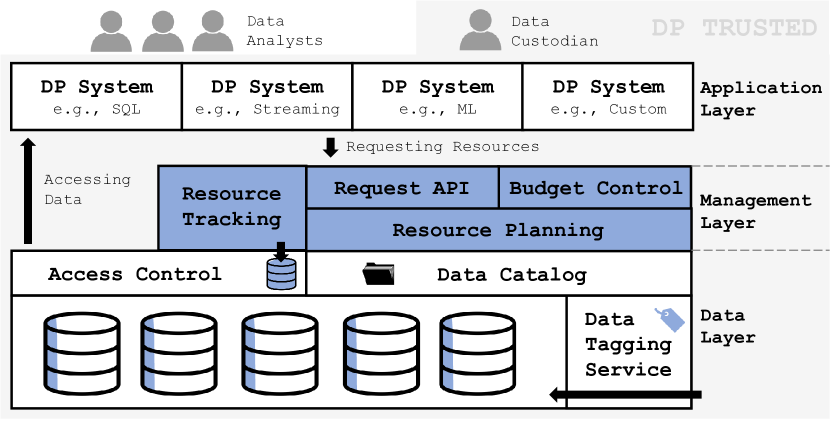
- Cohere provides a unified interface abstracting user data across heterogeneous applications, enabling a global view of privacy guarantees.
- It introduces partitioning attributes (PAs) to model group-level privacy budgets, allowing fine-grained allocation per data group.
- The system uses a novel, optimized integer linear programming (ILP) formulation for privacy budget allocation, maximizing utility under RDP composition constraints.
- It incorporates subsampling-aware privacy analysis to reduce over-conservativeness in budget accounting.
- The planner supports both exact ILP solving and heuristic optimization for scalability, with performance tuned for offline budget planning.
- User rotation is used to ensure semantic consistency and reduce bias in query semantics across applications.
Experimental results
Research questions
- RQ1How can differential privacy budgets be centrally managed and allocated across diverse, independent applications in large-scale systems?
- RQ2What system-level abstractions are needed to ensure continuity and prevent privacy budget exhaustion in long-running workloads?
- RQ3How can fine-grained privacy accounting improve utility without compromising end-to-end privacy guarantees?
- RQ4What trade-offs exist between allocation accuracy, performance, and scalability in privacy budget planning?
- RQ5How does the integration of subsampling and partitioning attributes affect overall system utility and budget efficiency?
Key findings
- Cohere achieves a 6.4–28x improvement in utility compared to the state of the art across diverse complex workloads, demonstrating significant efficiency gains.
- The integration of fine-grained privacy analysis and subsampling-aware accounting has a greater impact on utility than the choice of allocation algorithm.
- The ILP-based planner solves all workload instances within an average of 48 minutes, with peak memory usage of 1.3 GB, confirming feasibility for real-world deployment.
- Heuristic-based planning reduces simulation time to 3.5 minutes (without PAs) and up to 22 minutes (with PAs), showing practical scalability for complex workloads.
- The use of partitioning attributes increases memory usage to ~550MB, but enables more accurate and fair budget allocation across data groups.
- The system’s planner is not on the critical path, justifying the use of abundant compute to optimize scarce privacy budgets.

Read this paper
Open the full text in the Nubint reader and ask about any passage as you read.
Read this paper on NubintThis review was generated by AI from the original paper. Please check the paper before citing it.