
[Paper Review] Cold Start Similar Artists Ranking with Gravity-Inspired Graph Autoencoders
This paper proposes a gravity-inspired graph autoencoder framework to solve the cold start problem in music streaming services by ranking similar artists for new artists using a directed, attributed graph of existing artist relationships and side information. The method learns node embeddings and uses a physics-inspired decoder to rank neighbors, outperforming baselines on Deezer's industrial dataset with 41.42% NDCG@200 under optimal hyperparameter tuning.
On an artist's profile page, music streaming services frequently recommend a ranked list of "similar artists" that fans also liked. However, implementing such a feature is challenging for new artists, for which usage data on the service (e.g. streams or likes) is not yet available. In this paper, we model this cold start similar artists ranking problem as a link prediction task in a directed and attributed graph, connecting artists to their top-k most similar neighbors and incorporating side musical information. Then, we leverage a graph autoencoder architecture to learn node embedding representations from this graph, and to automatically rank the top-k most similar neighbors of new artists using a gravity-inspired mechanism. We empirically show the flexibility and the effectiveness of our framework, by addressing a real-world cold start similar artists ranking problem on a global music streaming service. Along with this paper, we also publicly release our source code as well as the industrial graph data from our experiments.
Motivation & Objective
- Address the cold start problem in music streaming services where new artists lack listening data and thus cannot benefit from usage-based similarity measures.
- Model the 'Fans Also Like' feature as a directed, attributed graph to capture artist relationships and side information such as genre, country, and audio features.
- Develop a graph autoencoder with a gravity-inspired decoder to predict and rank similar artists for new (cold-start) artists based on learned node embeddings.
- Enable flexible control over popularity bias in recommendations by tuning the gravity decoder’s hyperparameter λ to balance between popular and diverse artist recommendations.
- Release public code and industrial-scale graph data from Deezer to support reproducibility and future research in graph-based cold start recommendation.
Proposed method
- Represent the music catalog as a directed, attributed graph where each artist node connects to its top-k most similar artists via directed edges.
- Incorporate side information (e.g., genre, country, audio embeddings) into node features to enrich the graph representation.
- Train a graph autoencoder using a GCN-based encoder to learn low-dimensional node embeddings from the graph structure and features.
- Apply a gravity-inspired decoder that computes similarity scores between a cold artist and candidate neighbors using a physics-inspired formula: similarity = (mass_i * mass_j) / distance_ij^2, where mass is derived from node embeddings.
- Introduce a hyperparameter λ to control the trade-off between mass (popularity) and proximity (semantic similarity) in the final ranking.
- Use the decoder output to rank candidate artists, with higher scores indicating greater similarity, and evaluate using standard ranking metrics like NDCG.

Experimental results
Research questions
- RQ1Can a graph autoencoder with a gravity-inspired decoder effectively predict and rank similar artists for new artists in the absence of usage data?
- RQ2How does incorporating side information (e.g., genre, audio features) improve the performance of cold start artist ranking?
- RQ3To what extent can the gravity-inspired decoder flexibly control the trade-off between recommending popular and diverse artists?
- RQ4How does the model’s performance compare to strong baselines in a real-world industrial setting?
- RQ5Can the proposed framework be generalized to other cold start recommendation problems beyond music?
Key findings
- The gravity-inspired graph autoencoder achieved 41.42% NDCG@200 on Deezer’s cold start artist ranking task, outperforming multiple strong baselines.
- Including all three types of side information—genre, country, and audio features—yielded the best performance, confirming the value of multimodal input.
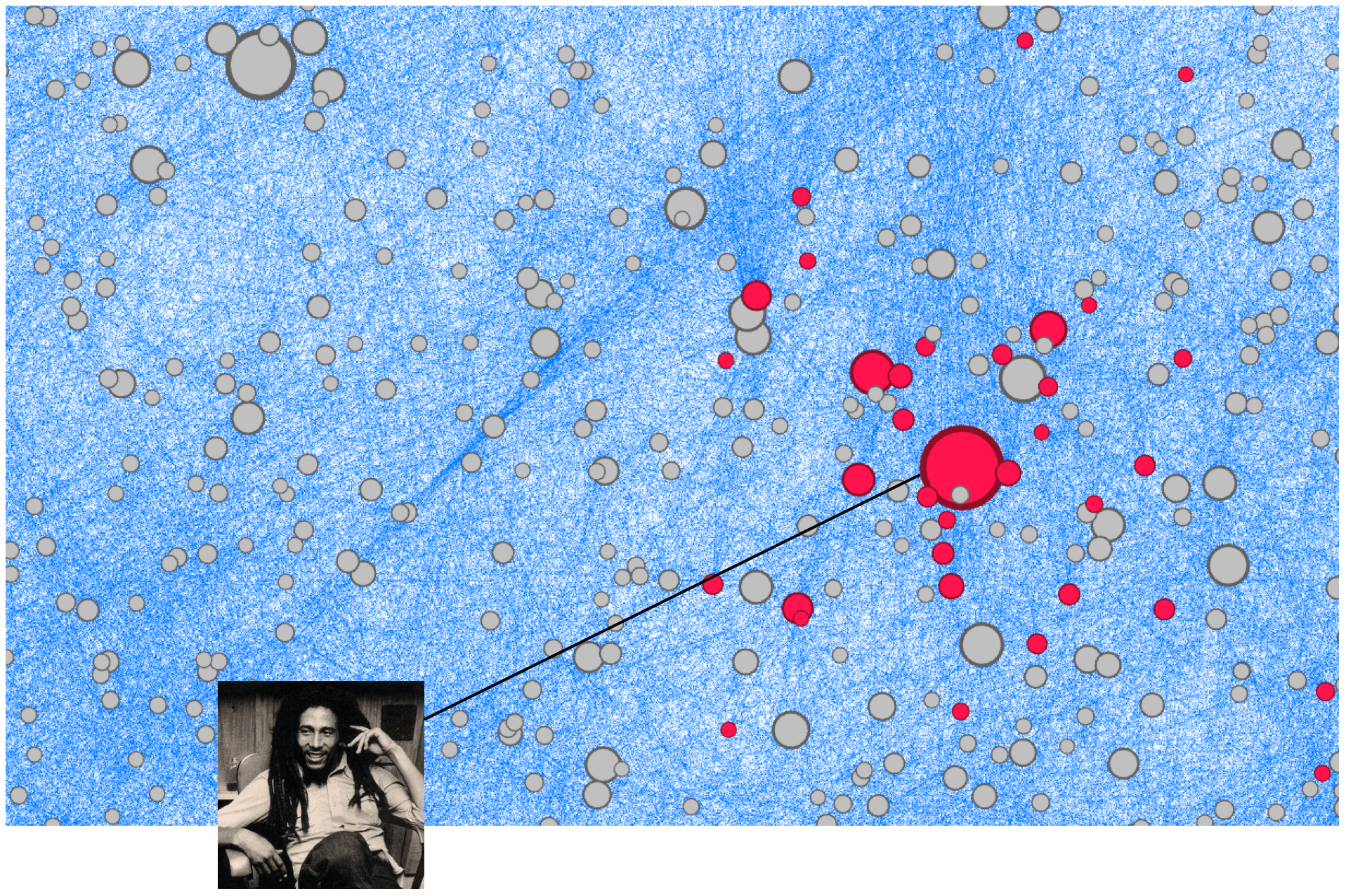
- The hyperparameter λ enabled effective control over popularity bias: λ=5 achieved optimal performance, favoring less popular but relevant artists over purely popularity-driven rankings.
- Node masses learned by the model showed moderate correlation (Pearson r=0.208) with artist popularity ranks, indicating that the model captures some popularity signal while remaining sensitive to semantic similarity.
- The model’s performance was robust across different evaluation metrics, with significant gains in NDCG and MAP when using the full graph and side information.
- The public release of code and industrial-scale graph data from Deezer supports reproducibility and enables future research in graph-based cold start recommendation.
Read this paper
Open the full text in the Nubint reader and ask about any passage as you read.
Read this paper on NubintThis review was generated by AI from the original paper. Please check the paper before citing it.