
[Paper Review] Collaborating with language models for embodied reasoning
The paper proposes a Planner-Actor-Reporter architecture that combines pre-trained language models with an embodied RL agent to perform multi-step reasoning and information gathering in a 2D grid world, demonstrating zero-shot generalization and RL-trained reporting to improve collaboration.
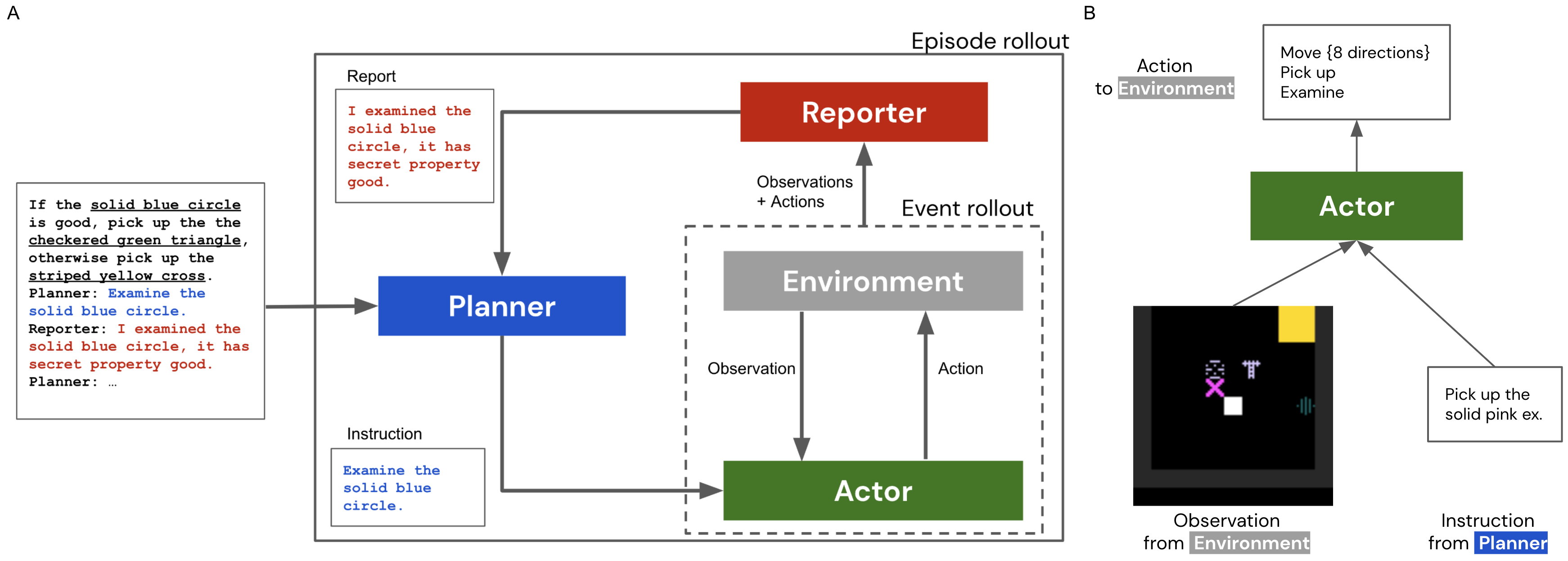
Reasoning in a complex and ambiguous environment is a key goal for Reinforcement Learning (RL) agents. While some sophisticated RL agents can successfully solve difficult tasks, they require a large amount of training data and often struggle to generalize to new unseen environments and new tasks. On the other hand, Large Scale Language Models (LSLMs) have exhibited strong reasoning ability and the ability to to adapt to new tasks through in-context learning. However, LSLMs do not inherently have the ability to interrogate or intervene on the environment. In this work, we investigate how to combine these complementary abilities in a single system consisting of three parts: a Planner, an Actor, and a Reporter. The Planner is a pre-trained language model that can issue commands to a simple embodied agent (the Actor), while the Reporter communicates with the Planner to inform its next command. We present a set of tasks that require reasoning, test this system's ability to generalize zero-shot and investigate failure cases, and demonstrate how components of this system can be trained with reinforcement-learning to improve performance.
Motivation & Objective
- Demonstrate how a pre-trained language model can act as a planner issuing natural language instructions to an embodied agent (the Actor).
- Show how a Reporter translates Actor observations back to the Planner to form a closed loop for instruction refinement.
- Evaluate zero-shot generalization and robustness of planners across model sizes and task variants.
- Investigate training a Reporter via reinforcement learning to improve collaboration and reduce hand-crafted feedback.
- Analyze failure modes and robustness of the system under imperfect reporting.
Proposed method
- Implement a three-part system: Planner (LSLM), Actor (RL agent), and Reporter (translates Actor data back to Planner).
- Use Chinchilla-based LLMs at 7B and 70B parameters as Planners with few-shot prompts.
- Train the Actor on simple pick-up and examine tasks; observers use an in-environment Reporter to feed back instructions.
- Define a 2D partially observable grid-world with objects distinguished by color, shape, and texture; allow examine and pickup actions.
- Experiment with secret-property tasks requiring information gathering and conditional decisions based on reported properties.
- Evaluate robustness of the Planner to imperfect Reports and explore training the Reporter with RL to optimize reward.
Experimental results
Research questions
- RQ1Can a Planer-Actor-Reporter system enable zero-shot solving of information-gathering tasks in embodied environments?
- RQ2How does planner size (7B vs 70B) affect performance and robustness to Reporter imperfections?
- RQ3What are the main failure modes when the Reporter is imperfect, and can explicit prompting mitigate them?
- RQ4Can a learned Reporter improve performance through RL, reducing dependence on hand-crafted feedback?
- RQ5How well do the proposed tasks probe logical reasoning, generalization, exploration, and perception in embodied reasoning?
Key findings
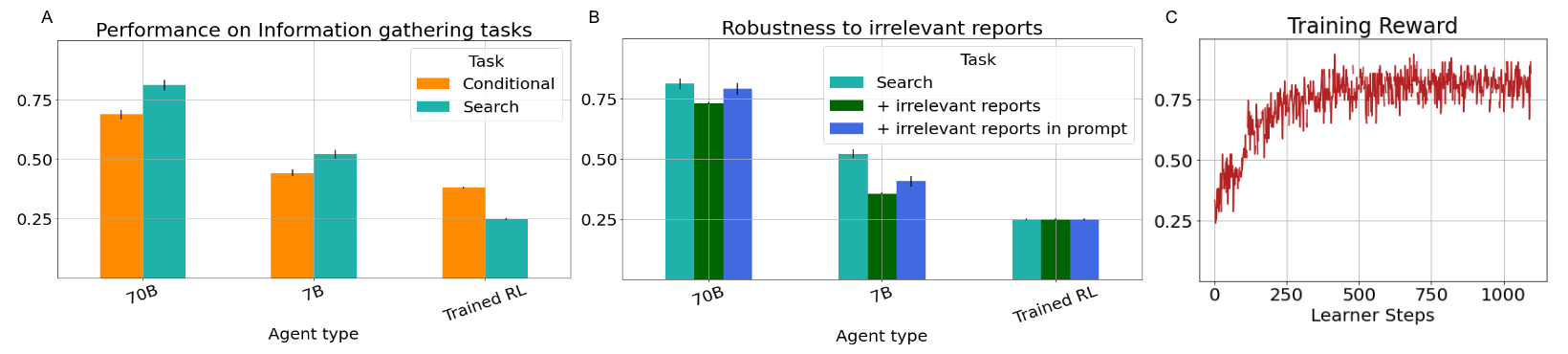
- 70B Planners achieve higher success than 7B planners on information-gathering tasks (e.g., better inference of correct object to pick up).
- Pure RL baselines struggle on secret-property tasks, while Planner-Actor-Reporter achieves strong zero-shot results.
- Planners show robustness to noisy reports, with 70B maintaining performance better than 7B under 20% irrelevant reports.
- Providing prompts that demonstrate a repeating strategy can restore performance when Reports are irrelevant.
- Training the Reporter with RL is viable and helps the Planner learn what information is most useful for task success.
Read this paper
Open the full text in the Nubint reader and ask about any passage as you read.
Read this paper on NubintThis review was generated by AI from the original paper. Please check the paper before citing it.