
[Paper Review] Collaborative Perception for Connected and Autonomous Driving: Challenges, Possible Solutions and Opportunities
This paper surveys challenges in collaborative perception for connected and autonomous driving, proposes a channel-aware framework to reduce communication latency, and validates improvements on the OPV2V dataset.
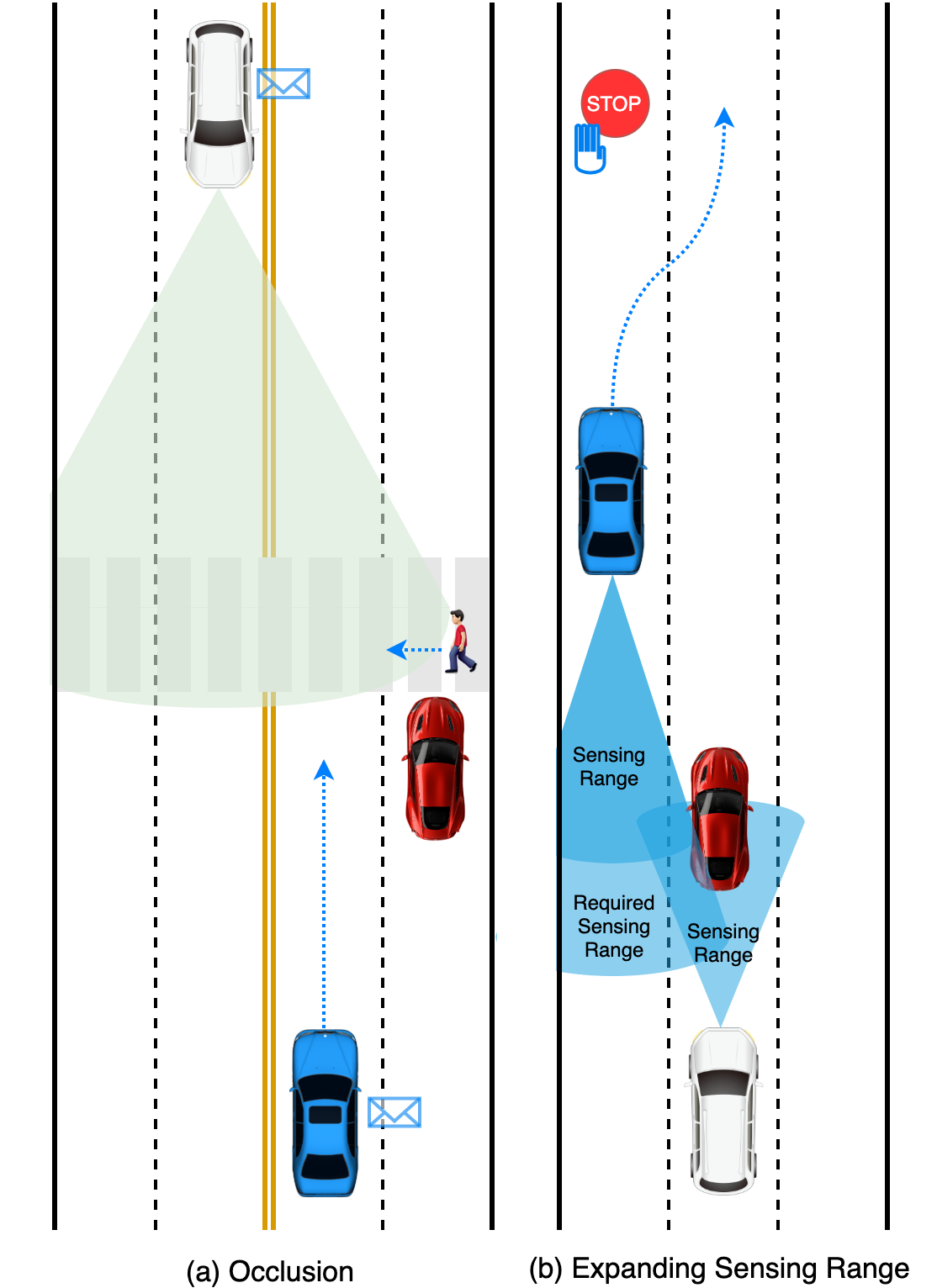
Autonomous driving has attracted significant attention from both academia and industries, which is expected to offer a safer and more efficient driving system. However, current autonomous driving systems are mostly based on a single vehicle, which has significant limitations which still poses threats to driving safety. Collaborative perception with connected and autonomous vehicles (CAVs) shows a promising solution to overcoming these limitations. In this article, we first identify the challenges of collaborative perception, such as data sharing asynchrony, data volume, and pose errors. Then, we discuss the possible solutions to address these challenges with various technologies, where the research opportunities are also elaborated. Furthermore, we propose a scheme to deal with communication efficiency and latency problems, which is a channel-aware collaborative perception framework to dynamically adjust the communication graph and minimize latency, thereby improving perception performance while increasing communication efficiency. Finally, we conduct experiments to demonstrate the effectiveness of our proposed scheme.
Motivation & Objective
- Identify key challenges hindering collaborative perception (data sharing asynchrony, data volume, pose errors, security).
- Analyze and compare potential solutions across communication, computation, and data fusion techniques.
- Propose a channel-aware collaborative perception framework to dynamically adjust communication graphs and reduce latency.
- Demonstrate practical gains through experiments on public datasets (OPV2V) and discuss future opportunities and open research directions.
Proposed method
- Discuss data-sharing modalities (early, intermediate, late fusion) and identify intermediate fusion as a favorable trade-off between perception accuracy and bandwidth.
- Describe time-delay compensation and latency-aware strategies to align asynchronous features across CAVs.
- Summarize pose-error mitigation techniques including attention-based and pose-correction methods.
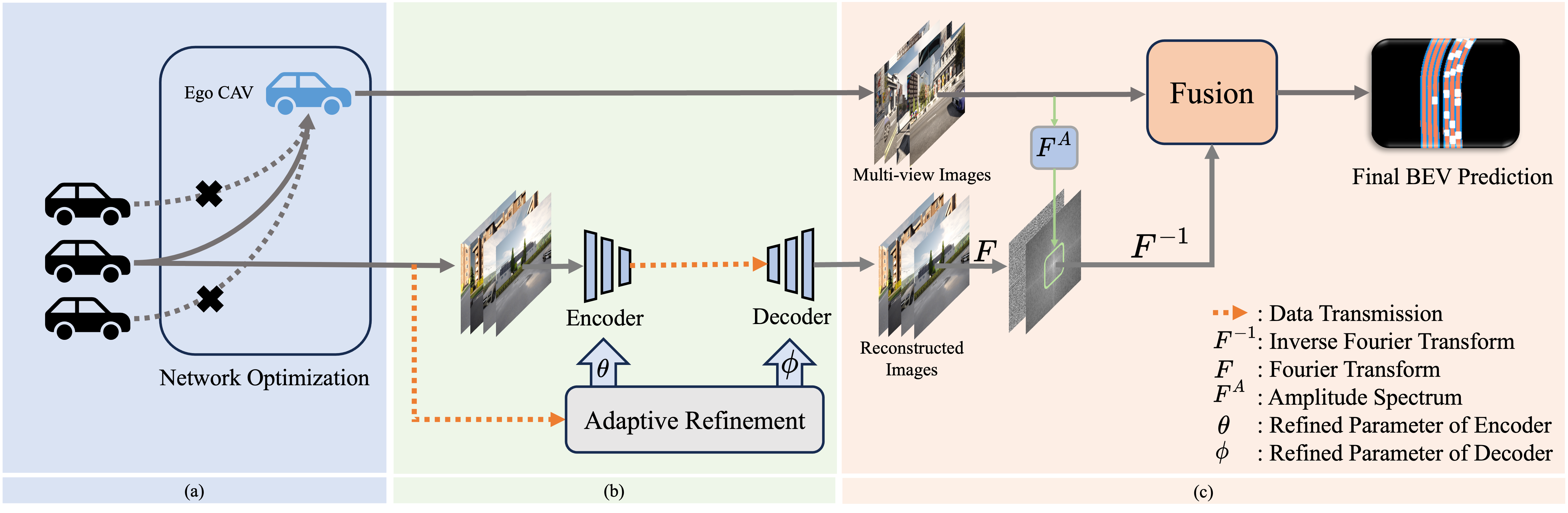
- Propose a channel-aware framework with three components: transmission delay minimization, adaptive data reconstruction, and domain alignment.
- Present an adaptive rate-distortion based reconstruction to compress and reconstruct data with real-time channel awareness.
- Introduce domain alignment using FFT-based amplitude/phase spectrum alignment to reduce cross-vehicle domain gaps.
Experimental results
Research questions
- RQ1What are the main challenges to realizing robust collaborative perception in V2X-enabled autonomous driving?
- RQ2How can communication strategies (fusion level, encoding, and graph topology) mitigate latency and data-volume issues?
- RQ3What methods effectively address pose errors and domain mismatch across collaborating vehicles?
Key findings
- The proposed method achieves the highest BEV segmentation IoU on OPV2V (55.06) compared to several baselines, outperforming the closest method by 2.11 IoU points.
- Vehicle class performance gains are particularly notable, with a 4.07 IoU margin over the next best method.
- Intermediate fusion frequently offers a favorable balance between perception accuracy and bandwidth usage according to cited work.
- The channel-aware framework demonstrates reduced average transmission delay and improved BEV fusion results in experiments.
- Domain alignment via FFT-based amplitude spectrum matching reduces cross-vehicle domain discrepancies and enhances fusion quality.
Read this paper
Open the full text in the Nubint reader and ask about any passage as you read.
Read this paper on NubintThis review was generated by AI from the original paper. Please check the paper before citing it.