
[Paper Review] Collaborative Perception in Autonomous Driving: Methods, Datasets and Challenges
This paper provides a comprehensive survey of collaborative perception in autonomous driving, systematically reviewing methods for ideal and real-world scenarios, large-scale datasets, and key challenges. It introduces a structured taxonomy of collaboration modules, benchmarks state-of-the-art models on public datasets, and identifies critical gaps in robustness, privacy, labeling efficiency, and complex scene handling, offering a roadmap for future research.
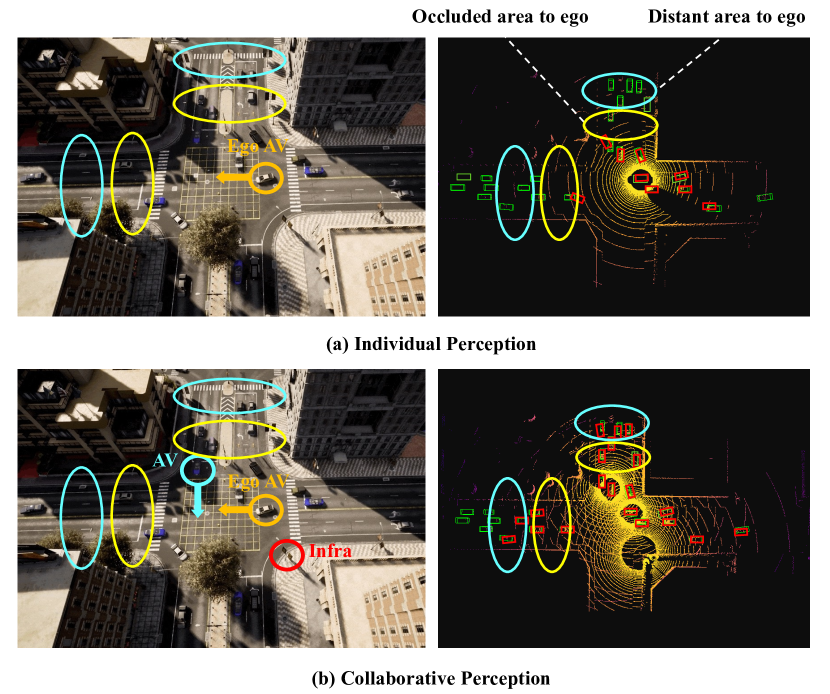
Collaborative perception is essential to address occlusion and sensor failure issues in autonomous driving. In recent years, theoretical and experimental investigations of novel works for collaborative perception have increased tremendously. So far, however, few reviews have focused on systematical collaboration modules and large-scale collaborative perception datasets. This work reviews recent achievements in this field to bridge this gap and motivate future research. We start with a brief overview of collaboration schemes. After that, we systematically summarize the collaborative perception methods for ideal scenarios and real-world issues. The former focuses on collaboration modules and efficiency, and the latter is devoted to addressing the problems in actual application. Furthermore, we present large-scale public datasets and summarize quantitative results on these benchmarks. Finally, we highlight gaps and overlook challenges between current academic research and real-world applications. The project page is https://github.com/CatOneTwo/Collaborative-Perception-in-Autonomous-Driving
Motivation & Objective
- To address the lack of systematic reviews focusing on collaboration modules and large-scale datasets in collaborative perception for autonomous driving.
- To categorize and analyze recent advances in collaborative perception methods under ideal conditions and real-world constraints such as communication latency, localization errors, and sensor noise.
- To compile and compare large-scale public datasets for collaborative perception, enabling standardized benchmarking and performance evaluation.
- To identify critical gaps between current academic research and real-world deployment, particularly in robustness, privacy, and labeling efficiency.
- To guide future research by highlighting underexplored areas such as federated learning integration, weakly supervised learning, and complex scene perception.
Proposed method
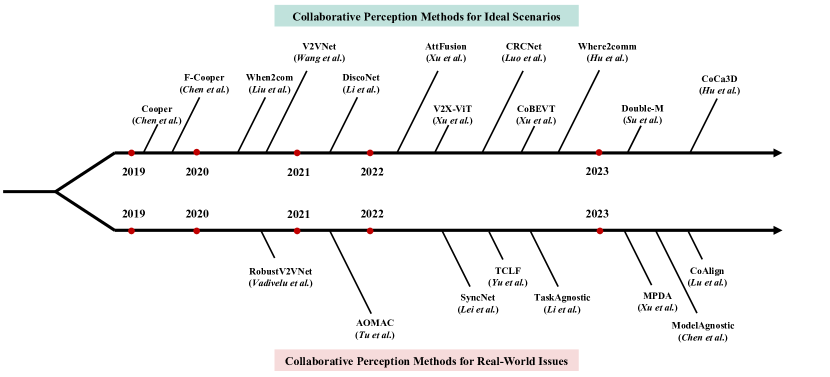
- Categorizes collaborative perception methods into two main streams: (1) collaboration modules for ideal scenarios emphasizing efficiency and accuracy, and (2) robustness solutions for real-world issues like communication delays and localization errors.
- Reviews state-of-the-art frameworks such as V2VNet, AttFusion, When2com, and V2X-ViT, which use attention mechanisms and feature-level fusion to improve perception under collaboration.
- Analyzes data compression strategies, including importance-based compression, to reduce bandwidth usage while preserving detection performance.
- Examines multi-sensor fusion and virtual point cloud generation techniques to enhance perception in adverse conditions like bad weather or long-range detection.
- Explores federated learning as a privacy-preserving alternative to direct data sharing, enabling model collaboration without exposing raw sensor data.
- Investigates low-labeling dependence through generalized weakly supervised learning and domain adaptation, using simulated data to reduce reliance on costly real-world annotations.
Experimental results
Research questions
- RQ1How can collaboration modules be designed to maximize detection accuracy and communication efficiency in ideal collaborative perception scenarios?
- RQ2What are the key challenges in deploying collaborative perception systems in real-world driving environments, and how can they be addressed to ensure robustness and safety?
- RQ3How do existing large-scale collaborative perception datasets compare in terms of scene diversity, annotation quality, and benchmark performance?
- RQ4What role can federated learning play in enabling privacy-preserving collaboration among autonomous vehicles from different manufacturers?
- RQ5To what extent can weakly supervised and domain adaptation techniques reduce the labeling cost in collaborative perception systems?
Key findings
- The paper identifies a significant research gap in real-world robustness, with most existing methods assuming ideal communication and sensor conditions, which limits practical deployment.
- Large-scale datasets such as nuScenes-Collab, BDD100K-Collab, and DeepAccident are emerging but still lack comprehensive coverage of complex scenes like bad weather and high-speed dynamics.
- State-of-the-art models like AttFusion and V2X-ViT achieve significant mAP improvements—up to 15% gain in mAP over individual perception—on benchmark datasets under ideal conditions.
- Federated learning-based approaches show promise in preserving data privacy while enabling model collaboration, though they remain underexplored in collaborative perception compared to individual perception.
- Current methods still heavily rely on fully annotated datasets, and only preliminary work exists on domain adaptation and weakly supervised learning in collaborative settings.
- The integration of virtual point cloud generation and spatiotemporal fusion is critical for improving long-range and high-speed object detection, especially in occluded or distant scenarios.
Read this paper
Open the full text in the Nubint reader and ask about any passage as you read.
Read this paper on NubintThis review was generated by AI from the original paper. Please check the paper before citing it.