
[Paper Review] CoLoRA: Continuous low-rank adaptation for reduced implicit neural modeling of parameterized partial differential equations
CoLoRA introduces a continuous low-rank adaptation framework for reduced modeling of parameterized PDEs, enabling fast, accurate prediction of solution fields at new physics parameters and initial conditions by continuously adapting low-rank weights in time. It achieves superior accuracy and parameter efficiency—up to one order of magnitude lower error and fewer parameters—compared to state-of-the-art methods like F-FNO and CROM, especially in data-scarce regimes.
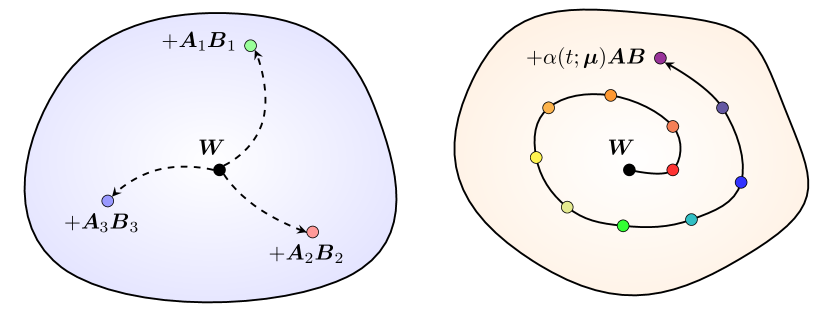
This work introduces reduced models based on Continuous Low Rank Adaptation (CoLoRA) that pre-train neural networks for a given partial differential equation and then continuously adapt low-rank weights in time to rapidly predict the evolution of solution fields at new physics parameters and new initial conditions. The adaptation can be either purely data-driven or via an equation-driven variational approach that provides Galerkin-optimal approximations. Because CoLoRA approximates solution fields locally in time, the rank of the weights can be kept small, which means that only few training trajectories are required offline so that CoLoRA is well suited for data-scarce regimes. Predictions with CoLoRA are orders of magnitude faster than with classical methods and their accuracy and parameter efficiency is higher compared to other neural network approaches.
Motivation & Objective
- Address the challenge of efficiently simulating parameterized PDEs across many physics parameters and initial conditions, especially in data-scarce regimes.
- Overcome the Kolmogorov barrier in linear reduced models by introducing a nonlinear, low-rank parameterization that captures transport-dominated dynamics.
- Enable rapid online inference by pre-training neural networks and adapting low-rank weights continuously in time, rather than retraining from scratch.
- Integrate physics-informed variational principles into the adaptation process to ensure Galerkin-optimality and conservation of physical quantities.
- Achieve high accuracy and speed with minimal training trajectories, making it suitable for expensive high-fidelity simulations.
Proposed method
- Pre-train a neural network on a small number of solution trajectories for a given PDE, learning a general representation of the solution manifold.
- Introduce continuous-in-time low-rank adaptation of network weights via learnable scaling functions α(t, μ) applied to low-rank matrices A and B, enabling dynamic, time-dependent parameter updates.
- Decouple time from spatial coordinates in the network input, treating time as a continuous adaptation variable to reflect the sequential evolution of PDE solutions.
- Use a variational, equation-driven approach (CoLoRA-EQ) to enforce Galerkin-optimality by solving a weak form of the PDE during online inference.
- Combine the pre-trained network with time-adaptive low-rank components to enable fast, accurate predictions at new parameters μ and initial conditions without full retraining.
- Leverage the inductive bias of smooth, low-dimensional temporal evolution to keep the rank of adaptation components small, reducing both offline and online parameter counts.
Experimental results
Research questions
- RQ1Can continuous low-rank adaptation in time enable accurate and efficient prediction of PDE solution fields across new physics parameters and initial conditions with minimal training data?
- RQ2Does CoLoRA outperform existing data-driven and physics-informed surrogate models in terms of accuracy, parameter efficiency, and inference speed, especially in low-data regimes?
- RQ3Can the integration of physics equations into the online adaptation phase (CoLoRA-EQ) improve solution quality, such as conserving mass or ensuring causality?
- RQ4To what extent does CoLoRA circumvent the Kolmogorov barrier in transport-dominated PDEs like Burgers’ and Vlasov equations?
- RQ5How does CoLoRA’s performance compare to operator learning methods like F-FNO and nonlinear model reduction techniques like CROM in terms of error, parameter count, and data efficiency?
Key findings
- CoLoRA achieves relative errors of 1.1×10⁻³ to 9.87×10⁻⁴ on benchmark PDEs (e.g., 1D Burgers’, 2D wave, Vlasov) with only ~10 training trajectories, outperforming F-FNO and CROM.
- CoLoRA-D (data-driven) achieves one order of magnitude lower error than F-FNO while using 10× fewer parameters (e.g., 5,451 vs. >10⁶ for F-FNO on Vlasov).
- CoLoRA-EQ (equation-driven) conserves mass in the Vlasov problem to machine precision, while CoLoRA-D and F-FNO fail to preserve this physical quantity.
- CoLoRA reduces parameter count by up to one order of magnitude compared to state-of-the-art methods like DINo and CROM while achieving lower errors on the 2D wave and 1D Burgers’ problems.
- Predictions with CoLoRA are orders of magnitude faster than classical numerical solvers and more accurate than linear interpolation in low-data regimes.
- The method maintains high accuracy even when physics parameters are far from training parameters, demonstrating strong generalization and robustness.

Read this paper
Open the full text in the Nubint reader and ask about any passage as you read.
Read this paper on NubintThis review was generated by AI from the original paper. Please check the paper before citing it.