
[Paper Review] Combining Generative Artificial Intelligence (AI) and the Internet: Heading towards Evolution or Degradation?
The paper investigates whether training generative AI models on a mix of real and AI-generated data leads to degradation in output quality, presenting preliminary diffusion-model experiments showing possible degeneration.
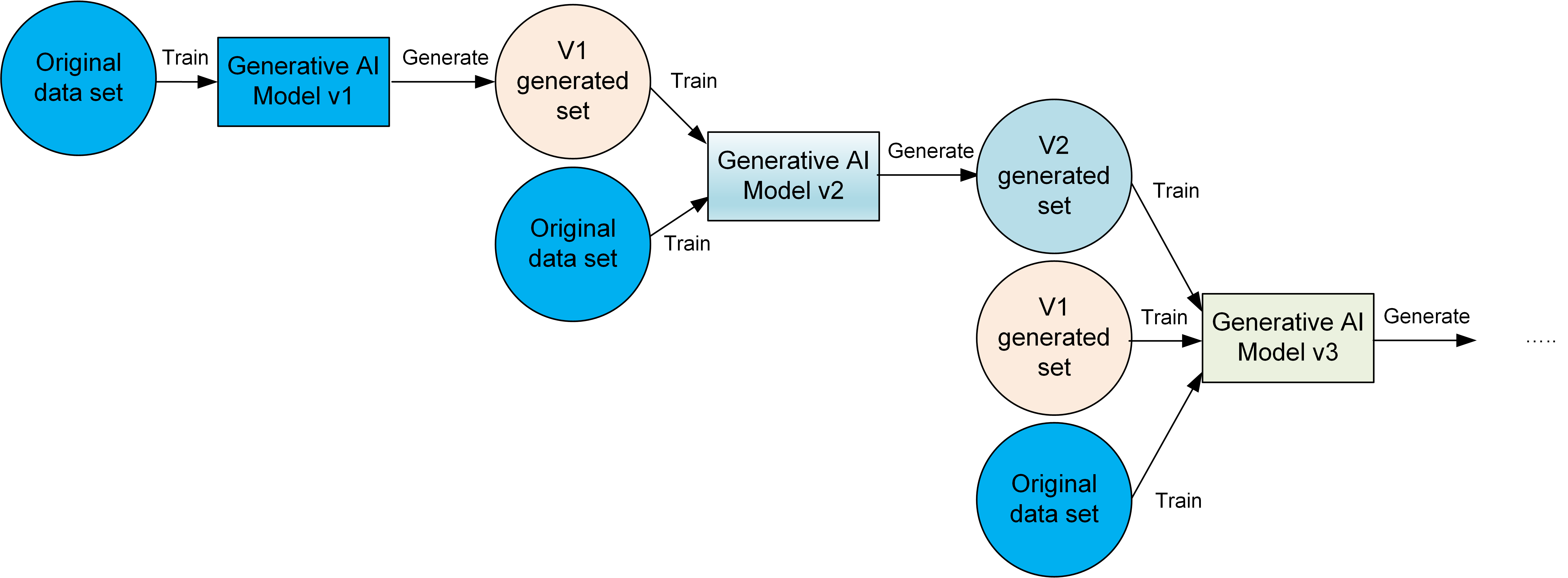
In the span of a few months, generative Artificial Intelligence (AI) tools that can generate realistic images or text have taken the Internet by storm, making them one of the technologies with fastest adoption ever. Some of these generative AI tools such as DALL-E, MidJourney, or ChatGPT have gained wide public notoriety. Interestingly, these tools are possible because of the massive amount of data (text and images) available on the Internet. The tools are trained on massive data sets that are scraped from Internet sites. And now, these generative AI tools are creating massive amounts of new data that are being fed into the Internet. Therefore, future versions of generative AI tools will be trained with Internet data that is a mix of original and AI-generated data. As time goes on, a mixture of original data and data generated by different versions of AI tools will populate the Internet. This raises a few intriguing questions: how will future versions of generative AI tools behave when trained on a mixture of real and AI generated data? Will they evolve with the new data sets or degenerate? Will evolution introduce biases in subsequent generations of generative AI tools? In this document, we explore these questions and report some very initial simulation results using a simple image-generation AI tool. These results suggest that the quality of the generated images degrades as more AI-generated data is used for training thus suggesting that generative AI may degenerate. Although these results are preliminary and cannot be generalised without further study, they serve to illustrate the potential issues of the interaction between generative AI and the Internet.
Motivation & Objective
- Motivate and explore how AI-generated data flowing back into the Internet could affect future generative AI models.
- Evaluate whether successive generations trained on mixed real and AI-generated data degrade in quality.
- Identify factors that influence degeneration and biases in evolving AI systems.
Proposed method
- Use a simple denoising diffusion implicit model (DDIM) trained on the Oxford Flowers dataset to generate synthetic images.
- Create multiple generations of models by augmenting training data with AI-generated images (V1, V2, V3, etc.).
- Introduce alpha (α) as the ratio of AI-generated data added per generation to the existing training set.
- Experiment with different α values (0.5, 1, 2) to assess impact on image quality across generations.
- Test mitigation by increasing training epochs (e.g., 80 epochs) to observe effects on degeneration.
Experimental results
Research questions
- RQ1Does training on a mixture of real and AI-generated images cause degeneration in subsequent generations of a diffusion model?
- RQ2How does the proportion of AI-generated data (α) affect the quality of generated images over generations?
- RQ3Can increasing training effort (e.g., more epochs) mitigate or delay degeneration?
Key findings
- Generated images degrade in quality with each new generation when trained on previous AI-generated data (α=1).
- Lower α (0.5) reduces degradation but does not eliminate it; higher α (2) accelerates degradation.
- Even with more training epochs, degeneration persists for α=1 in the experiments.
- Degeneration is demonstrated in a simple diffusion-model setup using the Oxford Flowers dataset.

Read this paper
Open the full text in the Nubint reader and ask about any passage as you read.
Read this paper on NubintThis review was generated by AI from the original paper. Please check the paper before citing it.