
[Paper Review] Commonsense-Aware Prompting for Controllable Empathetic Dialogue Generation
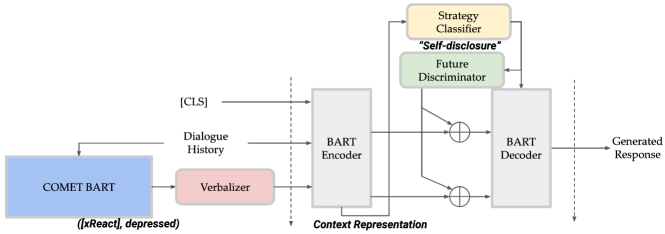
This paper proposes a prompt-based framework that enhances empathetic dialogue generation by injecting commonsense knowledge via verbalized COMET outputs and controlling response generation using a future discriminator (FUDGE). Results show that both commonsense prompting and strategy control significantly improve response quality on the ESConv dataset, with COMET-BART outperforming BART across metrics.
Improving the emotional awareness of pre-trained language models is an emerging important problem for dialogue generation tasks. Although prior studies have introduced methods to improve empathetic dialogue generation, few have discussed how to incorporate commonsense knowledge into pre-trained language models for controllable dialogue generation. In this study, we propose a novel framework that improves empathetic dialogue generation using pre-trained language models by 1) incorporating commonsense knowledge through prompt verbalization, and 2) controlling dialogue generation using a strategy-driven future discriminator. We conducted experiments to reveal that both the incorporation of social commonsense knowledge and enforcement of control over generation help to improve generation performance. Finally, we discuss the implications of our study for future research.
Motivation & Objective
- To improve empathetic dialogue generation by integrating social commonsense knowledge into pre-trained language models.
- To enable controllable response generation using a plug-and-play future discriminator (FUDGE) without requiring model fine-tuning.
- To investigate whether verbalized commonsense knowledge prompts enhance emotional awareness in dialogue models.
- To evaluate the impact of strategy control on response coherence and empathy.
- To compare the effectiveness of vanilla BART versus COMET-BART under different prompting and control settings.
Proposed method
- Commonsense knowledge is extracted from COMET and verbalized into natural language prompts to be concatenated with dialogue history.
- The verbalized commonsense prompts are injected into the input of pre-trained language models (BART and COMET-BART) to guide empathetic response generation.
- A future discriminator (FUDGE) is used to condition generation on specific dialogue strategies, enabling plug-and-play control without fine-tuning.
- The strategy control is applied by conditioning the generation process on predicted or ground-truth dialogue strategies via FUDGE's attribute-based discriminator.
- Joint training with generation and strategy classification loss is explored to improve strategy prediction and response quality.
- Automatic evaluation is conducted using BLEU, ROUGE-L, and BERTScore on the ESConv dataset.
Experimental results
Research questions
- RQ1Can verbalized commonsense knowledge prompts improve the emotional awareness and response quality in empathetic dialogue generation?
- RQ2Does the use of a future discriminator (FUDGE) enable effective, fine-grained control over dialogue generation without model fine-tuning?
- RQ3How does the integration of commonsense knowledge affect the performance of pre-trained language models in empathetic dialogue tasks?
- RQ4To what extent does joint training of generation and strategy prediction improve overall response quality?
- RQ5How do COMET-BART and vanilla BART compare in handling prompted commonsense knowledge and strategy control?
Key findings
- Incorporating verbalized commonsense knowledge via prompts consistently improved generation performance across both BART and COMET-BART models on BLEU, ROUGE-L, and BERTScore metrics.
- COMET-BART outperformed vanilla BART even without prompting, indicating that pre-training on commonsense reasoning enhances empathetic response generation.
- FUDGE-based strategy control improved generation quality when using ground-truth strategies, demonstrating effective control over response generation.
- When using a separate strategy classifier, performance dropped due to inaccurate strategy prediction, highlighting the dependency of control on prediction quality.
- Joint training with generation and strategy classification loss improved BART’s response quality despite lower strategy prediction accuracy, suggesting trade-offs in objective separation.
- The combination of commonsense prompting and FUDGE control yielded the best overall performance, showing synergistic benefits from both components.
Read this paper
Open the full text in the Nubint reader and ask about any passage as you read.
Read this paper on NubintThis review was generated by AI from the original paper. Please check the paper before citing it.