
[Paper Review] Compact realization of all-attosecond pump-probe spectroscopy
This paper presents a compact, 1 kHz laser-based setup for all-attosecond pump-probe spectroscopy using post-compressed few-femtosecond near-infrared pulses and a transient blueshift-enhanced high-harmonic generation (HHG) geometry. It achieves near-isolated attosecond XUV pulses with peak intensities up to 1×10¹³ W/cm², enabling element-specific, high-time-resolution studies of electron dynamics in atoms and molecules.
The ability to perform attosecond-pump attosecond-probe spectroscopy (APAPS) is a longstanding goal in ultrafast science. While first pioneering experiments demonstrated the feasibility of APAPS, the low repetition rates (10-120 Hz) and the large footprints of existing setups have so far hindered the widespread exploitation of APAPS. Here we demonstrate two-color APAPS using a commercial laser system at 1 kHz, straightforward post-compression in a hollow-core fiber and a compact high-harmonic generation (HHG) setup. The latter enables the generation of intense extreme-ultraviolet (XUV) pulses by using an out-of-focus HHG geometry and by exploiting a transient blueshift of the driving laser in the HHG medium. Near-isolated attosecond pulses are generated, as demonstrated by one-color and two-color XUV-pump XUV-probe experiments. Our concept allows selective pumping and probing on extremely short timescales and permits investigations of fundamental processes that are not accessible by other pump-probe techniques.
Motivation & Objective
- Overcome the limitations of low-repetition-rate, large-footprint setups that have hindered widespread adoption of attosecond-pump attosecond-probe spectroscopy (APAPS).
- Enable high-time-resolution studies of electron dynamics by generating intense, near-isolated attosecond extreme-ultraviolet (XUV) pulses using a compact, commercial laser system.
- Achieve selective probing and pumping of core- and inner-valence electron dynamics using XUV pulses, which are more localized and element-specific than near-infrared (NIR) pulses.
- Demonstrate that APAPS with XUV pump and XUV probe can achieve signal changes of 10–100%, significantly higher than the 10⁻⁴ changes seen in XUV-NIR experiments, enabling more robust measurements.
- Develop a scalable, stable, and compact platform for attosecond science that is suitable for routine laboratory use and future applications in complex systems.
Proposed method
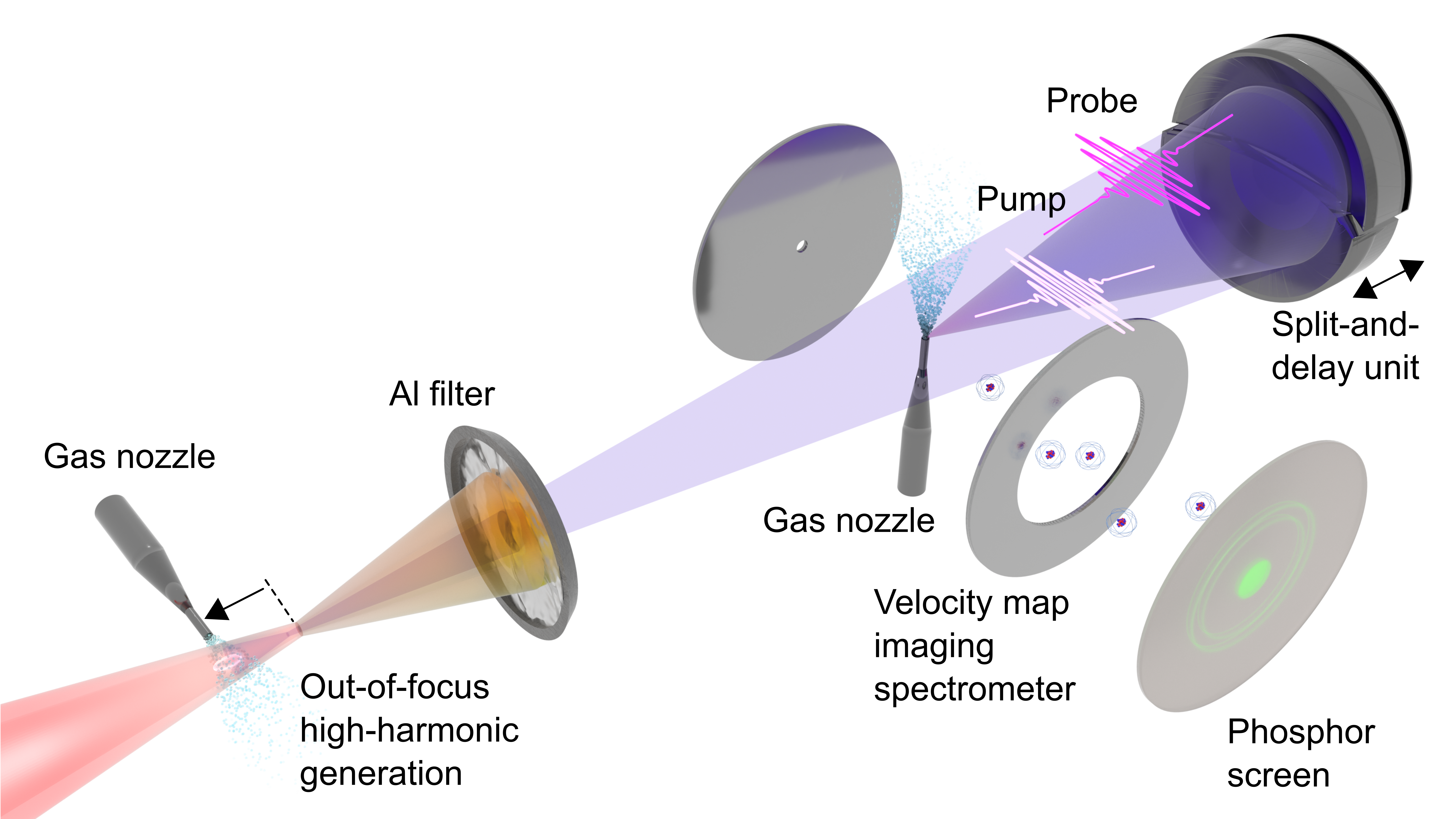
- Utilize a commercial 1 kHz, 36-fs, 13 mJ, 800 nm laser system as the driver for high-harmonic generation (HHG).
- Implement post-compression of the laser pulses using a 1 m long, 400 µm core hollow-core fiber filled with helium at 3.5 bar, achieving a compressed pulse duration of 3.8 fs.
- Employ a transient blueshift effect in the HHG medium by using an out-of-focus geometry to enhance the generation of intense, short XUV pulses.
- Optimize HHG efficiency using a 1 mm iris and a pulsed gas jet with krypton or xenon at 4 bar backing pressure.
- Characterize the XUV pulses using a spectrometer with a diffraction grating and microchannel plate / phosphor screen, with Al filters (100 nm and 200 nm) to suppress residual NIR light.
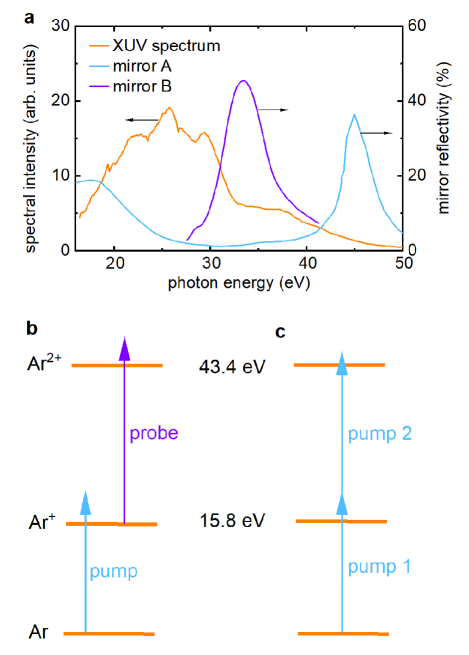
- Use a split-and-delay unit with spherical multilayer mirrors (reflectivity peaks at <25 eV and 33.5 eV) to control the pump-probe delay and overlap the XUV pulses spatially.
Experimental results
Research questions
- RQ1Can a compact, high-repetition-rate (1 kHz) laser system generate intense, near-isolated attosecond XUV pulses suitable for pump-probe experiments?
- RQ2Can the transient blueshift effect in an out-of-focus HHG geometry significantly enhance XUV pulse generation efficiency and intensity?
- RQ3Can all-attosecond pump-probe spectroscopy be realized with XUV pulses as both pump and probe, enabling higher signal-to-noise ratios than XUV-NIR schemes?
- RQ4What are the achievable XUV pulse durations and peak intensities in a compact, stable, and commercially viable setup?
- RQ5Can this setup resolve electron dynamics on the attosecond-to-few-femtosecond timescale with element-specific sensitivity?
Key findings
- The system generates near-isolated attosecond XUV pulses with a measured duration of approximately 100 attoseconds, confirmed by one-color and two-color XUV-pump XUV-probe experiments.
- XUV peak intensities of up to 1×10¹³ W/cm² were achieved, with pulse energies of 0.15 nJ at the sample (from mirror B at 33.5 eV), enabling strong-field interactions.
- The XUV pulse energy at the source was estimated at 10 nJ, with transmission and reflection losses reducing the final pulse energy to 0.12–0.15 nJ at the target.
- The setup achieved a signal change of 10–100% in XUV-pump XUV-probe experiments, significantly higher than the 10⁻⁴ changes typical in XUV-NIR pump-probe experiments.
- The use of a 1 kHz laser system enables a high signal-to-noise ratio and stable operation, overcoming the limitations of low-repetition-rate systems used in prior APAPS experiments.
- The transient blueshift effect in the out-of-focus HHG geometry enhanced the generation of intense XUV pulses, enabling efficient conversion even with moderate laser pulse energy (1 mJ).
Better researchstarts right now
From reading papers to final review, dramatically reduce your research time.
No credit card · Free plan available
This review was created by AI and reviewed by human editors.