
[Paper Review] Compact Transformer Tracker with Correlative Masked Modeling
This paper presents CTTrack, a compact ViT-based tracker with a correlative masked decoder that enhances feature aggregation during training; it achieves state-of-the-art-like performance while running at 40 fps, and the correlative decoder can be plugged into other trackers.
Transformer framework has been showing superior performances in visual object tracking for its great strength in information aggregation across the template and search image with the well-known attention mechanism. Most recent advances focus on exploring attention mechanism variants for better information aggregation. We find these schemes are equivalent to or even just a subset of the basic self-attention mechanism. In this paper, we prove that the vanilla self-attention structure is sufficient for information aggregation, and structural adaption is unnecessary. The key is not the attention structure, but how to extract the discriminative feature for tracking and enhance the communication between the target and search image. Based on this finding, we adopt the basic vision transformer (ViT) architecture as our main tracker and concatenate the template and search image for feature embedding. To guide the encoder to capture the invariant feature for tracking, we attach a lightweight correlative masked decoder which reconstructs the original template and search image from the corresponding masked tokens. The correlative masked decoder serves as a plugin for the compact transform tracker and is skipped in inference. Our compact tracker uses the most simple structure which only consists of a ViT backbone and a box head, and can run at 40 fps. Extensive experiments show the proposed compact transform tracker outperforms existing approaches, including advanced attention variants, and demonstrates the sufficiency of self-attention in tracking tasks. Our method achieves state-of-the-art performance on five challenging datasets, along with the VOT2020, UAV123, LaSOT, TrackingNet, and GOT-10k benchmarks. Our project is available at https://github.com/HUSTDML/CTTrack.
Motivation & Objective
- Assess whether vanilla self-attention suffices for information aggregation in visual tracking.
- Show that self-information enhancement dominates cross-information aggregation in multi-image attention.
- Develop a lightweight correlative masked decoder to train the encoder for invariant feature extraction without slowing inference.
- Demonstrate state-of-the-art performance on multiple tracking benchmarks.
- Provide a training-time module that can improve other transformer trackers without affecting speed.
Proposed method
- Adopt a plain Vision Transformer backbone that concatenates template and search image as input.
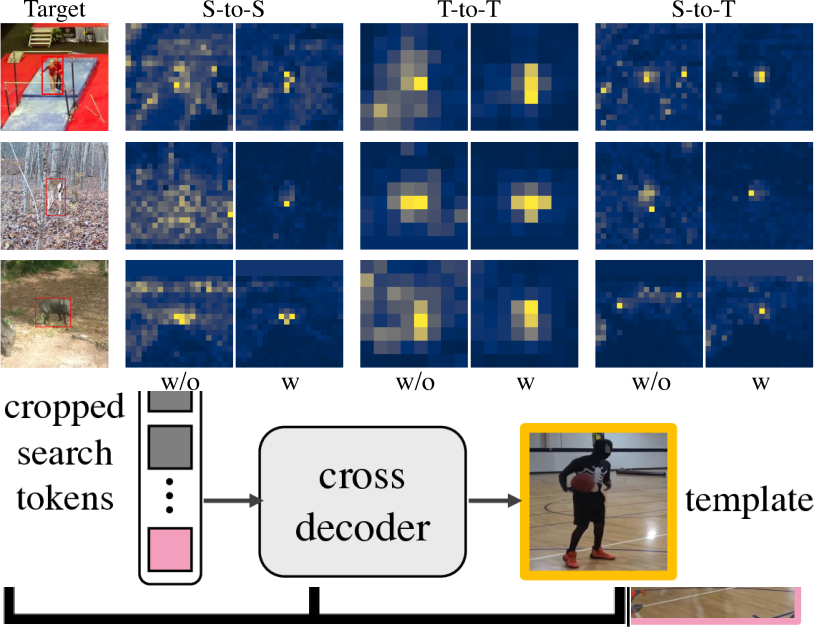
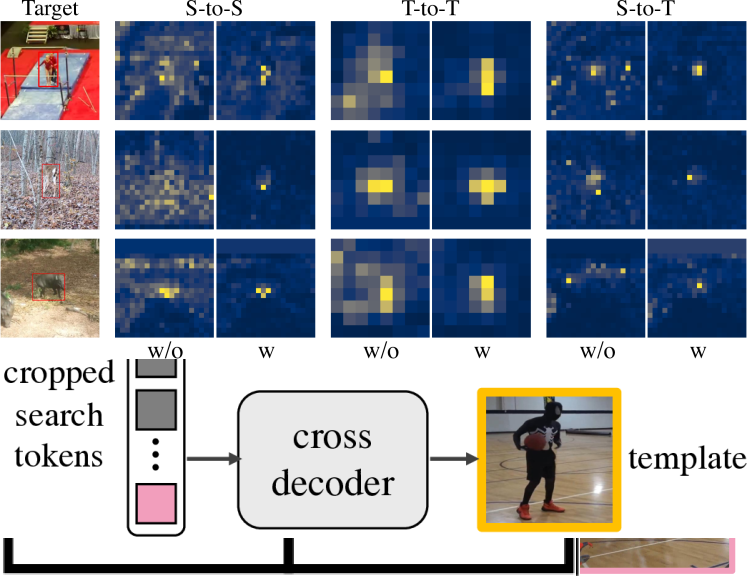
- Introduce a correlative masked decoder with a self-decoder and a cross-decoder to reconstruct template and search images from masked tokens.
- Train with a multi-task loss combining L1, generalized IoU, and a decoder reconstruction loss (MSE on masked tokens).
- Masking ratio for tokens is set to 75% to maximize representation learning, inspired by masked image modeling (MIM).
- During inference, use only the ViT backbone and a box head; the decoder is used only in training.
- Optionally update the online template using a scoring head to decide high-confidence updates.
Experimental results
Research questions
- RQ1Is self-attention sufficient for information aggregation in visual tracking when template and search are concatenated?
- RQ2Which information streams (self-information on template, cross-information, self-information on search) contribute most to tracking performance?
- RQ3Can correlative masked modeling improve CTTrack without compromising inference speed?
- RQ4How does CTTrack perform relative to state-of-the-art trackers on standard benchmarks?
Key findings
- The authors show that vanilla self-attention suffices for information aggregation in tracking and that self-information streams are more impactful than cross-information streams.
- CTTrack runs at 40 fps with a ViT backbone and a simple box head, demonstrating strong speed and accuracy.
- On LaSOT, CTTrack-L achieves 69.8% AUC and 76.2% Prec, while CTTrack-B achieves 64.0% AUC and 67.7% Prec in ablations.
- Across benchmarks, CTTrack-L attains 71.3% AUC on UAV123 and 84.9% AUC on TrackingNet, with GOT-10k AO 72.8%, indicating competitive state-of-the-art performance.
- Incorporating correlative masked decoding raises CTTrack-L AUC from baseline to 65.8% and Prec to 70.9% on LaSOT in ablations.
- The correlative masked decoder can be integrated into other trackers to boost performance without slowing inference.
Read this paper
Open the full text in the Nubint reader and ask about any passage as you read.
Read this paper on NubintThis review was generated by AI from the original paper. Please check the paper before citing it.