
[Paper Review] Comparison of Affine and Rational Quadratic Spline Coupling and Autoregressive Flows through Robust Statistical Tests
This paper conducts a rigorous comparative study of affine and rational quadratic spline coupling and autoregressive flows (RealNVP, MAF, C-RQS, A-RQS) on high-dimensional multimodal distributions (4D to 400D). Using robust two-sample test statistics—sliced Wasserstein distance, Kolmogorov-Smirnov test, and Frobenius norm of correlation differences—it demonstrates that A-RQS consistently outperforms other architectures in accuracy and training speed, while C-RQS suffers from instability and high training cost, especially in high dimensions.
Normalizing flows have emerged as a powerful brand of generative models, as they not only allow for efficient sampling of complicated target distributions but also deliver density estimation by construction. We propose here an in-depth comparison of coupling and autoregressive flows, both based on symmetric (affine) and non-symmetric (rational quadratic spline) bijectors, considering four different architectures: real-valued non-Volume preserving (RealNVP), masked autoregressive flow (MAF), coupling rational quadratic spline (C-RQS), and autoregressive rational quadratic spline (A-RQS). We focus on a set of multimodal target distributions of increasing dimensionality ranging from 4 to 400. The performances were compared by means of different test statistics for two-sample tests, built from known distance measures: the sliced Wasserstein distance, the dimension-averaged one-dimensional Kolmogorov--Smirnov test, and the Frobenius norm of the difference between correlation matrices. Furthermore, we included estimations of the variance of both the metrics and the trained models. Our results indicate that the A-RQS algorithm stands out both in terms of accuracy and training speed. Nonetheless, all the algorithms are generally able, without too much fine-tuning, to learn complicated distributions with limited training data and in a reasonable time of the order of hours on a Tesla A40 GPU. The only exception is the C-RQS, which takes significantly longer to train, does not always provide good accuracy, and becomes unstable for large dimensionalities. All algorithms were implemented using extsc{TensorFlow2} and extsc{TensorFlow Probability} and have been made available on \href{https://github.com/NF4HEP/NormalizingFlowsHD}{GitHub}.
Motivation & Objective
- To evaluate and compare the performance of four normalizing flow architectures—RealNVP, MAF, C-RQS, and A-RQS—on complex, high-dimensional, multimodal target distributions.
- To assess the robustness and generalization capability of these flows using non-parametric two-sample test statistics across increasing dimensions (4D to 400D).
- To analyze training efficiency, convergence speed, and model stability, particularly in low-data regimes and high-dimensional settings.
- To provide a systematic benchmark for normalizing flows in scientific machine learning, especially for applications in high-energy physics and density estimation.
Proposed method
- Employs four normalizing flow architectures: RealNVP (affine coupling), MAF (autoregressive), C-RQS (rational quadratic spline coupling), and A-RQS (rational quadratic spline autoregressive).
- Uses a set of robust two-sample test statistics: sliced Wasserstein distance, dimension-averaged 1D Kolmogorov-Smirnov test, and Frobenius norm of the difference between correlation matrices.
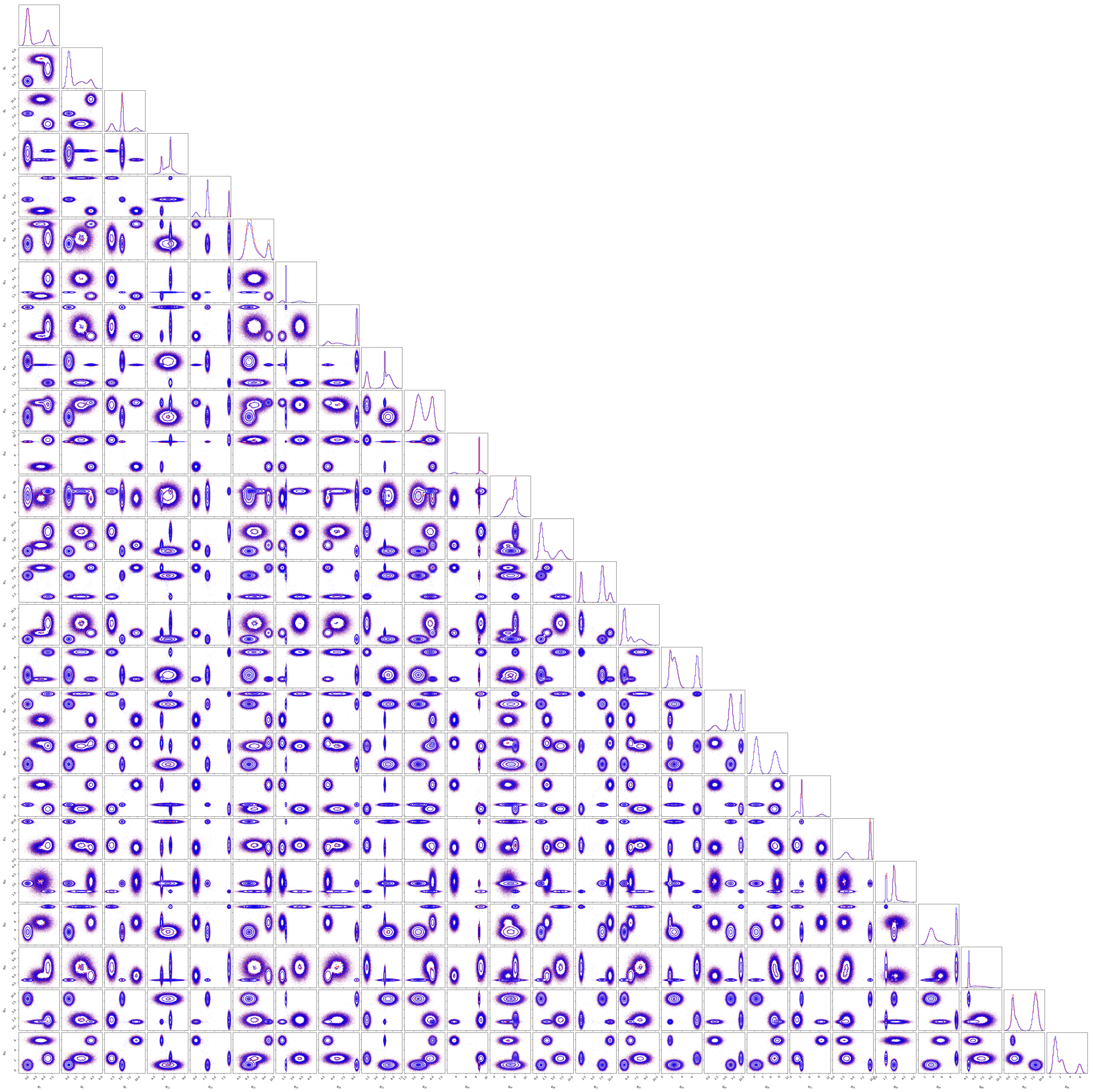
- Trains models on synthetic multivariate Gaussian mixture (CMoG) distributions with increasing dimensionality (4 to 400), using limited training data and minimal hyperparameter tuning.
- Measures training and inference time, loss convergence, and variance of metrics across multiple random seeds to assess stability and reproducibility.
- Implements all models using TensorFlow 2 and TensorFlow Probability, with code publicly available on GitHub.
- Evaluates both average and absolute best models across multiple runs to distinguish performance trends from outliers.
Experimental results
Research questions
- RQ1How do affine and rational quadratic spline-based coupling and autoregressive flows compare in learning high-dimensional multimodal distributions?
- RQ2Which architecture achieves the highest accuracy in matching target distributions across dimensions from 4 to 400, as measured by robust statistical tests?
- RQ3What is the trade-off between training speed, convergence stability, and model accuracy across the four architectures?
- RQ4Does the C-RQS architecture maintain performance and stability in high-dimensional settings, or does it suffer from numerical issues and slow convergence?
- RQ5Can these flows generalize well to complex, high-dimensional distributions with minimal hyperparameter tuning and limited training data?
Key findings
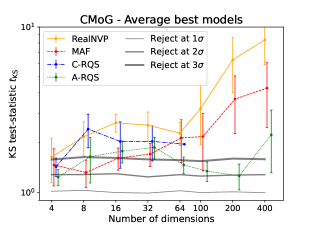
- The Autoregressive Rational Quadratic Spline (A-RQS) model achieves the best overall performance, consistently yielding the lowest test-statistic values across all dimensions, indicating superior distribution matching.
- A-RQS trains significantly faster than C-RQS, with training times under 10k seconds even at 400D, while C-RQS required over 70k seconds at 400D, indicating poor scalability.
- C-RQS showed instability and poor convergence in high-dimensional settings (≥200D), with high variance and frequent failure to match target distributions, despite using rational quadratic splines.
- MAF and RealNVP performed reasonably well but were outperformed by A-RQS in both accuracy and speed, especially beyond 100D.
- Even with minimal hyperparameter tuning, all models learned complex distributions within hours on a Tesla A40 GPU, indicating strong generalization with low data requirements.
- At 400D, A-RQS achieved a sliced Wasserstein distance of $3.3 imes 10^{-1}$ (mean), a KS-test $p$-value of $1.2 imes 10^{-1}$, and Frobenius norm of $2.7 imes 10^{-1}$, demonstrating strong fidelity to the target distribution.
Read this paper
Open the full text in the Nubint reader and ask about any passage as you read.
Read this paper on NubintThis review was generated by AI from the original paper. Please check the paper before citing it.