
[Paper Review] Complex Logical Reasoning over Knowledge Graphs using Large Language Models
LARK integrates logical reasoning over knowledge graphs with large language models by abstracting KG queries, retrieving subgraphs, and decomposing complex queries into single-operation prompts for sequential LLM reasoning, achieving state-of-the-art results on standard KG benchmarks.
Reasoning over knowledge graphs (KGs) is a challenging task that requires a deep understanding of the complex relationships between entities and the underlying logic of their relations. Current approaches rely on learning geometries to embed entities in vector space for logical query operations, but they suffer from subpar performance on complex queries and dataset-specific representations. In this paper, we propose a novel decoupled approach, Language-guided Abstract Reasoning over Knowledge graphs (LARK), that formulates complex KG reasoning as a combination of contextual KG search and logical query reasoning, to leverage the strengths of graph extraction algorithms and large language models (LLM), respectively. Our experiments demonstrate that the proposed approach outperforms state-of-the-art KG reasoning methods on standard benchmark datasets across several logical query constructs, with significant performance gain for queries of higher complexity. Furthermore, we show that the performance of our approach improves proportionally to the increase in size of the underlying LLM, enabling the integration of the latest advancements in LLMs for logical reasoning over KGs. Our work presents a new direction for addressing the challenges of complex KG reasoning and paves the way for future research in this area.
Motivation & Objective
- Motivate robust reasoning over large, noisy, incomplete knowledge graphs beyond traditional embedding-based methods.
- Decouple KG reasoning from LLM reasoning by using abstraction and subgraph contexts to leverage LLM strengths for simple prompts.
- Improve performance on complex first-order logic queries (p, ∧, ∨, ¬) through chain decomposition and logically-ordered prompting.
- Demonstrate scalability with larger LLMs and analyze the impact of query abstraction on generalization and hallucination reduction.
Proposed method
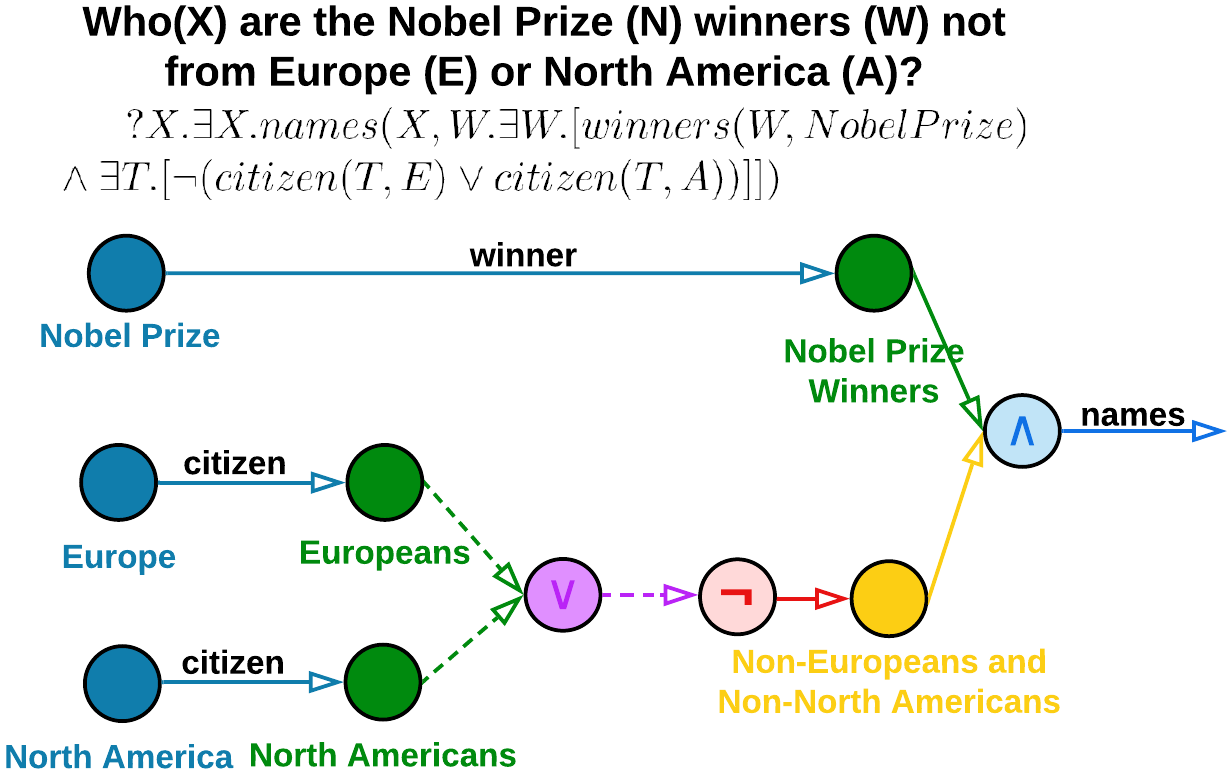
- Abstract entities and relations into unique IDs to form KG-agnostic prompts and reduce token load.
- Perform k-level neighborhood retrieval to construct context subgraphs around query entities/relations.
- Decompose complex multi-operation queries into sequences of single-operation queries (e.g., 3p → 1p chains; 3i/2i with projections).
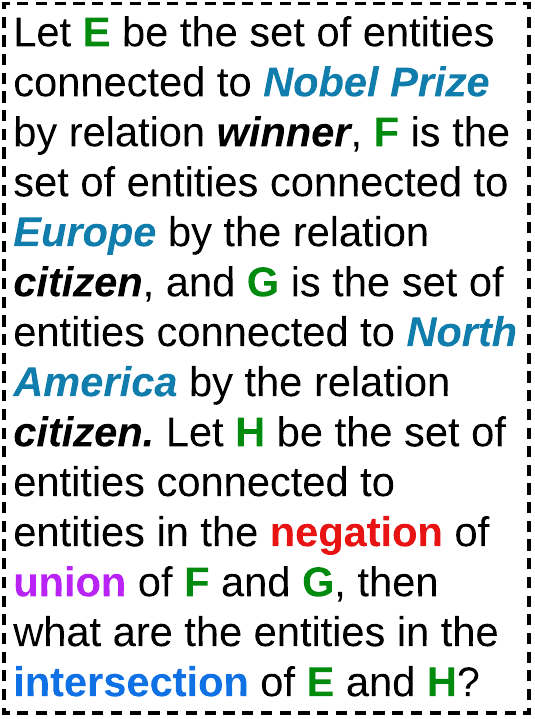
- Convert decomposed queries and neighborhood context into LLM prompts with placeholders for dependent answers and an in-memory cache of prior results.
- Process decomposed prompts in logically ordered phases, enabling batching and reuse of intermediate results while minimizing hallucination.
- Empirically validate LARK on FB15k, FB15k-237, and NELL995 against baselines (GQE, Q2B, BetaE, HQE, HypE, CQD).
Experimental results
Research questions
- RQ1Does LARK outperform state-of-the-art baselines on standard KG logical reasoning benchmarks?
- RQ2Are chain-decomposed prompts more effective than standard complex prompts for LLM-based KG reasoning?
- RQ3How does LARK performance scale with larger LLMs and token capacities?
- RQ4What is the impact of query abstraction on performance and generalization across datasets?
- RQ5Can LARK handle negation and complex query types more effectively than prior methods?
Key findings
- LARK outperforms previous state-of-the-art baselines by 33%–64% MRR on 14 FOL query types across several datasets.
- Chain decomposition yields 9%–26% improvements over complex queries, highlighting the benefit of breaking down reasoning for LLMs.
- Increasing LLM size (Flan-T5 L to XXL) yields substantial gains (up to 118% MRR increase on FB15k-237).
- Query abstraction reduces token load and hallucination risk with negligible loss in performance; semantic-rich variants can slightly hurt performance on complex queries due to token limits.
- LARK shows strong negation handling, often outperforming baselines on negation queries, with caveats related to token-length constraints on some query types.
Read this paper
Open the full text in the Nubint reader and ask about any passage as you read.
Read this paper on NubintThis review was generated by AI from the original paper. Please check the paper before citing it.