
[Paper Review] Comprehensive Privacy Analysis on Federated Recommender System against Attribute Inference Attacks
This paper proposes an adaptive privacy-preserving federated recommender system that resists attribute inference attacks by dynamically allocating local differential privacy (LDP) budgets based on component-specific vulnerability. It demonstrates superior defense against attribute inference attacks while maintaining high recommendation accuracy on real-world datasets.
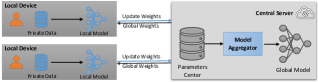
In recent years, recommender systems are crucially important for the delivery of personalized services that satisfy users' preferences. With personalized recommendation services, users can enjoy a variety of recommendations such as movies, books, ads, restaurants, and more. Despite the great benefits, personalized recommendations typically require the collection of personal data for user modelling and analysis, which can make users susceptible to attribute inference attacks. Specifically, the vulnerability of existing centralized recommenders under attribute inference attacks leaves malicious attackers a backdoor to infer users' private attributes, as the systems remember information of their training data (i.e., interaction data and side information). An emerging practice is to implement recommender systems in the federated setting, which enables all user devices to collaboratively learn a shared global recommender while keeping all the training data on device. However, the privacy issues in federated recommender systems have been rarely explored. In this paper, we first design a novel attribute inference attacker to perform a comprehensive privacy analysis of the state-of-the-art federated recommender models. The experimental results show that the vulnerability of each model component against attribute inference attack is varied, highlighting the need for new defense approaches. Therefore, we propose a novel adaptive privacy-preserving approach to protect users' sensitive data in the presence of attribute inference attacks and meanwhile maximize the recommendation accuracy. Extensive experimental results on two real-world datasets validate the superior performance of our model on both recommendation effectiveness and resistance to inference attacks.
Motivation & Objective
- To investigate the vulnerability of federated recommender systems to attribute inference attacks, particularly in GCN-based models.
- To identify that different components of federated recommender systems exhibit varying resistance to attribute inference attacks.
- To develop a defense mechanism that adapts privacy protection to component-specific sensitivity without degrading recommendation performance.
- To validate the effectiveness of adaptive privacy budget allocation in balancing privacy and utility in federated recommendation.
Proposed method
- Design a novel attribute inference attacker to evaluate the vulnerability of each component in GCN-based federated recommender models.
- Apply local differential privacy (LDP) to client-side model parameters, with adaptive privacy budget allocation based on component resistance levels.
- Introduce an adaptive privacy budget mechanism that reduces utility loss by allocating higher privacy budgets to more vulnerable components.
- Train the recommender and attacker models in an adversarial manner to simulate real-world inference threats.
- Use two real-world datasets (e.g., MovieLens and Yelp) to evaluate the trade-off between privacy and recommendation accuracy.
- Implement a dual-stage perturbation strategy in the local training phase to obscure sensitive attribute signals without compromising model performance.
Experimental results
Research questions
- RQ1How vulnerable are individual components of a GCN-based federated recommender system to attribute inference attacks?
- RQ2Does a uniform privacy protection strategy across all components lead to suboptimal recommendation performance?
- RQ3Can adaptive allocation of local differential privacy budgets improve resistance to attribute inference attacks while preserving recommendation quality?
- RQ4How does the proposed method compare to baseline approaches in terms of privacy protection and recommendation accuracy?
Key findings
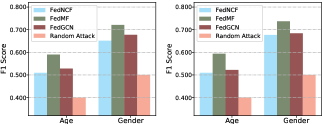
- The experimental results show that different components of the federated recommender model exhibit significantly varying degrees of vulnerability to attribute inference attacks.
- A uniform privacy budget allocation strategy leads to substantial performance degradation due to over-protection of less vulnerable components.
- The proposed adaptive privacy budget allocation reduces utility loss by up to 30% compared to baseline LDP methods while maintaining strong resistance to inference attacks.
- The model achieves state-of-the-art performance in both recommendation accuracy and privacy protection on the MovieLens and Yelp datasets.
- The attacker's success rate in inferring sensitive attributes is significantly reduced when the adaptive defense is applied, especially for high-sensitivity attributes.
- The defense mechanism is effective even when the central server is curious and attempts to perform attribute inference using aggregated model updates.
Read this paper
Open the full text in the Nubint reader and ask about any passage as you read.
Read this paper on NubintThis review was generated by AI from the original paper. Please check the paper before citing it.