
[Paper Review] Computational Approaches for Integrating out Subjectivity in Cognate Synonym Selection
This paper proposes using probabilistic binary and multi-valued character matrices to represent cognate data with all synonyms, avoiding subjective pre-selection. Using RAxML-NG, it shows that synonym selection drastically alters tree topologies, and that the optimal matrix type depends on dataset-specific properties like rate heterogeneity and inference difficulty, with all three matrix types recommended for evaluation due to dataset dependency.
Working with cognate data involves handling synonyms, that is, multiple words that describe the same concept in a language. In the early days of language phylogenetics it was recommended to select one synonym only. However, as we show here, binary character matrices, which are used as input for computational methods, do allow for representing the entire dataset including all synonyms. Here we address the question how one can and if one should include all synonyms or whether it is preferable to select synonyms a priori. To this end, we perform maximum likelihood tree inferences with the widely used RAxML-NG tool and show that it yields plausible trees when all synonyms are used as input. Furthermore, we show that a priori synonym selection can yield topologically substantially different trees and we therefore advise against doing so. To represent cognate data including all synonyms, we introduce two types of character matrices beyond the standard binary ones: probabilistic binary and probabilistic multi-valued character matrices. We further show that it is dataset-dependent for which character matrix type the inferred RAxML-NG tree is topologically closest to the gold standard. We also make available a Python interface for generating all of the above character matrix types for cognate data provided in CLDF format.
Motivation & Objective
- To investigate whether manual synonym selection in cognate data significantly alters phylogenetic tree topologies.
- To evaluate whether probabilistic character matrices can better represent cognate data with all synonyms than standard binary matrices.
- To determine if the choice of character matrix type affects the topological accuracy of RAxML-NG-inferred language trees.
- To identify dataset-level properties that predict which character matrix type yields the most accurate tree relative to a gold standard.
- To provide a practical, open-source Python interface for generating all three matrix types from CLDF-formatted cognate datasets.
Proposed method
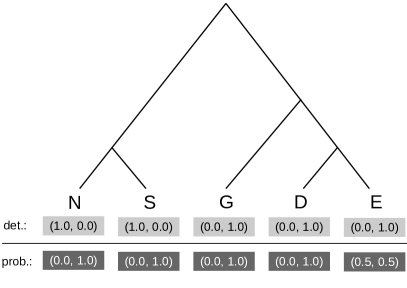
- The authors construct three types of character matrices: standard binary (A^b), probabilistic binary (A^b*), and probabilistic multi-valued (A^m*) from cognate data in CLDF format.
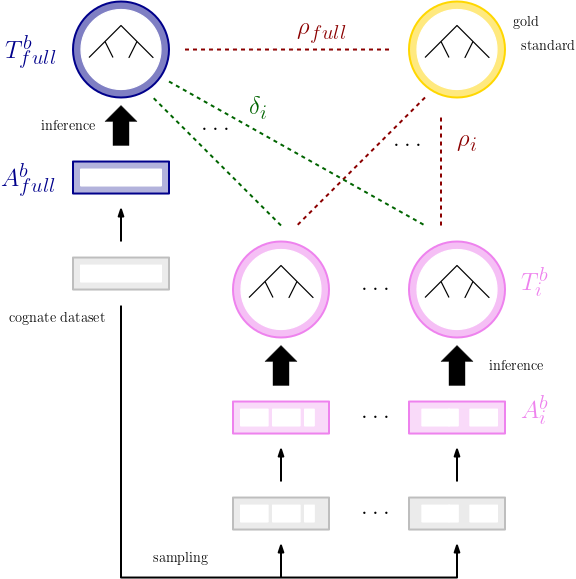
- They perform maximum likelihood tree inference using RAxML-NG on each matrix type for 11 cognate datasets with known gold-standard trees.
- The probabilistic matrices encode synonym presence with uniform probability distributions, allowing RAxML-NG to model uncertainty in synonym usage.
- Tree topologies from each matrix type are compared to the Glottolog gold standard using Robinson-Foulds distance to assess topological accuracy.
- They analyze model parameters such as the alpha shape parameter of the gamma distribution and inference difficulty scores to identify predictive features of matrix performance.
- A Python package is developed and released on GitHub to automate the generation of all three matrix types from CLDF-formatted cognate data.
Experimental results
Research questions
- RQ1Does manual synonym selection prior to tree inference lead to topologically different language trees compared to using all synonyms?
- RQ2Which character matrix type—standard binary, probabilistic binary, or probabilistic multi-valued—yields the most accurate tree topology when compared to the gold standard?
- RQ3Can dataset-specific properties such as rate heterogeneity (alpha shape parameter) or inference difficulty predict the best-performing character matrix type?
- RQ4Is there a consistent advantage to using probabilistic matrices over deterministic binary matrices across diverse cognate datasets?
- RQ5Can the performance of different matrix types be predicted based on observable data characteristics, or is it necessary to evaluate all types for each dataset?
Key findings
- Manual synonym selection can result in tree topologies that differ by up to 100% in topology from those inferred using all synonyms, indicating that such selection introduces substantial bias.
- The probabilistic multi-valued matrix (A^m*) performed best in 9 out of 11 datasets, particularly in those with high rate heterogeneity (alpha < 20), suggesting it better captures variation in synonym usage.
- The standard binary matrix (A^b) performed best in 5 out of 11 datasets, especially in cases with moderate to low inference difficulty, indicating that deterministic representation can outperform probabilistic models when signal is strong.
- Datasets with the highest performance from probabilistic matrices showed lower average difficulty scores (0.18) compared to those favoring binary matrices (0.45), indicating that probabilistic models are more effective when signal is weak.
- The alpha shape parameter of the gamma distribution was below 20 in 9 out of 11 datasets where probabilistic matrices outperformed, indicating that rate heterogeneity is a key predictor of matrix type performance.
- Due to the lack of sufficient data to train predictive models, the authors recommend evaluating all three matrix types for each new cognate dataset to ensure optimal topological accuracy.
Read this paper
Open the full text in the Nubint reader and ask about any passage as you read.
Read this paper on NubintThis review was generated by AI from the original paper. Please check the paper before citing it.