
[Paper Review] Computational Discovery of Microstructured Composites with Optimal Stiffness-Toughness Trade-Offs
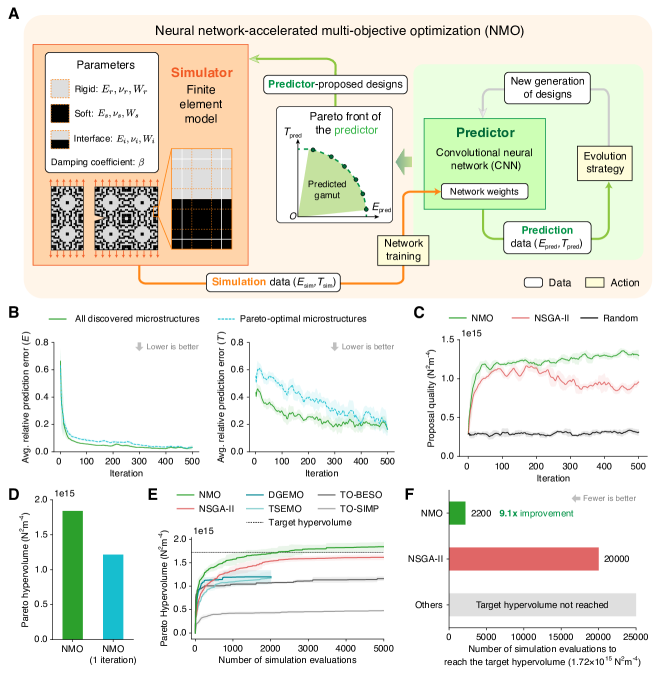
This paper presents a data-efficient, expert-knowledge-free pipeline integrating physical experiments, FEM simulations, and CNN-based prediction to discover microstructured composites with optimal stiffness-toughness trade-offs. By employing a nested-loop proposal-validation workflow, the method bridges simulation-to-reality gaps and identifies Pareto-optimal designs that achieve high stiffness and toughness, while automatically uncovering established toughening mechanisms through analysis of microstructure families.
The conflict between stiffness and toughness is a fundamental problem in engineering materials design. However, the systematic discovery of microstructured composites with optimal stiffness-toughness trade-offs has never been demonstrated, hindered by the discrepancies between simulation and reality and the lack of data-efficient exploration of the entire Pareto front. We introduce a generalizable pipeline that integrates physical experiments, numerical simulations, and artificial neural networks to address both challenges. Without any prescribed expert knowledge of material design, our approach implements a nested-loop proposal-validation workflow to bridge the simulation-to-reality gap and discover microstructured composites that are stiff and tough with high sample efficiency. Further analysis of Pareto-optimal designs allows us to automatically identify existing toughness enhancement mechanisms, which were previously discovered through trial-and-error or biomimicry. On a broader scale, our method provides a blueprint for computational design in various research areas beyond solid mechanics, such as polymer chemistry, fluid dynamics, meteorology, and robotics.
Motivation & Objective
- To systematically discover microstructured composites that achieve optimal trade-offs between stiffness and toughness, overcoming the limitations of trial-and-error or biomimicry.
- To address the simulation-to-reality gap in toughness prediction by integrating physical experiments with numerical simulations and machine learning.
- To enable data-efficient exploration of the entire Pareto front of stiffness-toughness trade-offs without relying on expert-designed material architectures.
- To automatically identify and validate intrinsic toughening mechanisms in discovered microstructures through pattern analysis and simulation validation.
Proposed method
- A nested-loop pipeline integrates three evaluators: a physical mechanical tester (slow, high accuracy), an FEM-based simulator (moderate speed and accuracy), and a CNN-based predictor (fast, lower accuracy) to iteratively refine and validate designs.
- The CNN predictor is trained using performance data from the mechanical tester and FEM simulator, with performance data propagated from slower to faster evaluators to improve accuracy.
- Proposed Pareto-optimal designs are sent from faster evaluators (CNN and FEM) to the mechanical tester for physical validation, ensuring real-world accuracy.
- A beam search algorithm selects diverse, maximally distinct microstructures from radial bins in performance space to explore the full Pareto front efficiently.
- Family-specific simulators are constructed via system identification on near-Pareto-optimal microstructures to improve local prediction accuracy and enable dense evolutionary sampling within each family.
- Isomap-based 2D embedding with Earth Mover’s Distance (EMD) as the metric visualizes microstructure pattern variation, and optimal transport-based interpolation generates additional patterns to refine the embedding space.

Experimental results
Research questions
- RQ1Can a simulation-experiment-ML pipeline discover microstructured composites with optimal stiffness-toughness trade-offs without prior expert knowledge of material design?
- RQ2How can the simulation-to-reality gap in toughness prediction be effectively bridged in complex microstructured composites?
- RQ3What are the intrinsic microstructural features and toughening mechanisms that underlie Pareto-optimal stiffness-toughness trade-offs?
- RQ4Can data-efficient, high-throughput discovery of optimal microstructures be achieved using a hybrid pipeline of physical testing, simulation, and deep learning?
Key findings
- The pipeline successfully discovered 11 near-Pareto-optimal microstructures across four distinct families, each with similar mechanical performance and pattern characteristics.
- Family-specific simulators reduced prediction errors on seed microstructures by up to 40% compared to the global simulator, significantly improving local accuracy.
- The method achieved high sample efficiency by minimizing the number of physical experiments required, with only three additional physical validations needed after dense evolutionary sampling.
- Isomap embedding with EMD-based distance revealed clear subfamily structures within each microstructure family, indicating pattern similarity and continuity in mechanical behavior.
- Interpolation using Wasserstein barycenters generated approximately 5% more microstructure patterns per subfamily, enhancing coverage of the design space.
- Video analysis of mechanical testing and simulation confirmed that the family-specific simulators accurately captured dominant toughening mechanisms, such as crack deflection and bridging, in the discovered microstructures.
Better researchstarts right now
From reading papers to final review, dramatically reduce your research time.
No credit card · Free plan available
This review was created by AI and reviewed by human editors.