
[Paper Review] Computational Intelligence and Deep Learning for Next-Generation Edge-Enabled Industrial IoT
This paper proposes a multi-exit-based federated edge learning (ME-FEEL) framework that enables resource-constrained industrial IoT devices to train and contribute to a shared model using partial sub-models via early exits, significantly reducing latency and improving participation. By integrating knowledge distillation and a greedy bandwidth-allocation algorithm, ME-FEEL achieves up to 32.7% higher accuracy than conventional federated learning under severe resource constraints.
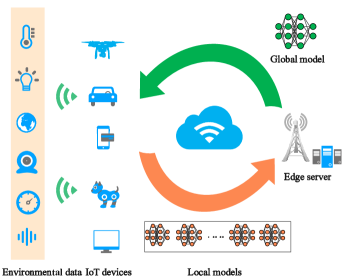
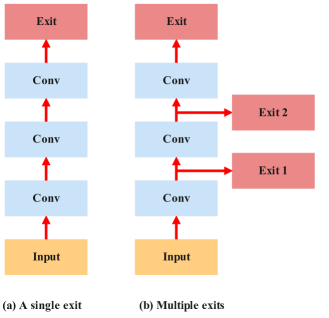
In this paper, we investigate how to deploy computational intelligence and deep learning (DL) in edge-enabled industrial IoT networks. In this system, the IoT devices can collaboratively train a shared model without compromising data privacy. However, due to limited resources in the industrial IoT networks, including computational power, bandwidth, and channel state, it is challenging for many devices to accomplish local training and upload weights to the edge server in time. To address this issue, we propose a novel multi-exit-based federated edge learning (ME-FEEL) framework, where the deep model can be divided into several sub-models with different depths and output prediction from the exit in the corresponding sub-model. In this way, the devices with insufficient computational power can choose the earlier exits and avoid training the complete model, which can help reduce computational latency and enable devices to participate into aggregation as much as possible within a latency threshold. Moreover, we propose a greedy approach-based exit selection and bandwidth allocation algorithm to maximize the total number of exits in each communication round. Simulation experiments are conducted on the classical Fashion-MNIST dataset under a non-independent and identically distributed (non-IID) setting, and it shows that the proposed strategy outperforms the conventional FL. In particular, the proposed ME-FEEL can achieve an accuracy gain up to 32.7% in the industrial IoT networks with the severely limited resources.
Motivation & Objective
- To address system heterogeneity in edge-enabled industrial IoT networks where devices vary in computational power, bandwidth, and channel quality.
- To enable low-latency, privacy-preserving model training by allowing devices to train only partial sub-models through early exits.
- To maximize the number of participating devices per communication round under strict latency and bandwidth constraints.
- To improve the performance of early exits—typically weaker in feature extraction—using self-knowledge distillation.
- To develop a joint exit selection and bandwidth allocation strategy that optimizes system-wide participation and convergence.
Proposed method
- The deep neural network is instrumented with multiple exits at different depths, allowing devices to train and upload only up to a selected exit based on their available resources.
- Each exit produces a prediction, and the model is trained such that all exits share a common sub-architecture to ensure compatibility during aggregation.
- A self-knowledge distillation technique is applied to transfer knowledge from deeper, more accurate exits to shallower ones, improving the performance of early exits.
- A greedy algorithm is proposed to jointly select the optimal exit per device and allocate available bandwidth to maximize the expected number of exits in each round.
- The framework is evaluated under non-iid data distribution using the Fashion-MNIST dataset in a latency- and bandwidth-constrained environment.
- The system is designed to maintain model privacy by exchanging only model weights, not raw data, aligning with federated learning principles.
Experimental results
Research questions
- RQ1How can edge-enabled industrial IoT devices with limited computational and communication resources participate effectively in federated learning?
- RQ2What is the optimal strategy for selecting which exit (sub-model depth) a device should train, given its resource constraints?
- RQ3How can the performance of early exits—typically less accurate—be improved without increasing model complexity?
- RQ4What joint resource allocation strategy maximizes the number of contributing devices per communication round under latency and bandwidth constraints?
- RQ5How does the proposed ME-FEEL framework perform compared to conventional federated learning under realistic, non-iid, and resource-limited conditions?
Key findings
- ME-FEEL achieved an accuracy gain of up to 32.7% compared to conventional federated learning in highly resource-constrained industrial IoT networks.
- The use of knowledge distillation improved the accuracy of the first exit by 6% and enhanced performance across all exits, with gains of 4.5%, 3.53%, 2.25%, and 1.3% for exits 2 to 5, respectively.
- Under a latency threshold of 12 seconds, ME-FEEL achieved a 2.68% accuracy gain over conventional FEEL and a 16.6% gain over FEEL-UB.
- When communication bandwidth decreased from 50 MHz to 35 MHz, ME-FEEL showed only minor performance degradation, maintaining a 20.75% accuracy advantage over FEEL-UB.
- The proposed greedy exit selection and bandwidth allocation algorithm effectively increased the number of participating devices per round, enhancing model convergence and robustness.
- ME-FEEL demonstrated superior robustness under varying latency and bandwidth conditions, outperforming both FEEL and FEEL-UB across all tested configurations.
Read this paper
Open the full text in the Nubint reader and ask about any passage as you read.
Read this paper on NubintThis review was generated by AI from the original paper. Please check the paper before citing it.