
[Paper Review] Computer Vision Aided Beam Tracking in A Real-World Millimeter Wave Deployment
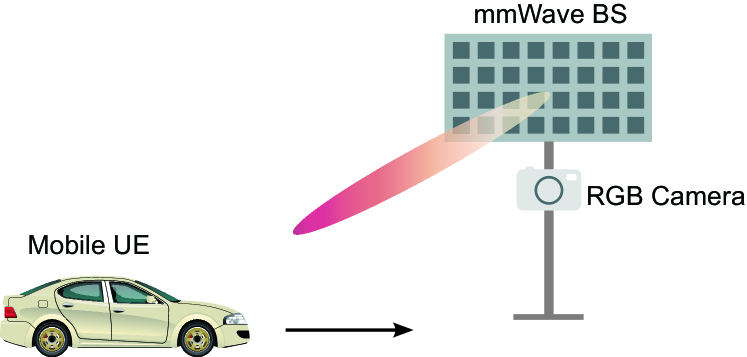
This paper proposes a vision-aided beam tracking framework using a deep encoder-decoder model that leverages visual data from cameras at mmWave base stations to predict future optimal beams, reducing beam training overhead by over 99% while achieving 64.47% top-1 accuracy and 97.66% normalized receive power on a real-world dataset.
Millimeter-wave (mmWave) and terahertz (THz) communications require beamforming to acquire adequate receive signal-to-noise ratio (SNR). To find the optimal beam, current beam management solutions perform beam training over a large number of beams in pre-defined codebooks. The beam training overhead increases the access latency and can become infeasible for high-mobility applications. To reduce or even eliminate this beam training overhead, we propose to utilize the visual data, captured for example by cameras at the base stations, to guide the beam tracking/refining process. We propose a machine learning (ML) framework, based on an encoder-decoder architecture, that can predict the future beams using the previously obtained visual sensing information. Our proposed approach is evaluated on a large-scale real-world dataset, where it achieves an accuracy of $64.47\%$ (and a normalized receive power of $97.66\%$) in predicting the future beam. This is achieved while requiring less than $1\%$ of the beam training overhead of a corresponding baseline solution that uses a sequence of previous beams to predict the future one. This high performance and low overhead obtained on the real-world dataset demonstrate the potential of the proposed vision-aided beam tracking approach in real-world applications.
Motivation & Objective
- To reduce beam training overhead in mmWave/THz systems, especially for high-mobility applications like V2X.
- To enable low-latency beam prediction by leveraging visual sensing data instead of relying solely on prior beam sequences.
- To develop a machine learning framework that predicts future beams using visual inputs, improving tracking robustness in dynamic environments.
- To evaluate the proposed vision-aided beam tracking approach on a large-scale real-world dataset with co-located visual and mmWave beam data.
- To demonstrate that visual data can outperform traditional beam sequence-based prediction in dynamic and blockage-prone scenarios.
Proposed method
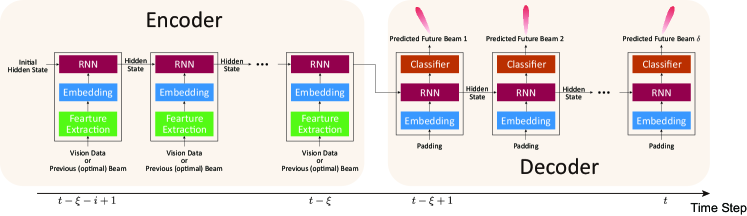
- A deep encoder-decoder neural network architecture is used to map visual inputs (RGB images) to predicted beam indices.
- The encoder processes visual data from the camera to extract spatial and environmental features relevant to beam direction.
- The decoder generates beam predictions based on the encoded visual representation, modeling temporal dynamics for future beam tracking.
- The model is trained end-to-end using real-world mmWave beam training data and corresponding visual snapshots from the DeepSense 6G dataset.
- Beam prediction is evaluated using top-k accuracy and normalized receive power, with performance compared against a baseline using previous optimal beam sequences.
- The beam training overhead is quantified as the number of beams swept in the codebook during prediction, with the vision-aided approach requiring significantly fewer beams.
Experimental results
Research questions
- RQ1Can visual sensing data from cameras at mmWave base stations effectively reduce beam training overhead in real-world mmWave deployments?
- RQ2How does vision-aided beam tracking performance compare to beam tracking based on previous optimal beam sequences in terms of accuracy and receive power?
- RQ3To what extent does visual data improve beam tracking robustness in dynamic or non-line-of-sight (NLoS) environments compared to beam sequence-based methods?
- RQ4How does the size of the beam codebook affect the performance of vision-aided beam tracking in terms of accuracy and receive power?
- RQ5Can the proposed vision-aided framework maintain high performance over time without drift, unlike beam sequence-based baselines?
Key findings
- The vision-aided beam tracking approach achieves a top-1 accuracy of 64.47% and a top-5 accuracy of 98.95% in predicting future beams on a real-world mmWave dataset.
- The normalized receive power of the top-1 predicted beam reaches 97.66%, indicating strong link quality even with a single beam prediction.
- The beam training overhead of the vision-aided approach is less than 1% of the baseline approach that uses eight previous optimal beams.
- When predicting the top-1 beam, the vision-aided method completely eliminates beam training overhead, achieving zero training cost in that case.
- The performance gain is especially pronounced in dynamic environments, as visual data captures environmental changes that beam sequences alone cannot.
- Increasing the beam codebook size from 16 to 64 improves normalized receive power by 6% (from 92.17% to 97.66%), demonstrating the benefit of oversampling.
Better researchstarts right now
From reading papers to final review, dramatically reduce your research time.
No credit card · Free plan available
This review was created by AI and reviewed by human editors.