
[Paper Review] ConDA: Unsupervised Domain Adaptation for LiDAR Segmentation via Regularized Domain Concatenation
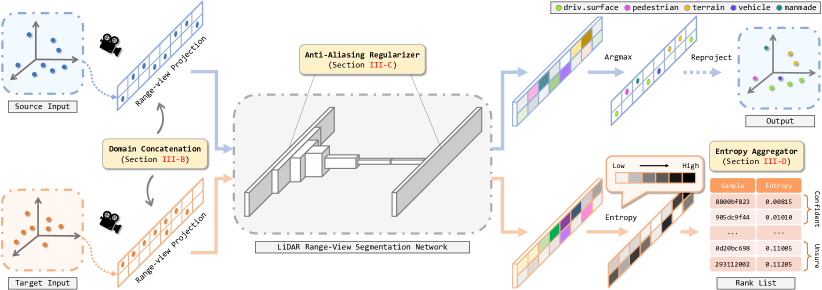
ConDA proposes a novel unsupervised domain adaptation framework for LiDAR semantic segmentation that constructs an intermediate domain by concatenating non-overlapping, spatially aligned regions from source (with ground-truth) and target (with pseudo-labels) LiDAR range views, enabling fine-grained cross-domain interaction. It achieves state-of-the-art performance with a 42.3% mIoU on the Boston→Singapore benchmark, significantly outperforming prior methods by leveraging a built-in anti-aliasing regularizer and entropy aggregator to reduce noise and aliasing artifacts.
Transferring knowledge learned from the labeled source domain to the raw target domain for unsupervised domain adaptation (UDA) is essential to the scalable deployment of autonomous driving systems. State-of-the-art methods in UDA often employ a key idea: utilizing joint supervision signals from both source and target domains for self-training. In this work, we improve and extend this aspect. We present ConDA, a concatenation-based domain adaptation framework for LiDAR segmentation that: 1) constructs an intermediate domain consisting of fine-grained interchange signals from both source and target domains without destabilizing the semantic coherency of objects and background around the ego-vehicle; and 2) utilizes the intermediate domain for self-training. To improve the network training on the source domain and self-training on the intermediate domain, we propose an anti-aliasing regularizer and an entropy aggregator to reduce the negative effect caused by the aliasing artifacts and noisy pseudo labels. Through extensive studies, we demonstrate that ConDA significantly outperforms prior arts in mitigating domain gaps.
Motivation & Objective
- To address the domain gap in LiDAR semantic segmentation between cities like Boston and Singapore, where labeled data is scarce in target domains.
- To improve unsupervised domain adaptation (UDA) by enabling fine-grained, spatially coherent interactions between source and target domains beyond simple feature alignment.
- To mitigate the negative impact of noisy pseudo-labels and aliasing artifacts in self-training during UDA for 3D point cloud segmentation.
- To develop a training framework that enhances model generalization through explicit regularization and uncertainty-aware supervision.
Proposed method
- Constructs an intermediate domain by concatenating non-overlapping spatial regions (e.g., front-top, back-bottom) from source and target LiDAR range views while preserving their relative positions to maintain semantic coherency.
- Applies a built-in anti-aliasing regularizer within each convolution block to suppress high-frequency aliasing artifacts without requiring target annotations.
- Introduces an entropy aggregator that filters out high-entropy (low-confidence) pseudo-labels from the target domain to improve the quality of self-training signals.
- Uses joint self-training on the intermediate domain, leveraging both source ground-truth and refined target pseudo-labels for improved feature learning.
- Employs a range-view (RV) representation of LiDAR point clouds to preserve spatial context and enable structured domain mixing.
- Trains a segmentation backbone end-to-end using a combination of cross-entropy loss on source data and consistency regularization on the intermediate domain.
![Figure 1: Illustrative examples for domain concatenation. (a) Visual RGB and LiDAR range-view (RV) projections of the source (ground-truth) and target (pseudo-labels) domains. Images adopted from nuScenes [ 2 ] . (b) Cylindrical representation of LiDAR RV. (c) Concatenated examples. Mixing domains u](https://ar5iv.labs.arxiv.org/html/2111.15242/assets/x1.png)
Experimental results
Research questions
- RQ1Can domain concatenation of spatially aligned, non-overlapping regions from source and target LiDAR data preserve semantic coherency while enabling fine-grained cross-domain interaction?
- RQ2Does introducing an anti-aliasing regularizer within the network architecture reduce the negative impact of aliasing artifacts in UDA for LiDAR segmentation?
- RQ3Can an entropy-based filtering mechanism improve the quality of pseudo-labels and thus enhance self-training performance in the absence of target annotations?
- RQ4Does the proposed intermediate domain training strategy lead to better generalization and higher mIoU compared to standard self-training or adversarial adaptation?
Key findings
- ConDA achieves a 42.3% mIoU on the Boston→Singapore UDA benchmark, significantly outperforming prior state-of-the-art methods such as CBST (38.1%) and IntraDA (36.8%).
- The method achieves a 27.9% mIoU on the 'rider' class and 82.3% on 'motorcycle' in the Boston→Singapore setting, showing strong gains on rare and challenging classes.
- The entropy aggregator reduces the number of low-confidence pseudo-labels, improving the reliability of self-training and contributing to a 4.2% mIoU gain over baseline self-training.
- The anti-aliasing regularizer effectively suppresses high-frequency noise, reducing the negative impact of region re-grouping during domain concatenation.
- ConDA outperforms adversarial methods like AdvEnt and DADA in both mIoU and inference speed, with training time comparable to MinEnt and CBST.
- Qualitative results show ConDA reduces false predictions holistically around the ego-vehicle, unlike prior methods that show limited or localized improvements.
Better researchstarts right now
From reading papers to final review, dramatically reduce your research time.
No credit card · Free plan available
This review was created by AI and reviewed by human editors.