
[Paper Review] Confidence on the Focal: Conformal Prediction with Selection-Conditional Coverage
This paper proposes a conformal prediction framework that ensures finite-sample exact coverage conditional on data-driven selection of test units, addressing selection bias in practical applications. It introduces a general method for constructing prediction sets with valid uncertainty quantification for selected units, applicable to arbitrary selection rules and demonstrated to achieve exact coverage in drug discovery and healthcare prediction scenarios.
Conformal prediction builds marginally valid prediction intervals that cover the unknown outcome of a randomly drawn test point with a prescribed probability. However, in practice, data-driven methods are often used to identify specific test unit(s) of interest, requiring uncertainty quantification tailored to these focal units. In such cases, marginally valid conformal prediction intervals may fail to provide valid coverage for the focal unit(s) due to selection bias. This paper presents a general framework for constructing a prediction set with finite-sample exact coverage, conditional on the unit being selected by a given procedure. The general form of our method accommodates arbitrary selection rules that are invariant to the permutation of the calibration units, and generalizes Mondrian Conformal Prediction to multiple test units and non-equivariant classifiers. We also work out computationally efficient implementation of our framework for a number of realistic selection rules, including top-K selection, optimization-based selection, selection based on conformal p-values, and selection based on properties of preliminary conformal prediction sets. The performance of our methods is demonstrated via applications in drug discovery and health risk prediction.
Motivation & Objective
- To address the limitation of marginally valid conformal prediction in scenarios where practitioners focus on a data-driven subset of test units, leading to potential under-coverage due to selection bias.
- To develop a general framework that guarantees finite-sample exact coverage conditional on the selection of specific test units, regardless of the selection rule used.
- To extend existing conformal prediction methods, such as Mondrian Conformal Prediction, to handle multiple test units and non-equivariant classifiers under arbitrary selection procedures.
- To provide computationally efficient implementations for realistic selection rules, including top-K selection, optimization-based selection, and selection based on p-values or preliminary prediction sets.
- To validate the method’s performance through empirical studies in drug discovery and health risk prediction, demonstrating exact coverage under selection while maintaining reasonable prediction set size.
Proposed method
- Proposes a general framework for constructing prediction sets with exact finite-sample coverage conditional on selection, based on a selection-invariant calibration procedure.
- Uses a reference set construction method that ensures exchangeability under the selection rule, enabling valid conditional coverage via permutation invariance.
- Applies a superset construction technique to ensure that the final prediction set is a superset of the true conditional prediction set, preserving coverage under selection.
- Employs a three-component union structure (Equation 26) to build the final prediction set, allowing for multiple disjoint intervals when necessary, particularly under high miscoverage levels.
- Introduces a computationally efficient algorithm for selection rules such as top-K, optimization-based selection, and selection based on conformal p-values or preliminary prediction set size.
- Leverages random forests for estimating point predictions and conditional standard deviations in the preliminary conformal set construction, used as a basis for selection rules.

Experimental results
Research questions
- RQ1Can conformal prediction maintain exact coverage for a selected subset of test units when the selection is data-driven and dependent on the calibration data?
- RQ2How can a general framework be designed to ensure selection-conditional coverage for arbitrary selection rules that are invariant to permutation of calibration units?
- RQ3What is the impact of different selection rules—such as top-K, optimization-based, or size-based selection—on the size and coverage of prediction sets?
- RQ4To what extent does the proposed method, JOMI, outperform vanilla conformal prediction in terms of coverage validity and prediction set size when applied to selected units?
- RQ5How does the method handle cases where preliminary prediction sets are used to guide selection, and what is the trade-off between coverage and set size?
Key findings
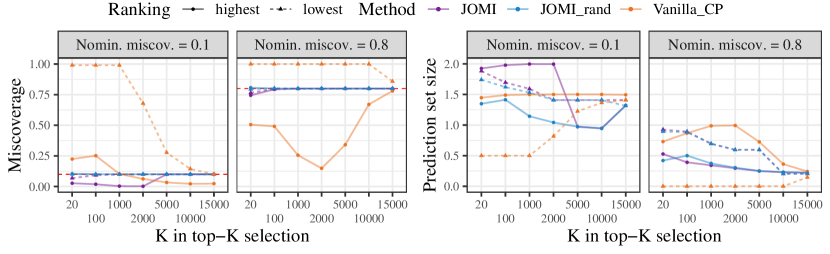
- Vanilla conformal prediction exhibits significant under-coverage (e.g., up to 30% miscoverage at α=0.1) when applied to selected units, especially under size-based or optimization-based selection rules.
- The proposed JOMI method achieves exact coverage across all tested selection rules, including top-K, constraint-based optimization, and small-sized prediction set selection, with empirical miscoverage rates consistently near the nominal level.
- For selection based on small preliminary prediction sets (|C| ≤ 5), JOMI maintains exact coverage while only slightly inflating the prediction set size, with the average number of disjoint segments in the final set being nearly one (0.98 on average), indicating a single connected interval.
- Under selection based on a threshold on the upper bound of preliminary prediction sets (e.g., upper bound < 6), vanilla conformal prediction shows under-coverage for small α values, while JOMI maintains exact coverage despite constructing a superset.
- In optimization-based selection with budget constraints, JOMI maintains exact coverage while showing a slight positive correlation between the size of the selection set and the reference set size, indicating robustness to selection complexity.
- The method is computationally efficient and scalable, with reproducible results available via a public GitHub repository, enabling replication across diverse applications in drug discovery and healthcare.
Read this paper
Open the full text in the Nubint reader and ask about any passage as you read.
Read this paper on NubintThis review was generated by AI from the original paper. Please check the paper before citing it.