
[Paper Review] Conformal Temporal Logic Planning using Large Language Models
This paper proposes HERACLEs, a hierarchical conformal planner that uses Large Language Models (LLMs) to generate robot plans for tasks specified in natural language (NL), while leveraging Linear Temporal Logic (LTL) over NL-based atomic propositions. By integrating automata-based task decomposition, LLMs for plan generation, and conformal prediction for uncertainty-aware correctness assessment, HERACLEs ensures probabilistic guarantees on mission satisfaction and dynamically decides when to request help, outperforming prior methods in efficiency and reliability on mobile manipulation tasks.
This paper addresses planning problems for mobile robots. We consider missions that require accomplishing multiple high-level sub-tasks, expressed in natural language (NL), in a temporal and logical order. To formally define the mission, we treat these sub-tasks as atomic predicates in a Linear Temporal Logic (LTL) formula. We refer to this task specification framework as LTL-NL. Our goal is to design plans, defined as sequences of robot actions, accomplishing LTL-NL tasks. This action planning problem cannot be solved directly by existing LTL planners because of the NL nature of atomic predicates. To address it, we propose HERACLEs, a hierarchical neuro-symbolic planner that relies on a novel integration of (i) existing symbolic planners generating high-level task plans determining the order at which the NL sub-tasks should be accomplished; (ii) pre-trained Large Language Models (LLMs) to design sequences of robot actions based on these task plans; and (iii) conformal prediction acting as a formal interface between (i) and (ii) and managing uncertainties due to LLM imperfections. We show, both theoretically and empirically, that HERACLEs can achieve user-defined mission success rates. Finally, we provide comparative experiments demonstrating that HERACLEs outperforms LLM-based planners that require the mission to be defined solely using NL. Additionally, we present examples demonstrating that our approach enhances user-friendliness compared to conventional symbolic approaches.
Motivation & Objective
- Address the challenge of specifying complex robot missions using natural language (NL) while maintaining formal correctness guarantees.
- Overcome the limitations of existing LTL planners that rely on low-level system state predicates, which require manual effort and increase formula complexity.
- Develop a planning framework that can reason about the correctness of LLM-generated plans for NL-specified sub-tasks with uncertainty quantification.
- Enable dynamic decision-making on whether to proceed with a plan or request assistance, improving robustness in complex or ambiguous task scenarios.
- Provide theoretical probabilistic guarantees on mission satisfaction while minimizing reliance on human intervention through confidence-aware planning.
Proposed method
- Define LTL tasks over atomic propositions that are true when high-level NL sub-tasks (e.g., 'deliver water to table') are completed, rather than low-level system states.
- Use automata theory and a prior task decomposition algorithm to determine the next NL-specified sub-task that advances mission progress.
- Employ Large Language Models (LLMs) to generate robot plans for the selected NL sub-task, enabling natural language grounding of complex actions.
- Apply conformal prediction (CP) to construct prediction sets of candidate plans that contain the ground-truth plan with a user-specified probability (e.g., 95%), enabling uncertainty-aware decision-making.
- Integrate CP with the LLM-based plan generation to assess confidence: if the prediction set is too large or contains no valid plans, the system requests help from the LTL planner or a human operator.
- Execute the final plan using standard low-level controllers, with the entire pipeline ensuring probabilistic mission satisfaction guarantees.
Experimental results
Research questions
- RQ1Can LTL tasks defined over natural language-based atomic propositions lead to shorter, more efficient LTL formulas compared to traditional system-state-based predicates?
- RQ2How can LLMs be effectively and safely integrated into robot planning for NL-specified tasks while ensuring correctness and avoiding hallucinations?
- RQ3Can conformal prediction be used to quantify uncertainty in LLM-generated robot plans and guide dynamic assistance requests?
- RQ4What is the impact of different conformal prediction algorithms (e.g., RAPS vs. vanilla CP) on prediction set size, runtime, and mission success rate?
- RQ5How does the proposed HERACLEs framework compare to existing LTL and NL-based planners in terms of computational efficiency, correctness, and robustness under ambiguity?
Key findings
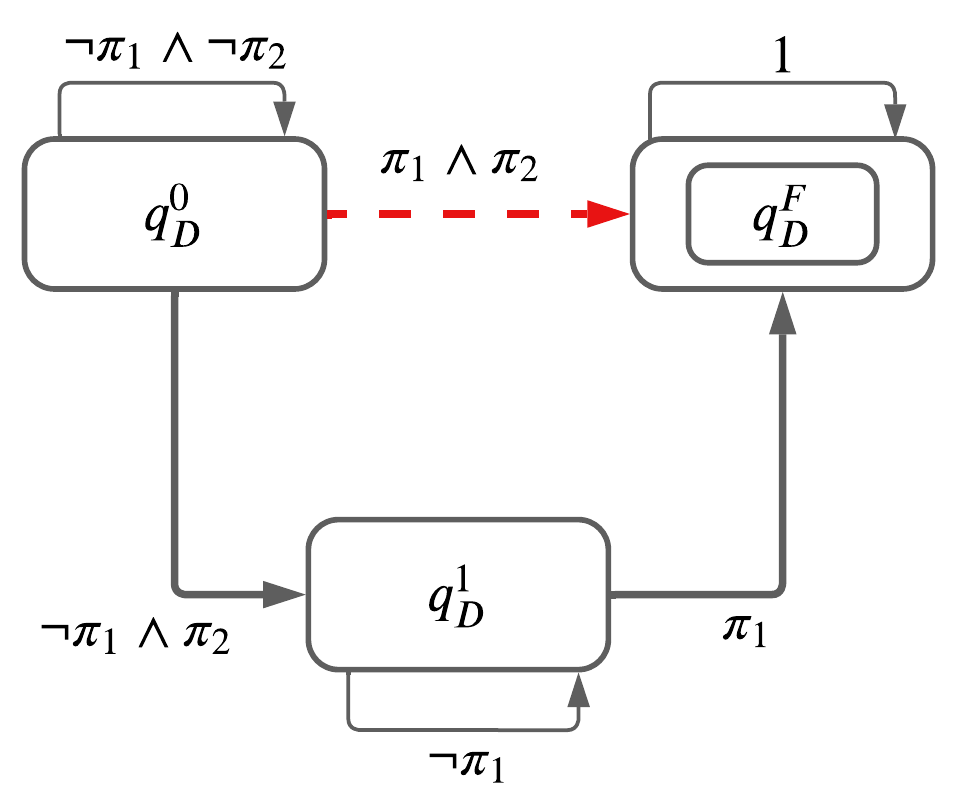
- LTL formulas defined over NL-based atomic predicates are significantly shorter than those based on low-level system states: for a two-delivery task, the NL-based formula yields a 4-state DFA, while the system-state version requires a 25-state DFA with 225 edges.
- HERACLEs achieved 100% mission satisfaction rate on singleton prediction sets when using RAPS for conformal prediction, exceeding the 95% target with 99% confidence (δ = 0.01).
- The vanilla CP algorithm produced smaller average prediction set construction times (1.26×10⁻⁶ seconds) than RAPS (3.35×10⁻⁵ seconds), but RAPS generated smaller prediction sets, reducing the need for assistance.
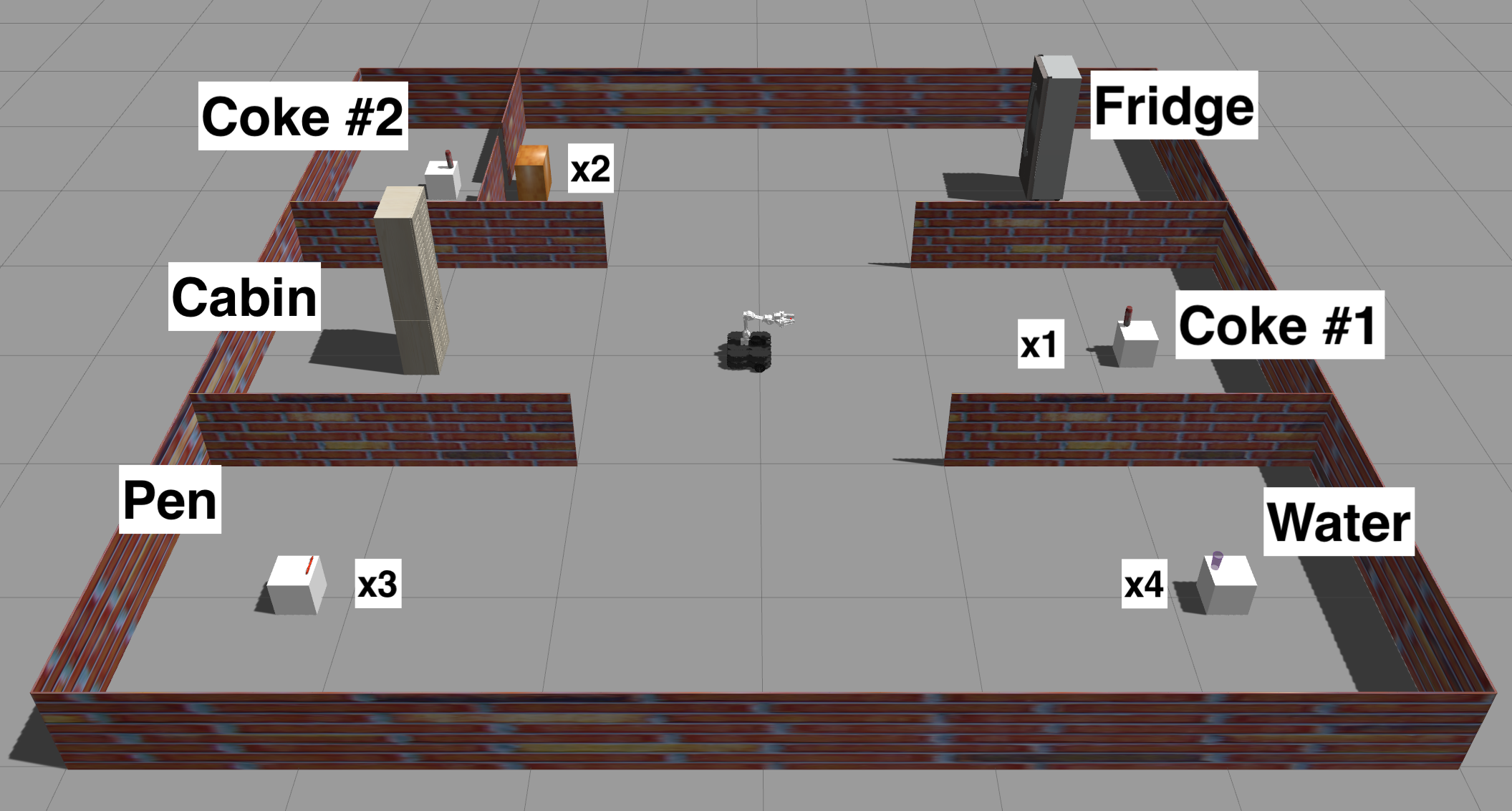
- In case studies, HERACLEs successfully detected unreachable goals (e.g., blocked Coke #2) and requested help from the LTL planner, which generated alternative sub-tasks to restore mission progress.
- When ambiguity arose (e.g., both water and Coke qualify as 'drinks'), the system correctly identified uncertainty via CP and requested human input, leading to successful resolution.
- The framework demonstrated robustness in complex scenarios: 97.2% of plans generated with vanilla CP and 100% with RAPS satisfied their LTL specifications, confirming the theoretical guarantees.
Read this paper
Open the full text in the Nubint reader and ask about any passage as you read.
Read this paper on NubintThis review was generated by AI from the original paper. Please check the paper before citing it.