
[Paper Review] Consistency-guided Prompt Learning for Vision-Language Models
CoPrompt introduces a consistency-guided fine-tuning framework that combines prompting and adapters with input perturbations to improve few-shot downstream performance while preserving zero-shot generalization in vision-language models. It achieves state-of-the-art base-to-novel, cross-dataset, and domain generalization results on 11 datasets.
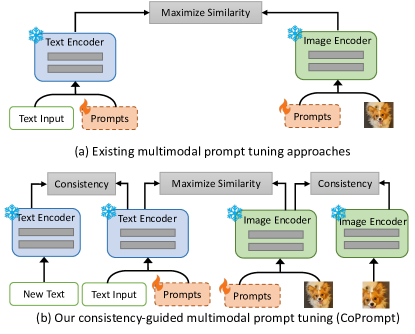
We propose Consistency-guided Prompt learning (CoPrompt), a new fine-tuning method for vision-language models. Our approach improves the generalization of large foundation models when fine-tuned on downstream tasks in a few-shot setting. The basic idea of CoPrompt is to enforce a consistency constraint in the prediction of the trainable and pre-trained models to prevent overfitting on the downstream task. Additionally, we introduce the following two components into our consistency constraint to further boost the performance: enforcing consistency on two perturbed inputs and combining two dominant paradigms of tuning, prompting and adapter. Enforcing consistency on perturbed input serves to further regularize the consistency constraint, thereby improving generalization. Moreover, the integration of adapters and prompts not only enhances performance on downstream tasks but also offers increased tuning flexibility in both input and output spaces. This facilitates more effective adaptation to downstream tasks in a few-shot learning setting. Experiments show that CoPrompt outperforms existing methods on a range of evaluation suites, including base-to-novel generalization, domain generalization, and cross-dataset evaluation. On generalization, CoPrompt improves the state-of-the-art on zero-shot tasks and the overall harmonic mean over 11 datasets. Detailed ablation studies show the effectiveness of each of the components in CoPrompt. We make our code available at https://github.com/ShuvenduRoy/CoPrompt.
Motivation & Objective
- Address overfitting when fine-tuning large vision-language foundation models in few-shot settings.
- Enforce consistency between trainable and pre-trained models on both text and image branches.
- Enhance the consistency constraint with input perturbations and a combined prompting-adapter framework.
- Demonstrate improved base-to-novel generalization, cross-dataset evaluation, and domain generalization over prior SOTA methods.
Proposed method
- Adopt CLIP as the vision-language backbone and extend it with multi-modal prompting.
- Introduce a cosine-based consistency loss between trainable and pre-trained embeddings for both text and image branches.
- Use input perturbations: GPT-generated descriptive text for the text branch and image augmentations for the image branch.
- Incorporate adapters on both text and image branches to increase learning capacity while applying the consistency constraint.
- Combine the consistency loss with a supervised loss into a final objective L = L_ce + lambda * L_cc.
Experimental results
Research questions
- RQ1Can a consistency-guided fine-tuning approach maintain zero-shot capabilities while improving few-shot downstream performance?
- RQ2Does enforcing cross-modal consistency on perturbed inputs improve generalization to novel classes and across datasets?
- RQ3What is the impact of adding adapters and prompting in a unified framework under a consistency constraint?
- RQ4How do different components (text vs. image consistency, perturbations, adapters) contribute to overall performance?
Key findings
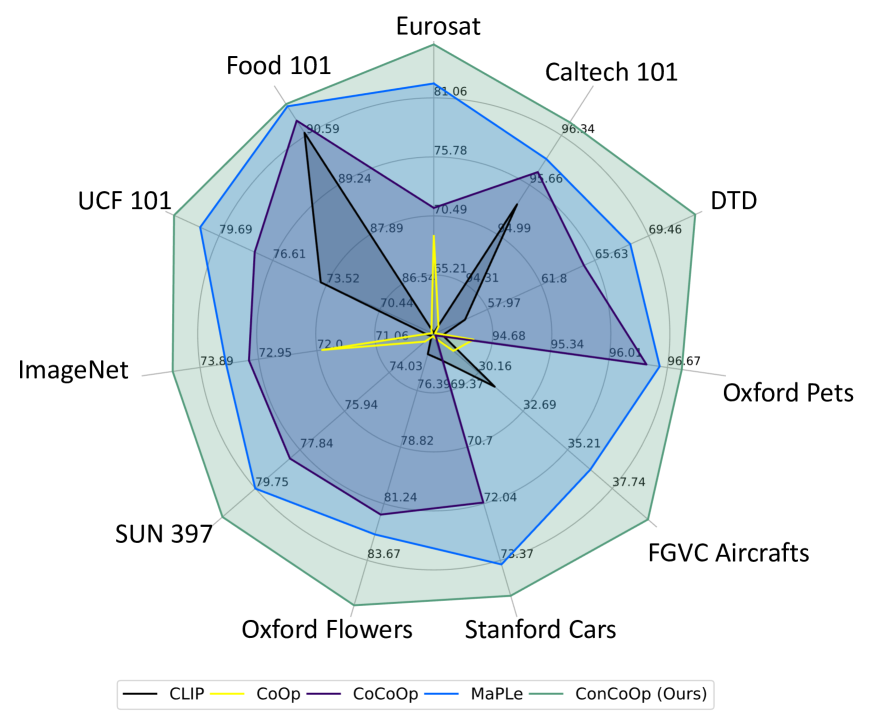
- CoPrompt achieves state-of-the-art base-to-novel generalization, with a 2.09 percentage point improvement in novel accuracy over the prior SOTA.
- CoPrompt attains a 1.93 percentage point improvement in harmonic mean over MaPLe across 11 datasets.
- On average across datasets, CoPrompt surpasses prior methods in base accuracy and maintains or improves novel accuracy, mitigating base-vs-novel trade-offs.
- CoPrompt demonstrates strong cross-dataset and domain generalization, with notable gains on datasets like EuroSAT and DTD.
- Ablation studies show adapters, input perturbations, and the consistency constraint each contribute to performance, with text-consistency having notable impact and cosine distance as the effective criterion.
Read this paper
Open the full text in the Nubint reader and ask about any passage as you read.
Read this paper on NubintThis review was generated by AI from the original paper. Please check the paper before citing it.