
[Paper Review] Constraining hadronization mechanisms with $ m Λ_{ m c}^{+}$/D$^0$ production ratios in Pb-Pb collisions at $\sqrt{s_{ m NN}} = 5.02$ TeV
This study measures the $\rm\Lambda_{\rm c}^{+}/D^0$ production ratio in Pb-Pb collisions at $\sqrt{s_{\rm NN}} = 5.02$ TeV with high precision across centrality and transverse momentum ($p_{\rm T}$) ranges down to 1 GeV/$c$. It finds a 3.7$\sigma$ enhancement in the $p_{\rm T}$-differential ratio for $4 < p_{\rm T} < 8$ GeV/$c$ compared to pp collisions, supporting coalescence or statistical hadronization models for charm baryon formation in the quark-gluon plasma.
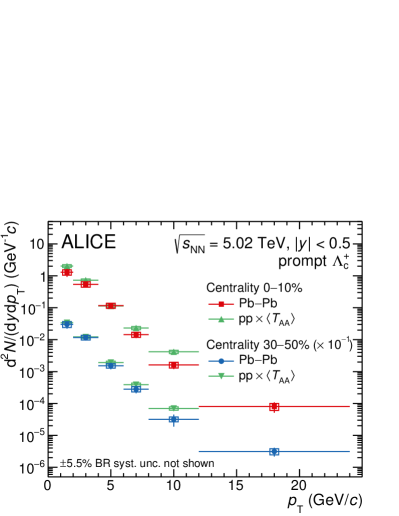
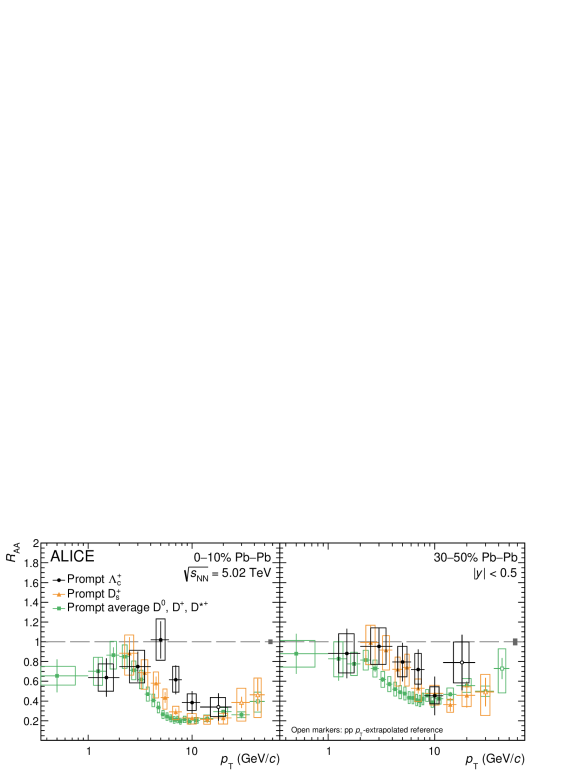
The production of prompt $ m Λ_{ m c}^{+}$ baryons at midrapidity ($|y|<0.5$) was measured in central (0-10%) and mid-central (30-50%) Pb-Pb collisions at the center-of-mass energy per nucleon-nucleon pair $\sqrt{s_{ m NN}} = 5.02$ TeV with the ALICE detector. The results are more precise, more differential in centrality, and reach much lower transverse momentum ($p_{ m T}=1$ GeV/$c$) with respect to previous measurements performed by the ALICE, STAR, and CMS Collaborations in nucleus-nucleus collisions, allowing for an extrapolation down to $p_{ m T}=0$. The $p_{ m T}$-differential $ m Λ_{ m c}^{+}$/D$^0$ production ratio is enhanced with respect to the pp measurement for $4
Motivation & Objective
- To constrain hadronization mechanisms of charm quarks in the quark-gluon plasma by measuring $\rm\Lambda_{\rm c}^{+}/D^0$ ratios in Pb-Pb collisions.
- To investigate whether coalescence or statistical hadronization models better describe charm baryon production in a hot, dense medium.
- To determine if the $p_{\rm T}$-differential $\rm\Lambda_{\rm c}^{+}/D^0$ ratio evolves with multiplicity and centrality, as predicted by coalescence models.
- To resolve discrepancies between $\rm\Lambda_{\rm c}^{+}/D^0$ ratios in pp collisions and heavy-ion systems, especially at low $p_{\rm T}$.
Proposed method
- Measure $\rm\Lambda_{\rm c}^{+}$ and $D^0$ production yields in midrapidity ($|y| < 0.5$) using the ALICE detector in Pb-Pb collisions at $\sqrt{s_{\rm NN}} = 5.02$ TeV.
- Analyze data in 0–10% (central) and 30–50% (mid-central) collision centrality bins to study system-size dependence.
- Perform $p_{\rm T}$-differential and $p_{\rm T}$-integrated ratio measurements down to $p_{\rm T} = 1$ GeV/$c$, enabling extrapolation to $p_{\rm T} = 0$.
- Compare results with theoretical models including quark coalescence, resonance recombination, and statistical hadronization with feed-down from unobserved charm baryons.
- Use pp collision data at the same energy as a reference to isolate medium effects in heavy-ion collisions.
- Apply kinematic and topological reconstruction techniques to identify $\rm\Lambda_{\rm c}^{+}$ and $D^0$ decays with high efficiency and low background.
Experimental results
Research questions
- RQ1Does the $p_{\rm T}$-differential $\rm\Lambda_{\rm c}^{+}/D^0$ ratio show a significant enhancement in central Pb-Pb collisions compared to pp collisions at $\sqrt{s_{\rm NN}} = 5.02$ TeV?
- RQ2Is the observed enhancement consistent with models of charm quark hadronization via coalescence or statistical hadronization in the quark-gluon plasma?
- RQ3Does the $p_{\rm T}$-integrated $\rm\Lambda_{\rm c}^{+}/D^0$ ratio increase with collision centrality or multiplicity, as predicted by coalescence models?
- RQ4How do the $p_{\rm T}$-differential and $p_{\rm T}$-integrated ratios compare across different collision systems (pp, p–Pb, Pb–Pb), and what do they reveal about hadronization mechanisms?
Key findings
- The $p_{\rm T}$-differential $\rm\Lambda_{\rm c}^{+}/D^0$ ratio is enhanced by 3.7 standard deviations in the $4 < p_{\rm T} < 8$ GeV/$c$ range in central Pb-Pb collisions compared to pp collisions.
- The $p_{\rm T}$-integrated $\rm\Lambda_{\rm c}^{+}/D^0$ ratio in Pb-Pb collisions is compatible with the pp measurement within 1$\sigma$ uncertainty.
- The observed $p_{\rm T}$-differential enhancement is qualitatively similar to that seen in the strange sector for the $\Lambda/{\rm K}^{0}_{\rm{S}}$ ratio, suggesting common medium effects.
- Model calculations incorporating quark coalescence or statistical hadronization with feed-down from unobserved charm-baryon states describe the data well.
- The measurement extends down to $p_{\rm T} = 1$ GeV/$c$, enabling reliable extrapolation to $p_{\rm T} = 0$, improving constraints on low-$p_{\rm T}$ hadronization dynamics.
- The results support the role of coalescence mechanisms in charm baryon formation, particularly in high-multiplicity, hot-medium environments.
Read this paper
Open the full text in the Nubint reader and ask about any passage as you read.
Read this paper on NubintThis review was generated by AI from the original paper. Please check the paper before citing it.