
[Paper Review] Constraint on Early Dark Energy from Isotropic Cosmic Birefringence
This paper constrains the photon-axion coupling constant in early dark energy (EDE) models using the cosmic microwave background (CMB) $EB$ power spectrum, which arises from parity-violating interactions. It finds $g = (0.04 \pm 0.16)\,M_{\text{Pl}}^{-1}$ at 68% credible level, ruling out significant EDE-induced cosmic birefringence and providing a robust, foreground-independent limit with implications for fundamental physics and string theory embeddings.
Polarization of the cosmic microwave background (CMB) is sensitive to new physics violating parity symmetry, such as the presence of a pseudoscalar "axionlike" field. Such a field may be responsible for early dark energy (EDE), which is active prior to recombination and provides a solution to the so-called Hubble tension. The EDE field coupled to photons in a parity-violating manner would rotate the plane of linear polarization of the CMB and produce a cross-correlation power spectrum of $E$- and $B$-mode polarization fields with opposite parities. In this paper, we fit the $EB$ power spectrum predicted by the photon-axion coupling of the EDE model with a potential $V(ϕ)\propto [1-\cos(ϕ/f)]^3$ to polarization data from Planck. We find that the unique shape of the predicted $EB$ power spectrum is not favored by the data and obtain a first constraint on the photon-axion coupling constant, $g=(0.04\pm 0.16)M_{ ext{Pl}}^{-1}$ (68% CL), for the EDE model that best fits the CMB and galaxy clustering data. This constraint is independent of the miscalibration of polarization angles of the instrument or the polarized Galactic foreground emission. Our limit on $g$ may have important implications for embedding EDE in fundamental physics, such as string theory.
Motivation & Objective
- To test whether early dark energy (EDE) models with a pseudoscalar axionlike field coupled to photons can produce observable cosmic birefringence in the CMB.
- To constrain the photon-axion coupling constant $g$ using the unique shape of the predicted $EB$ power spectrum from parity-violating interactions.
- To determine whether the observed $EB$ spectrum from Planck data favors EDE-induced birefringence or is better explained by post-recombination effects or instrumental miscalibration.
- To assess the compatibility of the derived $g$-constraint with fundamental physics principles such as the weak gravity conjecture and string theory.
Proposed method
- Model the EDE potential as $V(\phi) \propto [1 - \cos(\phi/f)]^3$, which allows the field to drive a transient dark energy phase before recombination.
- Include a Chern-Simons interaction term $\mathcal{L} \propto g\phi F_{\mu\nu}\tilde{F}^{\mu\nu}$ in the Lagrangian, which induces parity violation and rotates CMB polarization planes.
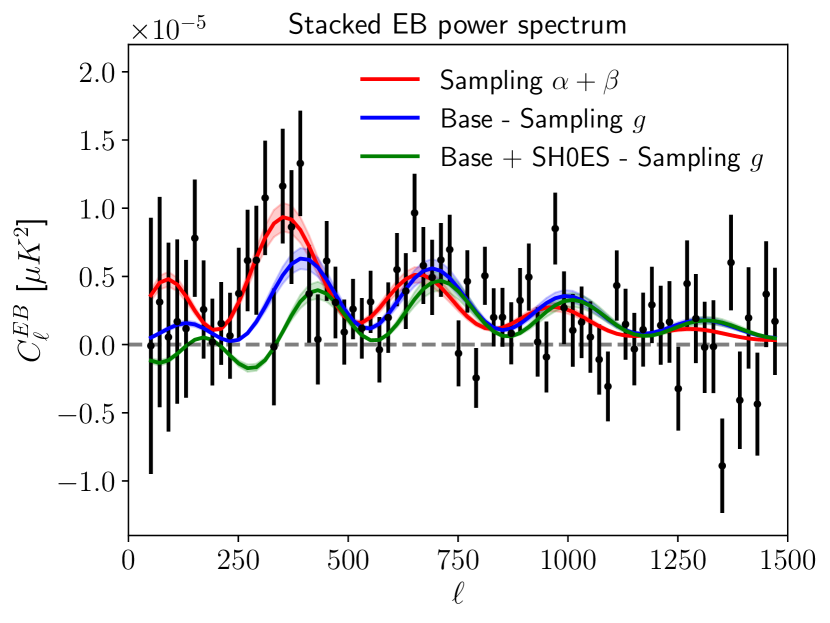
- Compute the predicted $EB$ power spectrum from the photon-axion coupling, which has a distinctive shape sensitive to $g$ and independent of $\ell$-mode mixing.
- Fit the predicted $EB$ spectrum to Planck 2018 polarization data using a joint likelihood analysis that marginalizes over $\alpha$ (miscalibration) and $\beta$ (post-recombination birefringence).
- Use the $EB$ spectrum's odd-parity nature to isolate the signal from parity-violating physics, avoiding contamination from standard $E$- and $B$-mode sources.
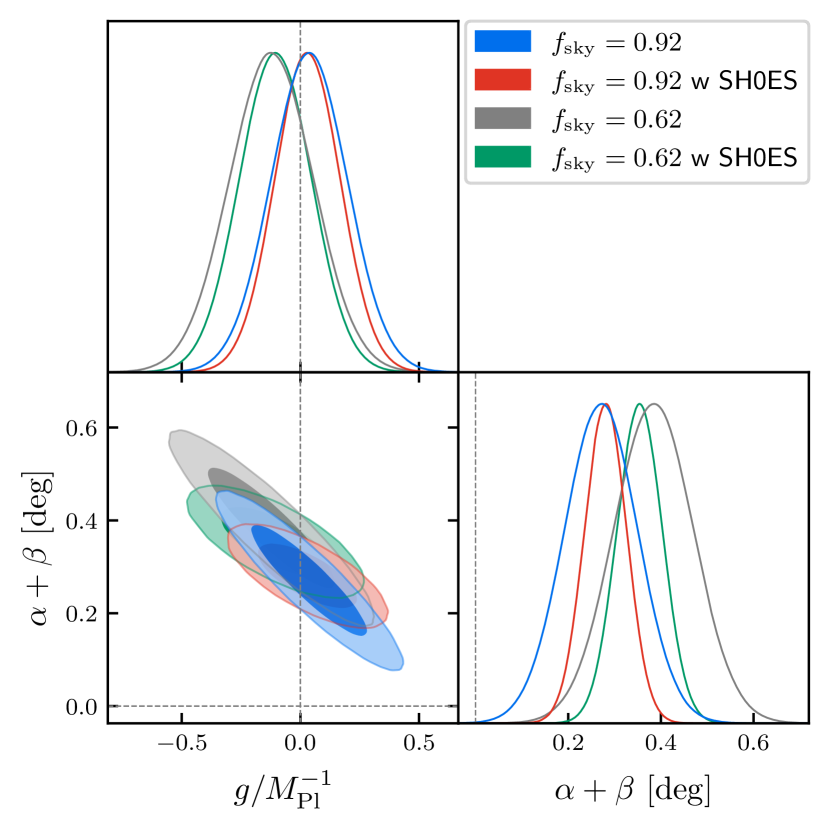
- Perform a Bayesian analysis with the GetDist package and validate robustness by varying $f_{\text{EDE}}$ and $n$ in the potential, confirming that the constraint depends primarily on $\alpha + \beta$.
Experimental results
Research questions
- RQ1Does the observed $EB$ power spectrum from Planck data show evidence for cosmic birefringence induced by early dark energy via a photon-axion coupling?
- RQ2Can the unique spectral shape of the $EB$ power spectrum from EDE-induced birefringence be distinguished from other sources of $EB$ correlation?
- RQ3Is the constraint on the photon-axion coupling constant $g$ robust against uncertainties in instrumental miscalibration or Galactic foreground emission?
- RQ4What are the implications of the derived $g$-constraint for embedding EDE in fundamental theories such as string theory or quantum gravity?
- RQ5Does the observed $g$-limit conflict with the weak gravity conjecture, which suggests $|g| \gtrsim M_{\text{Pl}}^{-1}$?
Key findings
- The Planck data do not favor cosmic birefringence induced by early dark energy via a photon-axion coupling, with the $EB$ spectrum showing no significant deviation from zero.
- The photon-axion coupling constant is constrained to $g = (0.04 \pm 0.16)\,M_{\text{Pl}}^{-1}$ at 68% credible level, indicating a very weak coupling.
- The constraint is robust and independent of the miscalibration angle $\alpha$ and post-recombination birefringence $\beta$, as the $EB$ spectrum shape depends primarily on $\alpha + \beta$.
- The derived $g$-value is much smaller than the gravitational coupling scale, suggesting $|g| \ll M_{\text{Pl}}^{-1}$, which may conflict with the weak gravity conjecture if $|g| \gtrsim M_{\text{Pl}}^{-1}$ is required.
- For the EDE model with $f = 0.15\,M_{\text{Pl}}$, the anomaly coefficient is constrained to $c_{\phi\gamma} = 5.2 \pm 21$ at 68% C.L., which is inconsistent with a natural value if $|c_{\phi\gamma}| \gtrsim 130$ is required by the weak gravity conjecture.
- The method is generalizable to other EDE models, such as $n=2$ potentials, and can be applied to future CMB experiments with improved sensitivity.
Better researchstarts right now
From reading papers to final review, dramatically reduce your research time.
No credit card · Free plan available
This review was created by AI and reviewed by human editors.